• العربية
  • فارسی
Brand
  • Iran Insight
  • Politics
  • Economy
  • Analysis
  • Special Report
  • Opinion
  • Podcast
  • Iran Insight
  • Politics
  • Economy
  • Analysis
  • Special Report
  • Opinion
  • Podcast
  • Theme
  • Language
    • العربية
    • فارسی
  • Iran Insight
  • Politics
  • Economy
  • Analysis
  • Special Report
  • Opinion
  • Podcast
All rights reserved for Volant Media UK Limited
volant media logo

Khamenei’s former representative Ali Taeb dies, state media says

Jul 12, 2025, 00:57 GMT+1Updated: 13:15 GMT+1

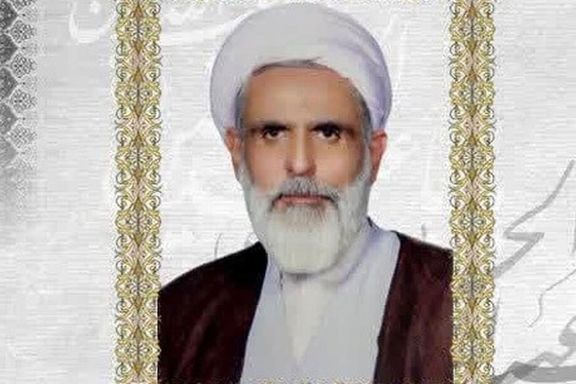
Ali Taeb, a former representative of Iran’s Supreme Leader in the command center responsible for suppressing protests, has died, Iranian state media reported without providing any further explanation.

Taeb was Ali Khamenei’s representative at Sarallah Headquarters, one of the Islamic Revolutionary Guard Corps’ most critical domestic security commands—and a target of Israeli strikes during the recent conflict.

Ali Taeb’s brothers—Hossein Taeb and Mehdi Taeb—are two of the most influential operatives in the Islamic Republic establishment.

Hossein served as the long-time head of the IRGC Intelligence Organization (IRGC-IO), directly under the control of the Supreme Leader. Known for his ruthlessness, clerical ties, and proximity to Mojtaba Khamenei, Hossein was widely viewed as one of the most powerful figures in the Islamic Republic—until his ousting in 2022.

Ali Taeb’s role at Sarallah Headquarters placed him at the heart of Tehran’s security response to unrest and foreign threats. That position—and his familial ties to Hossein and Mehdi Taeb—make his sudden death significant.

According to Iranian state media, Ali Taeb was a veteran of the Iran-Iraq War and a deeply embedded cleric in the Islamic Republic’s ideological apparatus.

Though he originally studied mechanical engineering at Iran University of Science and Technology, he was reportedly persuaded by leading clerics such as Ayatollah Bahjat and Allameh Tabatabaei to enter the seminary. Early in his religious studies, he operated under an alias while evading the Shah’s intelligence services.

He later rose through the ranks of the IRGC, serving as deputy head of propaganda during the war, commander of the Ramadan Base, and head of the Motahari University in Qom.

He held multiple top roles including advisor to the Joint Chiefs of the IRGC, president of the Foundation for Martyrs and Veterans in Qom, and director of Al-Mustafa International University.

He was also a member of the board of trustees at the Noor Computer Research Center and ran the Ghadir Information Center.

Most Viewed

Iran negotiators ordered to return after internal rift over Islamabad talks
1
EXCLUSIVE

Iran negotiators ordered to return after internal rift over Islamabad talks

2
ANALYSIS

US blockade enters murky phase as tankers spoof signals and buyers hesitate

3
ANALYSIS

Why the $100 billion Hormuz toll revenue is a myth

4

US tightens financial squeeze on Iran, warns banks over oil money flows

5
ANALYSIS

US blockade targets Iran oil boom amid regional disruption

Banner
Banner

Spotlight

  • Hardliners push Hormuz ‘red line’ as US blockade tests Iran’s leverage
    INSIGHT

    Hardliners push Hormuz ‘red line’ as US blockade tests Iran’s leverage

  • Ideology may be fading in Iran, but not in Kashmir's ‘Mini Iran'
    INSIGHT

    Ideology may be fading in Iran, but not in Kashmir's ‘Mini Iran'

  • War damage amounts to $3,000 per Iranian, with blockade set to add to losses
    INSIGHT

    War damage amounts to $3,000 per Iranian, with blockade set to add to losses

  • Why the $100 billion Hormuz toll revenue is a myth
    ANALYSIS

    Why the $100 billion Hormuz toll revenue is a myth

  • US blockade targets Iran oil boom amid regional disruption
    ANALYSIS

    US blockade targets Iran oil boom amid regional disruption

  • Iran's digital economy battered by prolonged blackout
    INSIGHT

    Iran's digital economy battered by prolonged blackout

•
•
•

More Stories

Khamenei bested Trump in war, his senior advisor says

Jul 11, 2025, 22:50 GMT+1

A senior advisor to Iran’s Supreme Leader said that Ali Khamenei triumphed over US President Donald Trump in a 12-day Israel-Iran war capped by US attacks on Iranian nuclear sites, as officialdom doubles down on a victory narrative.

"Under the wise leadership of the Supreme Leader of the Islamic Revolution, we silenced Trump," Ali Larijani, the former Speaker of the Iranian Parliament and current advisor to Khamenei, said on Friday.

Larijani made his remarks during a memorial event for Saeid Izadi, a senior Revolutionary Guards commander killed in an Israeli airstrike in Qom on June 21.

Israel’s Defense Minister, Israel Katz, said on the same day that Izadi had coordinated financial and weapons transfers to Hamas ahead of the October 7, 2023, attacks.

The surprise 12-day campaign killed military commanders along with hundreds of civilians and pounded military and nuclear sites. Iranian missiles killed 27 Israelis.

Tehran officialdom swiftly declared the conflict a victory, in a narrative which jarred many war-weary Iranians.

Donald Trump said on June 27th he personally stopped a final, massive Israeli airstrike on Tehran and had previously alleged the United States was aware of Khamenei's wartime hiding place but had held off killing him.

Larijani condemned Israel’s assassination of Revolutionary Guard commanders inside Iran and said Israeli Prime Minister Benjamin Netanyahu does not understand Iran's culture or people.

In response to comments by Benjamin Netanyahu promoting the joint US-Israel doctrine of "peace through strength," Larijani said: "You made so much noise claiming Hamas and Hezbollah have been eliminated, but Hamas is still alive and continues to carry out operations."

Iran says Merz’s praise of Israeli campaign makes Berlin complicit

Jul 11, 2025, 22:30 GMT+1

Iran's foreign ministry on Friday condemned German Chancellor Friedrich Merz’s blessing of Israel’s military strikes on Iranian nuclear sites, saying his remarks make Germany complicit in the attacks.

“The Chancellor persists in his support for the Israeli regime’s lawless behavior and atrocity crimes, even at the cost of violating the fundamental principles of the UN Charter and international law,” Iranian Foreign Ministry spokesman Esmaeil Baqaei said Friday on X.

Chancellor Friedrich Merz, speaking during a parliamentary session on Wednesday, defended Israel’s attacks Iran, calling them legitimate self-defense.

“I have no doubt about the legitimacy and legality under international law of what Israel has done,” Merz said.

“Saying it was a preemptive strike against a potentially imminent nuclear attack from Iran is only one of several possible assumptions. One could also conclude that Israel has been attacked almost daily for years and has the right to defend itself militarily.”

During the conflict, Merz said Israel was doing the West's "dirty work" for it by degrading their shared enemy.

“Endorsing an injustice is no less than complicity in it,” Baqaei added.

Meanwhile, Israeli Prime Minister Benjamin Netanyahu said in an interview on Thursday that Israel had rolled back Iran's nuclear program—but implied that the confrontation with the Islamic Republic is not yet over.

Netanyahu cited Merz in the interview as one of the only heads of state to publicly back Israel's campaign.

Iran and Israel are currently observing a ceasefire following the recent 12-day war.

Green Movement leader Mousavi calls for referendum in Iran

Jul 11, 2025, 19:19 GMT+1

The leader of Iran's Green Movement Mir-Hossein Mousavi who has been under house arrest since 2011 called for a referendum on a constitutional assembly, arguing that the current political system ruling Iran does not represent all Iranian people.

“The bitter situation the country has faced is the result of a series of major mistakes,” Mousavi said in a statement published by reformist-leaning Iranian newspaper Hammihan.

“The twelve-day war (with Israel) showed that the only guarantee for the nation’s survival is respect for every citizen’s right to self-determination,” the former prime minister added.

“After the war that was waged against us, the people have expectations from the government. Leaving them unanswered only delights the enemy." Mousavi said the current structure of the Islamic Republic “does not represent all Iranians.”

The release of political prisoners and reforms to the state broadcaster’s approach, he added, were “the minimum expectations” of the public.

Mousavi was Iran’s prime minister from 1981 to 1989 before it switched to a presidential system.

Along with cleric Mehdi Karroubi, Mousavi was a candidate in the disputed 2009 presidential election and challenged the results, leading large protests dubbed the Green Movement for months before he was arrested and placed under house arrest.

His wife Zahra Rahnavard and Karroubi were also accused of sedition against the Islamic Republic and remain under house arrest.

Witchcraft and war: claims of Israeli sorcery draw scorn

Jul 11, 2025, 17:57 GMT+1
•
Maryam Sinaiee

A senior Tehran official has alleged Israel deployed the occult and supernatural spirits in its war with Iran, prompting widespread mockery and a renewed debate over the role of jinn in Iranian political discourse.

“A strange phenomenon,” declared Abdollah Ganji, former chief of the Islamic Revolutionary Guard Corps (IRGC)-affiliated daily Javan, to his 150,000 followers on X on July 9.

“After the recent war, several pieces of paper were found on the streets of Tehran containing talismans with Jewish symbols," he added. "A few years ago, the Supreme Leader said that hostile countries and Western and Hebrew intelligence services use occult sciences and jinn beings for espionage."

In March 2020, supreme leader Ali Khamenei alleged in a televised address that “enemies from among both jinn and human beings” were arrayed against Iran.

The quote was later removed from some official transcripts.

What Are Jinn?

Ganji—now an advisor to the mayor of Tehran—was echoing a broader pattern of supernatural claims pervading Iran’s official political narrative.

In Islamic tradition, jinn are supernatural beings made from fire, distinct from humans, who are created from soil.

Mentioned frequently in the Quran and rooted in pre-Islamic mythology, jinn are believed by some to have the ability to shapeshift, influence human thoughts, and act as agents of harm or espionage.

References to them remain common in Iranian political and religious rhetoric, particularly when discussing Israel and Western powers. Clerics on Iranian television and radio have repeatedly discussed Israel’s alleged use of jinn.

“Given the Zionists’ history of controlling jinn, many of their missions are carried out through them,” said Hojatoleslam Mehdi Karami in an October 2024 program.

In March 2023, state TV aired remarks by Quranic scholar Hojjat ol-Eslam Valiyollah Naghipourfar, who claimed Iran’s intelligence services had thwarted Israeli infiltration efforts conducted via jinn.

Scapegoating failure?

While many clerics view jinn as real and spiritually potent, others—particularly among Iran’s modernist theologians—interpret them metaphorically.

Ganji’s comment on X renewed the debate, with moderate voices pushing back.

“Talking about Jewish talismans and the role of jinn and fairies in Israel’s aggression against Iran is an attempt to downplay the role of infiltrators and to overlook the enemy’s tactics,” former government spokesman Abdollah Ramezanzadeh said on X.

Desert totems

Ganji’s post—and the ensuing debate—wasn’t missed in Israel.

“Consuming drugs and conversing with jinn are not desirable traits in someone leading a country,” an X account purporting to represent Israel's intelligence agency, the Mossad, posted in Persian.

To make the debate even more intriguing, Ganji’s post coincided with the circulation of a satellite image showing geometric patterns—including Stars of David and triangles—etched into a desert near a missile base in central Iran.

The origin of the shapes remains unclear, but some social media users linked them to occult or symbolic efforts aimed at Iran’s military.

Iranian authorities have since removed the markings but Israeli diplomat Waleed Gadban reposted an image of the desert patterns with a mocking caption: “We are closer to you than your jugular vein.”
Iranian missile attack struck inside US airbase in Qatar, Pentagon confirms

Jul 11, 2025, 17:35 GMT+1
•
Fardad Farahzad

A June 23 Iranian missile attack caused damage deep inside a US airbase in Qatar, the Pentagon said on Friday, confirming an Iran International report citing satellite imagery which indicated a cutting-edge communications hub within the facility was destroyed.

"One Iranian ballistic missile impacted Al Udeid Air Base June 23 while the remainder of the missiles were intercepted by U.S. and Qatari air defense systems," Department of Defense Spokesman Sean Parnell told Iran International in response to an emailed request for comment.

"The impact did minimal damage to equipment and structures on the base. There were no injuries. Al Udeid Air Base remains fully operational and capable of conducting its mission, alongside our Qatari partners, to provide security and stability in the region," Parnell added.

The imagery obtained by Iran International provided the most concrete indication yet of physical harm to the Al Udeid Air Base, the biggest US military facility in the Middle East and the forward headquarters of US Central Command (CENTCOM).

An open-source satellite image of the US airbase at Al Udeid Qatar before a 12-day Mideast war last month shows the geodesic radome housing the Air Force modernization enterprise terminal (MET).
100%
An open-source satellite image of the US airbase at Al Udeid Qatar before a 12-day Mideast war last month shows the geodesic radome housing the Air Force modernization enterprise terminal (MET).
A satellite image taken on June 24 by US firm Satellogic obtained by Iran International appears to the same radome reduced to a blackened smear.
100%
A satellite image taken on June 24 by US firm Satellogic obtained by Iran International appears to the same radome reduced to a blackened smear.
A zoomed in version of the satellite image obtained by Iran International of the US airbase at Al Udeid, Qatar.
100%
A zoomed in version of the satellite image obtained by Iran International of the US airbase at Al Udeid, Qatar.

Iran attacked Al Udeid in retaliation for US strikes on three Iranian nuclear sites the previous day, a surprise operation which capped off a 12-day war between Iran and Israel which US President Donald Trump said "obliterated" Iran's nuclear program.

"US forces, alongside our Qatari partners, successfully defended against an Iranian ballistic missile attack targeting Qatar’s Al-Udeid Air Base near Doha, Qatar," CENTCOM said the day of the attack.

President Trump at the time dismissed the Iranian response as "very weak" in a post on Truth Social.

"13 (missiles) were knocked down, and 1 was ‘set free,’ because it was headed in a nonthreatening direction,” Trump added. “I am pleased to report that NO Americans were harmed, and hardly any damage was done."

The United States did not retaliate following the attack and Trump swiftly promulgated a ceasefire which remains in place.

Open-source satellite imagery of the sprawling base encompassing runways, roads dozens of structures shows one distinctive site toward the center of the facility: a white geodesic dome.

A June 24 satellite picture from geospatial analytics company Satellogic obtained by Iran International appeared to show the area reduced to a blackened smear.

No apparent damage appears visible elsewhere.

The site is likely a radome, or weatherproof enclosure, housing a roughly satellite dish-shaped modernization enterprise terminal (MET) whose installation at Al Udeid was described in a 2016 press release on the US Air Force's official website.

Costing $15 million, the MET "provides secure communication capabilities including voice, video and data services, linking service members in the U.S. Central Command area of responsibility with military leaders around the world," the Air Force wrote.

The MET in Qatar was the first outside the United States and features anti-jamming technology, it added.

A US officers briefs colleagues about the new Modernized Enterprise Terminal (MET) at Al Udeid Air Base, Qatar, Jan. 21, 2016 in this US Air Force file photo.
100%
A US officers briefs colleagues about the new Modernized Enterprise Terminal (MET) at Al Udeid Air Base, Qatar, Jan. 21, 2016 in this US Air Force file photo.
The Modernized Enterprise Terminal (MET) sits inside a radome at Al Udeid Air Base, Qatar, Jan. 21, 2016, in this US Air Force file photo.
100%
The Modernized Enterprise Terminal (MET) sits inside a radome at Al Udeid Air Base, Qatar, Jan. 21, 2016, in this US Air Force file photo.

"Two US Army Patriot systems and several more operated by Qatar were responsible for defending the base," Farzin Nadimi, a defense and security analyst at the Washington Institute, told Iran International. "From the moment the Iranian missiles were detected, they had just about two minutes to respond."

An Iranian drone, he added, could have formed an as-yet undisclosed part of the attack, Nadimi said. "It may have slipped through while the Patriot batteries were busy intercepting incoming missiles."