• العربية
  • فارسی
Brand
  • Iran Insight
  • Politics
  • Economy
  • Analysis
  • Special Report
  • Opinion
  • Podcast
  • Iran Insight
  • Politics
  • Economy
  • Analysis
  • Special Report
  • Opinion
  • Podcast
  • Theme
  • Language
    • العربية
    • فارسی
  • Iran Insight
  • Politics
  • Economy
  • Analysis
  • Special Report
  • Opinion
  • Podcast
All rights reserved for Volant Media UK Limited
volant media logo

Israel struck over 1,480 targets in Iran during 12-day war – Israeli sources

Jun 25, 2025, 12:22 GMT+1

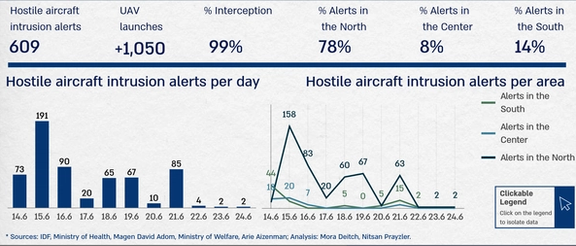
Israel carried out a wide-scale military campaign inside Iran over a 12-day conflict, striking more than 1,480 targets and launching around 1,500 air sorties that dropped 3,500 munitions, Israeli media and defense sources reported.

The campaign, focused largely on western Iran and Tehran, also included long-range strikes as far as Mashhad airport, approximately 2,300 km from Israel.

According to data from the Israeli military and national rescue services (MDA), 29 Israelis were killed during the conflict – 28 by Iranian missile fire and one woman reportedly suffering cardiac arrest during air raid sirens.

(Source: Institute for National Security Studies)
100%
(Source: Institute for National Security Studies)

The Israeli Air Force conducted 600 mid-air refueling operations during the offensive, which also targeted 80 Iranian air defense systems and 250 missile launch platforms.

Eight nuclear sites across Iran were bombed, with severe damage reported at two key facilities. Initial waves of airstrikes targeted Natanz and Isfahan, while subsequent attacks hit Arak, Parchin, Karaj, Bonab, and Tehran.

According to analysis by the Institute for National Security Studies (INSS), the strikes significantly degraded Iran’s nuclear infrastructure and eliminated much of the country’s strategic launch capability.

Iran fired approximately 600 missiles at Israeli territory in retaliation. Fatalities were recorded in multiple cities, including Rishon LeZion, Haifa, Petah Tikva, Kiryat Ata, and Beersheba. More than 30,000 buildings across Israel were damaged during the hostilities.


(Source: Institute for National Security Studies)
100%
(Source: Institute for National Security Studies)

Most Viewed

Iran negotiators ordered to return after internal rift over Islamabad talks
1
EXCLUSIVE

Iran negotiators ordered to return after internal rift over Islamabad talks

2
ANALYSIS

US blockade enters murky phase as tankers spoof signals and buyers hesitate

3
ANALYSIS

Why the $100 billion Hormuz toll revenue is a myth

4

US tightens financial squeeze on Iran, warns banks over oil money flows

5
INSIGHT

Ideology may be fading in Iran, but not in Kashmir's ‘Mini Iran'

Banner
Banner

Spotlight

  • Hardliners push Hormuz ‘red line’ as US blockade tests Iran’s leverage
    INSIGHT

    Hardliners push Hormuz ‘red line’ as US blockade tests Iran’s leverage

  • Ideology may be fading in Iran, but not in Kashmir's ‘Mini Iran'
    INSIGHT

    Ideology may be fading in Iran, but not in Kashmir's ‘Mini Iran'

  • War damage amounts to $3,000 per Iranian, with blockade set to add to losses
    INSIGHT

    War damage amounts to $3,000 per Iranian, with blockade set to add to losses

  • Why the $100 billion Hormuz toll revenue is a myth
    ANALYSIS

    Why the $100 billion Hormuz toll revenue is a myth

  • US blockade targets Iran oil boom amid regional disruption
    ANALYSIS

    US blockade targets Iran oil boom amid regional disruption

  • Iran's digital economy battered by prolonged blackout
    INSIGHT

    Iran's digital economy battered by prolonged blackout

•
•
•

More Stories

Strikes unlikely to destroy Iran’s nuclear capacity, former MI6 chief says

Jun 25, 2025, 12:09 GMT+1

Military strikes on Iran likely failed to eliminate the country’s nuclear expertise or uranium stockpiles, former British intelligence chief Sir John Sawers said on Wednesday, warning that without renewed diplomacy, further military escalation may be inevitable.

“You can't destroy the know-how, we almost certainly haven't destroyed the partially enriched uranium,” the former MI6 head told Bloomberg in an interview.

Sawers called on the Trump administration and European governments to re-engage politically with Tehran to avoid a cycle of repeated military confrontations.

“Engaging with Iran to reach a political agreement is important if they want to prevent the need for strikes over and over again,” he said.

Iran restores communications after wartime blackout, minister apologizes

Jun 25, 2025, 12:05 GMT+1

Iran has restored internet, mobile, and landline services to pre-conflict levels following disruptions imposed during its recent war with Israel, Communications Minister Sattar Hashemi said on Wednesday.

The blackout, which affected millions across the country, was described by Hashemi as a “forced situation” driven by national security concerns. Iranian officials had accused Israel of exploiting digital networks for military operations during the 12-day conflict.

“I apologize to the people for the disruption,” Hashemi said in a televised statement, acknowledging the difficulties caused by the communication restrictions.

Some Iranian users regained access to previously banned platforms such as Instagram and WhatsApp without VPNs or IP-masking tools on Wednesday, according to the reformist Shargh newspaper. The paper cited changes in internet protocol settings as part of the ongoing restoration process.

Sources told Shargh the apparent unblocking is temporary and technical in nature, not a shift in policy on foreign platforms.

In photos: Aftermath of Israeli strikes in Tehran

Jun 25, 2025, 11:42 GMT+1
A view of the aftermath of an Israeli strike on a building last week, after the ceasefire between Israel and Iran, in Tehran, Iran, June 25, 2025.
100%
A view of the aftermath of an Israeli strike on a building last week, after the ceasefire between Israel and Iran, in Tehran, Iran, June 25, 2025.
100%
A view of the aftermath of an Israeli strike on a building last week, after the ceasefire between Israel and Iran, in Tehran, Iran, June 25, 2025.
100%
A view of the aftermath of an Israeli strike on a building last week, after the ceasefire between Israel and Iran, in Tehran, Iran, June 25, 2025.
A woman works in her house after an Israeli strike on a building last week, after the ceasefire between Israel and Iran, in Tehran, Iran, June 25, 2025.
100%
A woman works in her house after an Israeli strike on a building last week, after the ceasefire between Israel and Iran, in Tehran, Iran, June 25, 2025.

Iran’s move to block nuclear monitoring is response to attacks, Russia says

Jun 25, 2025, 10:29 GMT+1

Russia criticized recent US and Israeli military action against Iran on Wednesday, saying the situation is deeply concerning and has seriously damaged the credibility of the UN nuclear watchdog.

The Kremlin said the Iranian parliament’s decision to suspend cooperation with the International Atomic Energy Agency (IAEA) was a direct result of what it called an “unprovoked attack” on Iran.

Responding to US President Donald Trump’s remarks that the strikes had set Iran’s nuclear program back by decades, the Kremlin said it does not believe anyone has realistic data yet, calling such assessments premature.

Moscow also said it is aware that the US maintains certain contacts with Iranian officials through indirect channels, but provided no further details.

Iran executes three men over 2020 Israeli killing of nuclear scientist

Jun 25, 2025, 10:25 GMT+1

Iranian authorities said they have executed three men accused of smuggling equipment allegedly used in the assassination of Mohsen Fakhrizadeh, a senior figure in Iran's nuclear program who was assassinated in 2020.

The judiciary’s official news outlet, Mizan, reported on Wednesday that Edris Aali, Azad Shojaei, and Rasoul Ahmad Mohammad were put to death at Urmia Central Prison in northwest Iran.

The three were charged with "corruption on earth" and "enmity against God," accusations often levied in cases involving alleged collaboration with foreign governments.

Authorities said the men had worked to smuggle components hidden in shipments of alcoholic beverages, which they claim were ultimately used in the assassination of a high-ranking Iranian official.

While Iranian state media did not name Fakhrizadeh directly in its recent coverage, the allegations correspond with earlier reports linking the men to his killing.

Fakhrizadeh, a senior officer in Iran’s Revolutionary Guards and a prominent figure in its nuclear development efforts, was shot dead in an attack east of Tehran in November 2020. Iran has blamed Israel for orchestrating the assassination.

Edris Aali, Azad Shojaei, and Rasoul Ahmad Mohammad
100%
Edris Aali, Azad Shojaei, and Rasoul Ahmad Mohammad

Contested confessions and accusations of torture

Human rights organizations have raised concerns about the case. According to an exclusive report by Iran International, all three men—reportedly Kurdish cross-border porters known as kolbars—were convicted based on confessions obtained under severe duress.

Aali and Shojaei were reportedly detained for months in Ministry of Intelligence facilities before being transferred to Urmia Prison.

Family members told media outlets the men denied involvement and said their televised confessions were extracted under torture. Ahmad Mohammad, an Iraqi national from the Kurdish city of Sulaimaniyah, was arrested two years after the killing, allegedly after his phone number was found in Aali’s contact list.

Israel has not officially claimed responsibility for the assassination, though officials have not denied involvement. In the years following the incident, Israeli media and intelligence sources have described it as a remote-controlled, AI-assisted operation using a weapon smuggled into Iran in parts and reassembled inside the country.

An Israeli intelligence officer told Channel 12 in 2022 that the operation relied on facial recognition to avoid harming Fakhrizadeh’s wife, who was in the car with him, and took less than three minutes to carry out.

Iran’s former Intelligence Minister Mahmoud Alavi said in 2022 that efforts to apprehend the main perpetrators had failed, with several suspects fleeing the country shortly after the attack.

Fakhrizadeh, long described by Western intelligence agencies as the architect of Iran’s nuclear weapons program, was sanctioned by the United Nations and had survived previous assassination attempts.