• العربية
  • فارسی
Brand
  • Iran Insight
  • Politics
  • Economy
  • Analysis
  • Special Report
  • Opinion
  • Podcast
  • Iran Insight
  • Politics
  • Economy
  • Analysis
  • Special Report
  • Opinion
  • Podcast
  • Theme
  • Language
    • العربية
    • فارسی
  • Iran Insight
  • Politics
  • Economy
  • Analysis
  • Special Report
  • Opinion
  • Podcast
All rights reserved for Volant Media UK Limited
volant media logo

Iran postpones implementation of new hijab law following backlash

Dec 14, 2024, 21:19 GMT+0Updated: 12:06 GMT+0
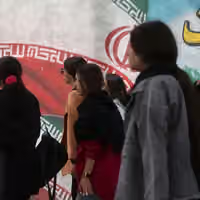
A woman defying Iran's hijab regulations walks alongside a conscript in Tehran's Valiasr crossroad in December 2024

The Islamic Republic has officially postponed the implementation of the controversial hijab law that imposes severe penalties on women and girls who defy veiling requirements, following huge backlash from the public and the international community.

Iran's Supreme National Security Council, in a letter to the parliament on Saturday, requested that the process of implementing the Hijab and Chastity law be halted so that an amended bill can be submitted to the parliament by the government, said a member of the Parliament's presiding board.

The 'Law on Protecting the Family through the Promotion of the Culture of Chastity and Hijab,' comprising 74 articles, was set to take effect yesterday. It imposes severe penalties on women and girls who defy veiling requirements, including exorbitant fines, prison terms, flogging, and even death penalty.

On Tuesday, Amnesty International condemned the new law, saying it intensifies the oppression of women and girls while exposing activists opposing the rules to charges carrying the death penalty.

“Iranian authorities have adopted a new draconian law that further erases the human rights of women and girls, imposing the death penalty, flogging, prison terms and other severe penalties to crush ongoing resistance to compulsory veiling,” Amnesty International said in a press release.

Drafted in May 2023, less than a year after the Woman Life Freedom uprising sparked by the death in custody of Mahsa Amini in September 2022, the law was introduced in response to widespread defiance of compulsory veiling by women and girls, Amnesty said.

Amnesty detailed sections of the new law and how it, warning it criminalizes acts such as “nudity, indecency, unveiling and bad dressing.”

Article 50 of the law defines “unveiling” as failing to cover the head with a hijab, chador, or headscarf. “Bad dressing” is defined in Article 48 as exposing body parts below the neck, other than the hands and feet, or wearing clothing deemed to “contribute to or incite sin by others”.

However, the rights group warned terms such as “nudity” and “indecency” remain undefined in the new law, allowing for subjective interpretation and enforcement.

Amnesty highlighted that activism against the hijab law may even be deemed “corruption on earth,” a charge punishable by death under Iran's penal code—a concern recently raised by Iranian women’s rights activists.

“This shameful law intensifies the persecution of women and girls for daring to stand up for their rights following the ‘Woman Life Freedom’ uprising,” said Diana Eltahawy, Amnesty International’s deputy regional director for the Middle East and North Africa.


Most Viewed

Iran negotiators ordered to return after internal rift over Islamabad talks
1
EXCLUSIVE

Iran negotiators ordered to return after internal rift over Islamabad talks

2
ANALYSIS

US blockade enters murky phase as tankers spoof signals and buyers hesitate

3
ANALYSIS

Why the $100 billion Hormuz toll revenue is a myth

4

US tightens financial squeeze on Iran, warns banks over oil money flows

5
ANALYSIS

US blockade targets Iran oil boom amid regional disruption

Banner
Banner

Spotlight

  • Hardliners push Hormuz ‘red line’ as US blockade tests Iran’s leverage
    INSIGHT

    Hardliners push Hormuz ‘red line’ as US blockade tests Iran’s leverage

  • Ideology may be fading in Iran, but not in Kashmir's ‘Mini Iran'
    INSIGHT

    Ideology may be fading in Iran, but not in Kashmir's ‘Mini Iran'

  • War damage amounts to $3,000 per Iranian, with blockade set to add to losses
    INSIGHT

    War damage amounts to $3,000 per Iranian, with blockade set to add to losses

  • Why the $100 billion Hormuz toll revenue is a myth
    ANALYSIS

    Why the $100 billion Hormuz toll revenue is a myth

  • US blockade targets Iran oil boom amid regional disruption
    ANALYSIS

    US blockade targets Iran oil boom amid regional disruption

  • Iran's digital economy battered by prolonged blackout
    INSIGHT

    Iran's digital economy battered by prolonged blackout

•
•
•

More Stories

Iran sentences Iranian-American journalist to 10 years in prison

Dec 14, 2024, 19:57 GMT+0

Iranian-American journalist Reza Valizadeh, who previously worked for a US government-funded broadcaster, has been sentenced to 10 years in prison by a Tehran Revolutionary Court.

Valizadeh has also been banned from residing in Tehran and neighboring provinces, prohibited from leaving the country, and barred from political party membership for two years, defense attorney Mohammad Hossein Aghasi tweeted on Friday.

Valizadeh worked for Radio Free Europe/Radio Liberty's Persian Service, known as Radio Farda, for 10 years before leaving the organization in November 2022. In March, after 14 years abroad, he returned to Iran to visit his family, according to a tweet he posted. Despite receiving assurances from security officials over the phone that he would not face any problems, authorities arrested him in September.

His two court sessions, held in November, proceeded without a prosecution representative, with the judge taking on that role, according to Radio Farda.

People close to the journalist say he walked into a "security trap" after receiving informal assurances from Iranian security officials that he would not face legal issues upon returning to Iran.

According to HRANA, Valizadeh remains in Ward 209 of Evin Prison, a section run by the Ministry of Intelligence, where he lacks access to basic amenities and visitation rights.

Valizadeh’s sentence was communicated to him and his lawyer only after a delay. HRANA rights group also reported that he has not been moved to the prison’s public ward, even though investigations have concluded.

International organizations, including Reporters Without Borders and the Committee to Protect Journalists, have criticized Valizadeh’s detention. The US State Department called his arrest unjust and described it as a violation of international law.

"Iran routinely imprisons U.S. citizens and other countries' citizens unjustly for political purposes. This practice is cruel and contrary to international law," a State Department spokesperson said last month.

Before his emigration, Valizadeh was briefly detained in 2007 in Iran. His professional history includes working with outlets such as Radio France, Voice of America, Radio Farda, and Iran’s state broadcaster IRIB.

Israel targets Iranian tunnels in Syria as talks exclude Tehran

Dec 14, 2024, 16:58 GMT+0

Israel has conducted a series of airstrikes targeting weapons storage and infrastructure in Syria, while Iran was left out of international talks on the country's political future.

Jordan-based Al-Ghad TV reported that Israeli fighter jets carried out 17 airstrikes on Friday night and early Saturday, focusing on areas near Damascus.

These strikes hit ballistic Scud missile warehouses, rocket launchers, and the Nasiriyah military airport in the Qalamoun region, according to the report.

According to the Al-Ghad TV report, the Israeli strikes on the outskirts of Damascus targeted strategic military assets linked to Iran's regional influence. These included weapons tunnels, which reportedly housed advanced missile systems.

Israel has not commented on the strikes, adhering to its usual policy of ambiguity regarding military operations in Syria. However, Israeli officials have previously emphasized that such actions aim to prevent the transfer of advanced weapons to Hezbollah and other Iran-backed forces.

Meanwhile, top diplomats from the United States, Turkey, the European Union, and several Arab nations convened on Saturday to discuss Syria's future. Iran and Russia were notably absent from the talks hosted in Aqaba. Participants included US Secretary of State Antony Blinken, UN Special Envoy for Syria Geir Pedersen, and foreign ministers from countries such as Saudi Arabia, Egypt, and Qatar.

The discussions centered on guiding Syria toward a political transition following the recent ousting of Bashar al-Assad. Arab diplomats issued a statement advocating for a peaceful and inclusive transition, new constitutional frameworks, and elections while reaffirming their commitment to combating terrorism.

Turkey, which has supported Syrian opposition forces for years, is expected to play a significant role in shaping Syria’s future government. Turkish Foreign Minister Hakan Fidan announced on Friday that Turkey’s embassy in Damascus would reopen, signaling a shift in Turkey’s approach as it seeks to consolidate influence in Syria.

While the United States shares some interests with Turkey, conflicting priorities remain, particularly regarding the Syrian Democratic Forces (SDF). The SDF, a Kurdish-led coalition that has been instrumental in fighting ISIS, is viewed by Ankara as an extension of the outlawed Kurdistan Workers' Party (PKK). Turkish-backed rebels have clashed with the SDF in northern Syria, complicating the geopolitical landscape.

The exclusion of Iran from the talks reflects its diminished influence in post-Assad era as regional and global powers align to shape Syria's political transition. Iran’s billions of dollars spent in Syria, including the construction of military infrastructure and weapons depots, face increasing threats from Israeli airstrikes and the shifting diplomatic focus of key players like Turkey and Saudi Arabia.

As the international community moves forward with plans for Syria's political transition, Iran's marginalization in the process underscores a growing consensus among its rivals to curb Tehran's regional ambitions. 


Iran releases songstress after brief arrest over concert without hijab

Dec 14, 2024, 16:50 GMT+0

Iranian security forces arrested and released female singer Parastoo Ahmadi during the weekend, after she livestreamed aconcert without mandatory hijab in defiance of the Islamic Republic's law.

Ahmadi was arrested in Mazandaran, northern Iran, three days after she published on YouTube her unveiled performance in a caravanserai, her lawyer Milad Panahipour told Emtedad news website.

"We have no information about the charges against Parastoo Ahmadi, the arresting authority, or her place of detention," Panahipour said.

Two members of her band, Ehsan Beiraghdar and Soheil Faghih-Nassiri, were also arrested on Saturday, according to the lawyer. All three were released by Sunday morning.

On December 12, the Judiciary of the Islamic Republic issued a statement saying that the concert was held "without legal authorization and adherence to Sharia principles" and that "appropriate action" will be taken against the singer and production team.

The Caravanserai Concert, held on Wednesday night, quickly became one of the most discussed topics on Iranian social media.

Despite YouTube being restricted in Iran, the performance has attracted over 1.5 million views over the past three days, with clips widely shared online.

Ahmadi, in her introduction, described the concert as hypothetical, saying, “I am Parastoo; a girl who wants to sing for the people she loves... this is a right I could not forsake.”

Ahmadi was born in 1997 in Nowshahr in northern Iran. She is a graduate in directing from Sooreh University and spent years playing the piano and doing song covers which she shared on her Instagram page.

Iranian law prohibits women from singing solo or appearing in public without a hijab. Ahmadi’s performance, in which she bared her shoulders, challenged these long-standing restrictions.

Her earlier acts of defiance, including a rendition of Az Khoon-e Javanan-e Vatan (“From the Blood of the Youth of the Nation”) during 2022 nationwide anti-veil protests, had already brought her into conflict with authorities. Following that performance, she was summoned by security officials and her home was searched.

Artistic defiance has become a hallmark of Iran’s protest movements, with musicians such as Shervin Hajipour, Mehdi Yarrahi, Saman Yasin, and Toomaj Salehi facing arrest for their roles in mobilizing dissent. Ahmadi’s concert continues this tradition, positioning her as both an artist and an activist in a country where such roles carry significant risks.

The judiciary’s swift action shows the government’s determination to curb what it sees as cultural transgressions, even as social media amplifies these acts of resistance to global audiences.

Iran's rial hits record low amid growing uncertainty

Dec 14, 2024, 15:18 GMT+0

The Iranian currency hit an all-time low of 753,000 rials to the US dollar on Saturday, marking the sixth record drop since September, when Tehran began losing influence in the region to Israel and other players.

Compared to the same date last year, when the dollar was valued at 505,000 rials, the current rate represents a staggering 48% rise.

The rial began trading below 740,000 to the dollar on Saturday morning but surged above 750,000 rials by noon.

The euro reached almost 800,000 rials, while the British pound was trading at 950,000 rials. Almost all other major currencies and currencies of neighboring countries also rose against the rial, including the afghani.

One notable shock to the currency market came on November 6, when the dollar initially jumped past 700,000 rials following the news of Donald Trump’s victory in the US presidential elections. But the currency had begun its decline in September after serious blows by Israel against Iran's main regional proxy, Hezbollah and an Israeli air strike that destroyed most of Iran's air defenses.

However, authorities temporarily stabilized the rate below the 700,000 thresholds, most likely by selling foreign currencies to support the rial.

The downward trend resumed later that month after the International Atomic Energy Agency’s (IAEA) Board of Governors issued a resolution critical of Tehran for its nuclear program which has breached international regulations, producing 60% enriched uranium as Iran edges ever closer to nuclear weapons capability.

The fall of Bashar al-Assad in Syria last week came as a new shock to the rial, which fell to new lows several times in recent days.

The rial has faced significant volatility throughout the year, influenced by volatility in the region and direct conflict between Iran and Israel.

Iran’s reliance on oil and gas exports for foreign currency earnings has made the country particularly vulnerable to international sanctions. Under Joe Biden’s presidency, sanctions enforcement eased somewhat, offering Tehran a lifeline. But the return of Donald Trump to the White House, combined with Europe’s increasingly tough stance to crack down on Iran's nuclear program, foreshadows greater economic strain for the Islamic Republic.

Inflation in Iran already exceeds 40%, and the rial’s devaluation will exacerbate price hikes, further eroding the purchasing power of ordinary Iranians.

Tens of millions have faced declining living standards over the past five years, with wages lagging behind inflation and around one third of the population now living below the poverty line.

The average worker who was earning almost $200 per month earlier this year is now getting the equivalent of $150 or less, while official data suggests that $500 is the bare minimum required to meet basic needs.

As the dollar’s rise continues, the impact on daily life for Iranians grows more severe. Essential goods and services, already out of reach for many, are likely to see further price increases, deepening economic hardship and fueling public discontent.

Iranian sent to solitary ahead of execution over alleged Israel links

Dec 14, 2024, 14:55 GMT+0

Authorities have transferred political prisoner Mohammad-Amin Mahdavi Shayesteh to solitary confinement ahead of his execution for "insulting Islamic sanctities" and "collaboration with the enemy," according to Iran Human Rights (IHR).

IHR noted that the charge of collaborating with Israel against 26-year-old Shayesteh, who was arrested last year, was based on confessions obtained under torture and used to expedite his death sentence. The human rights group emphasized the lack of evidence in the case, pointing out that "an empty handgun magazine" and "a pepper spray" were presented as proof of "possession of illegal weapons" to support the charge of "collaboration with the enemy."

"The Islamic Republic is experiencing its greatest crises in its history and, to prevent public protests and cover up its regional failures, resorts to intimidation through the execution of defenseless prisoners," Mahmood Amiry-Moghaddam, Director of IHR, tweeted on Friday.

In recent months, Iranian authorities have escalated their use of the death penalty, with human rights groups reporting that over 42 political prisoners currently face the risk of execution.

According to a November 21 report by HRANA, at least 133 executions were documented in the past month alone, averaging more than four per day. This follows data from the Iran Human Rights Organization, which recorded at least 166 executions in October.

HRANA’s reports reveal an annual average of 811 executions between October 2023 and October 2024, encompassing both political detainees and ordinary prisoners.

This surge in executions coincides with rising tensions between Iran and Israel, with some suggesting that the government is leveraging geopolitical crises to distract from its domestic repression.