• العربية
  • فارسی
Brand
  • Iran Insight
  • Politics
  • Economy
  • Analysis
  • Special Report
  • Opinion
  • Podcast
  • Iran Insight
  • Politics
  • Economy
  • Analysis
  • Special Report
  • Opinion
  • Podcast
  • Theme
  • Language
    • العربية
    • فارسی
  • Iran Insight
  • Politics
  • Economy
  • Analysis
  • Special Report
  • Opinion
  • Podcast
All rights reserved for Volant Media UK Limited
volant media logo

US should threaten to blow Iran 'to smithereens' for threats - Trump

Sep 25, 2024, 18:38 GMT+1Updated: 08:21 GMT+1
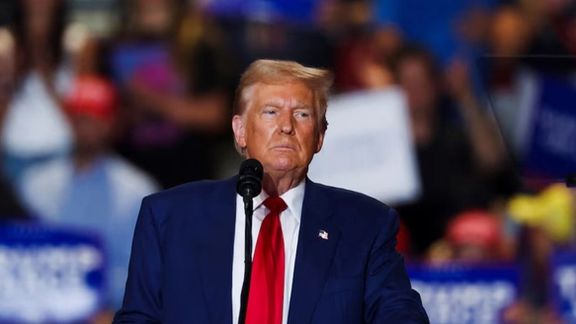
Republican presidential nominee and former US President Donald Trump looks on during a rally at Nassau Veterans Memorial Coliseum, in Uniondale, New York, US, September 18, 2024.

Republican presidential candidate Donald Trump said on Wednesday that the United States should threaten to bomb countries which seek the assassination of US leaders in the wake of an alleged Iranian plot on his life.

"If I were president, I'd inform the threatening country, in this case Iran, that if you do anything to harm this person, we're going to blow your largest cities and the country itself to smithereens, and there'd be no more threats," Trump told supporters at a rally in in North Carolina.

"But right now we don't have that leadership or necessary leaders," the former president added.

Trump earlier said that the Islamic Republic was seeking to kill him and that his security detail had been increased as his campaign said it was briefed on the threats by US security officials.

“Big threats on my life by Iran. The entire U.S. Military is watching and waiting. Moves were already made by Iran that didn’t work out, but they will try again," the former President said on X.

"I am surrounded by more men, guns, and weapons than I have ever seen before," he added. "An attack on a former President is a Death Wish for the attacker!"

A spokesperson from the US Office of the Director of National Intelligence acknowledged the briefing on Tuesday but declined to address any specifics.

Authorities in Iran did not immediately comment on the situation.

Trump's campaign said the Iranian threats were part of an effort to undermine the United States, Iran's main antagonist since its Islamic Revolution in 1979.

"President Trump was briefed earlier today by the Office of the Director of National Intelligence regarding real and specific threats from Iran to assassinate him in an effort to destabilize and sow chaos in the United States," it said in a statement.

The campaign said intelligence officials conveyed that Iranian threats have "heightened in the past few months", without elaborating.

Iran has issued repeated threats of retribution against those who were involved in the 2020 targeted killing of Qasem Soleimani, Iran's top military and intelligence operative in the Middle East.

Earlier this month, a Pakistani man with alleged ties to Iran pleaded not guilty to charges stemming from an alleged plot to assassinate an unnamed American politician in retaliation for Soleimani's killing.

The defendant named Trump as a potential target but had not conceived the scheme as a plan to assassinate the former president, according to a person familiar with the matter.

Federal authorities are separately investigating an apparent assassination attempt on Trump at his Florida golf course in mid-September and a July 13 shooting of the Republican presidential candidate at a rally in Pennsylvania. There has been no indication of Iranian involvement in either of the alleged attempts.

US government agencies said last week Iranian hackers sent emails containing stolen material from the Republican former president's campaign to people involved in Democratic President Joe Biden's then re-election campaign, as part of an alleged broader effort by Tehran to influence the US election.

Biden stepped aside as a candidate in late July and was replaced by Democratic Vice President Kamala Harris, who faces Trump in a tight race for the Nov. 5 US elections.

In August, the United States accused Iran of launching cyber operations against the campaigns of both US presidential candidates. Iran denied the allegations.

Most Viewed

Iran negotiators ordered to return after internal rift over Islamabad talks
1
EXCLUSIVE

Iran negotiators ordered to return after internal rift over Islamabad talks

2
ANALYSIS

US blockade enters murky phase as tankers spoof signals and buyers hesitate

3
ANALYSIS

Why the $100 billion Hormuz toll revenue is a myth

4

US tightens financial squeeze on Iran, warns banks over oil money flows

5
ANALYSIS

US blockade targets Iran oil boom amid regional disruption

Banner
Banner

Spotlight

  • Hardliners push Hormuz ‘red line’ as US blockade tests Iran’s leverage
    INSIGHT

    Hardliners push Hormuz ‘red line’ as US blockade tests Iran’s leverage

  • Ideology may be fading in Iran, but not in Kashmir's ‘Mini Iran'
    INSIGHT

    Ideology may be fading in Iran, but not in Kashmir's ‘Mini Iran'

  • War damage amounts to $3,000 per Iranian, with blockade set to add to losses
    INSIGHT

    War damage amounts to $3,000 per Iranian, with blockade set to add to losses

  • Why the $100 billion Hormuz toll revenue is a myth
    ANALYSIS

    Why the $100 billion Hormuz toll revenue is a myth

  • US blockade targets Iran oil boom amid regional disruption
    ANALYSIS

    US blockade targets Iran oil boom amid regional disruption

  • Iran's digital economy battered by prolonged blackout
    INSIGHT

    Iran's digital economy battered by prolonged blackout

•
•
•

More Stories

Israel’s UN ambassador calls Iranian president's UN speech a ‘game’

Sep 25, 2024, 16:15 GMT+1
•
Negar Mojtahedi

Israel’s Ambassador to the UN accused Iran's new president of "playing a game," claiming he is "lying, and unfortunately, some people are buying it" during his visit to New York.

Ambassador Danny Danon told Iran International that Iran's president Masoud Pezeshkian talks like's a moderate, speaks "nice in New York" but then sends "billions" to proxies like Hamas, Hezbollah and the Houthis.

On Monday, Pezeshkian told reporters during a visit to New York for the UN General Assembly meeting that Iran does not seek a wider war in the Middle East.

“We don’t want war. ... We want to live in peace,” Pezeshkian told reporters.

During his first address to the UNGA the following day, Iran's new president took aim at Israel, blaming the Jewish state for instability in the Mideast. He called for an immediate ceasefire and blamed Israel for assassinating "scientists, diplomats and guests" on Iranian soil.

Pezeshkian did not name Ismail Haniyeh, the leader of Hamas who was killed in Tehran on July 31. Haniyeh was in Iran at the time for the inauguration of Pezeshkian.

Danon called Pezeshkian "a dangerous man."

"I think that he knows how to play the game. And he played the game with the media, with the diplomats here. But when you look at the actions of the regime, the human rights abuses in Iran, the proxies that attack Israel and other forces of instability, you realize it's a dangerous regime. He's a dangerous man," said Danon.

Israel's UN Ambassador blamed the Islamic Republic of Iran for the conflict in Lebanon.

Danon said there are no territorial, economic or geopolitical disputes between Israel and Lebanon and that Iran-backed Hezbollah is the only force that has led to fighting between the two neighbors.

Hezbollah fired dozens of projectiles into Israel early Wednesday, including a missile aimed at Tel Aviv that was the militant group's deepest strike yet. That marked a further escalation after Israeli strikes on Lebanon killed hundreds of people.

"The Lebanese people are suffering because the regime of Teheran that are using Lebanon as a launching pad against Israel."

"Ask yourself why we have a conflict now between Hezbollah and Israel. What is the reasoning of the conflict? We have no dispute over territory, no dispute over resources. It's only because the Iranian regime wanted to support Hamas and they ordered Hezbollah to support Hamas. And the people of Lebanon and Israel are suffering because of that," said Danon.

Tuesday morning at the UNGA, US President Joe Biden urged for calm. He said full-scale war is not in anyone's interest. He added that if even the situation escalates a diplomatic solution is still possible.

During Danon's interview with Iran International, he thanked the US for their support but said they need to do more to help Israel and urged nations to do more when diplomacy fails. In his view, Iran is not capable of engaging in a diplomatic solution.

When asked what the next steps are in Lebanon, he said Israel will continue to push back until Hezbollah is farther away from the border and residents can move back to their homes in North of Israel. Hundreds of thousands of people are displaced on both sides of the border.

Iranian President Masoud Pezeshkian and his French counterpart Emmanuel Macron met on the sidelines of the 79th United Nations General Assembly summit. Macron urged Pezeshkian to use his influence with Hezbollah to deescalate tensions.

The UN Security Council said it would meet on Wednesday evening to discuss the conflict.

Hezbollah stands despite commanders killings - Iran's Supreme Leader

Sep 25, 2024, 15:43 GMT+1

In his first response to the recent Israeli strikes that killed Hezbollah commanders, Iran's Supreme Leader Ali Khamenei stated that the attacks will not undermine the group's strength.

“Hezbollah’s organizational and human strength far surpasses these notions. Their power, capabilities, and resilience are vastly superior to being significantly undermined by these martyrdoms,” Khamenei said on Wednesday.

“Undoubtedly, the loss of an individual, particularly a commander with a distinguished record of jihad in the path of God, is a significant blow. There is no question about that. Yet, despite these losses, they have prevailed thus far,” he added.

The Iranian leader's speech comes amid escalating regional tensions, as Tehran's key proxy group faces an intensifying Israeli offensive. Since Monday, Israeli military operations in Lebanon have resulted in 569 fatalities and over 1,800 injuries, including the assassination of multiple top commanders over the weekend.

In another part of his remarks, Khamenei likened the operations of Lebanese and Palestinian forces against Israel to Iran’s own struggle during the eight-year war with Iraq. He reaffirmed the “religious and undeniable duty” to return Palestine and the Al-Aqsa Mosque to their rightful owners.

Khamenei further asserted, "The Palestinian and Lebanese resistance will ultimately prevail," accusing Israel of targeting civilians out of frustration with its inability to defeat its adversaries.

Since Hezbollah’s founding in 1982, Iran has remained its steadfast ally. Khamenei attributed the recent escalation in Lebanon to US involvement following Israeli strikes that destroyed communication equipment provided to Hezbollah.

Despite Washington’s claims of ignorance regarding Israel’s plans, Khamenei insisted, "The US is both aware and complicit," adding that President Biden’s administration "requires a victory for the Zionist regime" ahead of the upcoming November presidential election.

Former US hostage criticizes Iranian presence in New York

Sep 25, 2024, 13:52 GMT+1

A former US diplomat held hostage in Iran has called the presence of the Iranian president's delegation for the UN General Assembly in New York a lavish escape while Iran grapples with severe domestic crises.

“This is a great vacation for them, believe me. They love this—they can get out of Iran, relax, have a great meal, and see things they couldn't see in Iran. So, this is an excuse to get out,” Barry Rosen, senior advisor at United Against Nuclear Iran (UANI), told Iran International.

Staying at the Millennium Hilton, the visit is costing over $1,000 per night for each member of Masoud Pezeshkian's 40-person delegation, including his family, Rosen remarked that "the larger the delegation, the better time they have."

He further suggested that the group seems detached from the ongoing crises in Iran, where "the economy's in shambles, there's a water crisis, an electricity crisis, every possible crisis, and most of all, a human rights crisis."

Criticizing the issuance of visas for Pezeshkian and his delegation, Rosen recalled a previous instance when he had successfully opposed the appointment of a UN ambassador, saying, "Years ago, I complained against the attempt to bring in a UN ambassador by the name of Aboutalebi, and he was stopped."

However, Rosen acknowledged that diplomatic protocol is difficult to challenge, stating that while the delegation is technically present "legally," he personally does not view them as such.

In 2014, the White House refused to issue a US visa to Iran's nominee for UN ambassador, Hamid Aboutalebi, due to his involvement in the 1979 seizure of the US embassy in Tehran, during which Barry Rosen and dozens of others were taken hostage.

The decision effectively barred Aboutalebi from assuming his position at the United Nations in New York, the official linked to the student group that orchestrated the embassy takeover.

On November 4, 1979, a group of radical students loyal to Ayatollah Khomeini stormed the US Embassy in Tehran, seizing American hostages for 444 days. Taking place in the chaotic aftermath of Iran's Islamic Revolution and the collapse of the Pahlavi monarchy, the crisis deeply strained US-Iranian relations, leaving a lasting impact for years to come.

Recalling the day of the hostage crisis, Rosen said, "We were taken hostage around 10 o'clock in the morning. It was raining, and before I knew it, several hundred people had scaled the walls and burst into my office. They told me, 'You're a member of the nest of spies.'"

To this day, the Islamic Republic refers to the former US embassy in Iran, now defunct, as the "nest of spies." He went on to describe the ordeal: "They put me in handcuffs, threw me into the kitchen of the ambassador's residence, and from that point, I was interrogated, beaten, and tied up.

"As I lay on the floor, I heard Imam Khomeini say that taking Americans as hostages was the right thing to do. At that moment, I realized I was in serious trouble for a long time."

Explaining that his initial trip to Iran was as part of the Peace Corps, a US government program that trains and deploys volunteers for international development assistance, Rosen recounted how he later became a press attaché, working alongside American Ambassador William H. Sullivan. His role was to inform both Iranian journalists and the international press about the events unfolding during the Iranian Revolution.

Reflecting on the anniversary of Mahsa Amini's death in police custody, which sparked months of protests across Iran in 2022, Rosen emphasized the resilience of Iranian women, calling them "the valiant heroes of Iran." He remarked on the severe punishment that women have endured over the past two years.

"There are so many people still going through the jails, being punished, with death penalties being carried out and hangings happening all over the place," Rosen added. "This regime has a lot to answer for."
Iranian hardliners attack Pezeshkian over remarks on Israel

Sep 25, 2024, 11:53 GMT+1
•
Maryam Sinaiee

While in New York, Masoud Pezeshkian faced backlash from hardliners at home following a Bloomberg report that claimed he suggested Iran was prepared to ease tensions with Israel.

The report entitled “Iran's President Says He’s Prepared to Ease Tensions With Israel” was released after Pezeshkian met with a US media delegation in New York on Monday.

"We are prepared to give up all our weapons, provided Israel also disarms, and an international organization steps in to ensure security in the region. We don't even need them—we know how to secure our own safety,” Pezeshkian is heard saying in an audio file from the meeting obtained by Iran International.

Some hardliners have even called for Pezeshkian’s impeachment, signaling potentially serious domestic political strife. It remains unclear where Supreme Leader Ali Khamenei stands. While Pezeshkian's foreign policy statements were likely approved by Khamenei, it remains to be seen whether he will step in to rein in the hardliners.

Foreign Minister Abbas Araghchi, and the head of the government’s Public Relations Council, Elias Hazrati, strongly rejected Bloomberg’s claim, but an audio recording of the meeting obtained by Iran International confirmed the the Iranian president made those remarks.
Pezeshkian said on X Tuesday that he had criticized the “UN inaction against the crimes of the occupying regime” in a meeting with the UN Secretary-General Antonio Guterres.

“The silence of the world, especially the Western countries, about the death of 41,000 innocent people in Gaza is incomprehensible. The Islamic world will not allow them to turn Lebanon into another Gaza,” he added in his tweet.

“A more beautiful world! President Pezeshkian talked about a region free from weapons of mass destruction and a world free from nuclear weapons,” the Pezeshkian administration’s X account posted Tuesday.

The harshest criticism has come from ultra-hardliners within the Paydari Party and its allies, who continue to quote the Bloomberg headline despite "corrections" from Araghchi and others. They accuse Pezeshkian of betraying Hezbollah, Hamas, Yemen, and other Iranian allies in the region.

“The least that should be done after this scandal in the US is to impeach such an incompetent person and remove him from the presidency of Iran!” one of the critics outraged by the alleged suggestion of the possibility of escalation with Israel posted on X.

“It seems that the multilateral diplomacy of Javad Zarif and President Pezeshkian will be damaging to the Resistance Axis. The message of peace from Iran as the main supporter of the Resistance Axis when Lebanon is on fire has boldened the Israeli army,” another critic charged.

Mohammad-Javad Zarif, Pezeshkian’s Vice President for Strategic Affairs, also took to X to defend Pezeshkian for “the most well-founded defense of the resistance of the people of Palestine, Lebanon, and Yemen” in New York, “exposing the dual standards of the Western countries in matters such as weaponization, war, and human rights” and “showing that genocidal Israel is an aggressor with nuclear weapons”.

Opponents of the Islamic Republic, however, are criticizing Pezeshkian's government for its support of militant groups within the Axis of Resistance, rather than for any alleged attempts at de-escalation in the region.

“Is Mr. Pezeshkian the President of Lebanon, Yemen, and Palestine … that he is talking on their behalf? Is it an honor to put Iran’s money and wealth in the mouths of terrorists?” one of the replies to Zarif’s post in Pezeshkian’s defense charged.

“Why did Lebanon and Yemen get themselves involved in this as if Israel occupied their lands? It was you who armed them. Otherwise, why should Lebanon and Yemen get involved in a Palestinian war?” another comment to Zarif’s post read.

“You and the criminal regime under the criminal Khamenei’s command send money and weapons to terrorist groups such as Hezbollah instead of supporting your own people … You’d better pay heed to human rights violations in Iran instead of theatrical human rights performances in New York…,” another X post declared.

Since his arrival in New York, Pezeshkian has held meetings with the UN Secretary-General, the President of the European Council, the King of Jordan, and presidents of Switzerland, Turkey, and Finland, the Elders Group, and some US media representatives.

Pezeshkian also sat for an interview with CNN’s Fareed Zakaria in which he warned about the escalation of the conflict between Israel and Hezbollah and an all-out war in the region.

In his Tuesday address to the UN General Assembly, he stated that Iran is willing to return to the now-defunct JCPOA nuclear agreement, provided the West meets its obligations, which would effectively mean the lifting of sanctions.

Iran brokers secret Russia-Houthi missile talks - Reuters

Sep 25, 2024, 09:44 GMT+1

Iran has facilitated secret negotiations between Russia and Yemen's Houthis in order for Moscow to provide the militia with advanced anti-ship missiles amid the Red Sea blockade.

Three sources confirmed to Reuters that discussions are ongoing, although Russia has not yet committed to providing the Yakhont supersonic missiles, also known as P-800 Oniks.

Such weapons would enhance the Houthis' ability to strike commercial vessels in the Red Sea with greater accuracy amid the blockade which began in November, posing a heightened threat to US and European warships defending the area.

Amid the ongoing war in Gaza, the Houthis, claiming solidarity with Iran-backed Hamas, have enforced a maritime blockade of the Red Sea, targeting commercial shipping, on the orders of Iran's Supreme Leader, Ali Khamenei.

Initially focused on the Red Sea, these attacks have now extended to other key waterways, including the Indian Ocean, disrupting international shipping and resulting in dozens of international seamen unrelated to Israel being taken hostage.

A US-led coalition of over 20 nations has mobilized to address the threat to global trade and the freedom of movement in the vital maritime corridors.

"Russia is negotiating with the Houthis for the transfer of Yakhont supersonic anti-ship missiles," a Western intelligence source told Reuters. "The Iranians are brokering the talks but do not want to have their signature over it."

In July, The Wall Street Journal reported that Russia was considering sending the missiles. In August, CNN reported that Russia had prepared to deliver missiles and other military equipment to the Houthis but pulled back last minute amid behind-the-scenes efforts by the United States and Saudi Arabia to halt the transfer.

Two regional officials said that the Houthis and Russians met in Tehran at least twice this year and that talks to supply dozens of missiles, which have a range of about 300 km (186 miles), were ongoing, with further meetings expected in the coming weeks.

For years, Iran has been accused of supplying the Houthis with funding, weapons and technical expertise, enabling the group to develop long-range missiles and drones. These shipments, often disguised as commercial cargo, have sometimes been intercepted by US naval forces and other international military operations.

In early September, the Houthis reached central Israel with a missile for the first time, which they claimed was hypersonic. The missile landed in an open area near Ben Gurion International Airport, causing no casualties and minimal damage.

Following the incident, Israeli Prime Minister Benjamin Netanyahu vowed that Israel would exact a "heavy price" on the Houthis, who control northern Yemen. In a press conference, Iranian President Masoud Pezeshkian denied that Tehran had supplied hypersonic missiles to the Houthis or short-range ballistic missiles to Russia.