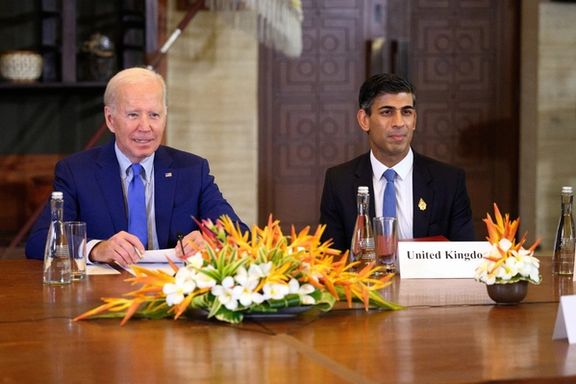
US President Joe Biden and British Prime Minister Rishi Sunak attend an emergency meeting of leaders at the G20 summit following the overnight missile strike by a Russian-made rocket on Poland, November 16, 2022 in Bali, Indonesia.
The new EU-US coordinated sanctions against Iran in the aftermath of Iran-Israel April 13-19 conflict is a notable development whose efficacious enforcement remains as elusive as ever.
However, the question is, first, how these new sanctions figure in the greater scheme of sanctions that have already been set in place by EU, US, and their G7 allies against Iran. And second, whether there exist measures that can tangibly enforce them.
The Many Different Types of Sanction Regimes
Over the past thirty years, major world powers, particularly US and EU, have increasingly resorted to sanctions as a major “non-military” leverageagainst “adversaries” or states that are held in violation of international conventions and treaties. The US sanctions are the broadest and oldest anti-Iran sanctions ever devised dating back to the 1979 US embassy hostage crisis. After the US, EU countries have the second largest sanction regime. The EU’s sanction regimes against Iran have never been as consistent as the US ones due the many ups and down in EU-Iran relations. The third regime of sanctions are those of UK and Canada sanctions, along with those of Australia, Japan, and South Korea.
EU-US Standoff and Collaboration over Iran Sanctions
The US boasts the broadest sanction regime in the world that encompasses over 26 countries and ten thematic sanction regimes, from counter narcotic and nuclear non-proliferation to cyber crimes and Global Magnitsky sanctions. Hence, as the EU has often sought to cajole a regime like that of Iran’s, it should come as no surprise that the EU-US have often clashed as to the path forward and disagreed over sanctions over many other aspects of their diplomacy vis-à-vis Iran.
Iran’s oil production and export since January 2023
Nonetheless, the Iranian regime’s mass repression of popular protests in 2018 and 2019 culminated to the statewide crackdown of 2022 Woman, Life, Freedom uprising, and forced the EU to adopt up to ten packages of human rights-based sanctions against various Iranian regime individuals and entities between 2018 and 2023. It was at this juncture that the EU’s resistance in joining the US comprehensive sanctions against Iran began to erode.
It should be highlighted that although the Biden administration maintained the Trump-era sanctions on Iran’s oil exports as it was negotiating a revival of the JCPOA, enforcement became a secondary concern since January 2021. This allowed Iran to more than double its oil exports to China by 2023 and weaken the sanctions regime.
Whether or not the US and EU would exert the will to enforce the sanctions remains the sticking question. In the last package of sanctions, including the Mahsa Act, passed by the Congress and signed by President Biden, there indeed exist many a set of measures to stop the Iranian petroleum exports, which constitute a major source of revenue for the Tehran and its military-industrial complex.
Today, sanctions have become a permanent fixture in the global foreign policy and international trade establishment. A growing literature is focusing on sanctions and their effectiveness. Amongst the many works that have been published on the topic, there exist ostensibly academic volumes such as How Sanctions Work: Iran and the Impact of Economic Warfare(Bajoghli, Nasr, et al, Stanford University Press, 2024). Such “studies” illustriously correspond in authorship and stance to those of “Iran Influence Network”, and it is thus no wonder that authors of such works are increasingly forced to tread a fine line between lobbying and consultancy. Other stakeholders concerned with the growing sanction regimes are globally active enterprises who have built comprehensive databases that catalogue “risky individuals and entities” to help them in compliance with the global sanction regimes. Such works may be a good starting point to verify governments’ commitment to sanction enforcement.
In the end, if the EU and US fail to substantially implement the many sanction regimes that they have created over the past several years, they may lose much in prestige in credibility in the eyes of the world community where Russia and China have been jockeying to replace them as global powers. The last curtain in this segment is yet to draw.
US Secretary of State Antony Blinken attends the US-Arab Quint Meeting with representatives from Egypt, Jordan, Saudi Arabia, Qatar, the United Arab Emirates and the Palestinian Authority, at the Four Seasons Hotel in Riyadh, Saudi Arabia, April 29, 2024.
During his visit to Saudi Arabia, US Secretary of State Antony Blinken emphasized the importance of increased collaboration with and among the Persian Gulf states to develop an integrated defense strategy aimed at countering Iran's regional influence.
“We’re focused on addressing the greatest threat to regional stability and regional security: Iran. …[Iran’s attack on Israel] highlights the acute and growing threat from Iran, but also the imperative that we work together on integrated defense,” Blinkensaid at Monday’s meeting with Foreign Ministers of the Gulf Cooperation Council Member States.
Blinken is on his inaugural leg of what some are calling a Middle East "crisis tour," making a stop in Riyadh to meet with Arab leaders to try and push for an Israel-Hamas ceasefire and humanitarian aid to the Gaza Strip.
The visit marks Blinken’s first time in the region since tensions between Tehran and Jerusalem began to ramp up.
The Secretary of State said that an upcoming meeting would enhance defense collaboration between the US and Persian Gulf states in response to Iran’s attack on Israel and the wider threat posed by Tehran.
“That’s the focus of the meeting that’s coming up in a few weeks with the US-GCC Working Group on Integrated Air and Missile Defense and Maritime Security,” Blinken said.
This month, Iran launched over 300 projectiles, including over 100 ballistic missiles, in its first direct attack at Israel.
The IDF has reported that it has, along with its allies, stopped 99% of the projectiles Iran fired on the country.
The attack followed the killing of seven senior Islamic Revolutionary Guards (IRGC) personnel in a strike on what was claimed to be Tehran’s consulate building in Damascus – an action widely attributed to Israel.
Israel’s retaliation, several strikes targeting the city of Isfahan, were largely downplayed by Tehran.
According toreporting from The Economist, new satellite imagery indicates that Iran responded by replacing a destroyed air-defense radar with a new one, effectively saving face while de-escalating tensions with Israel.
A photo of the founder of the Islamic Republic Rouhollah Khomeini in a book published in India
An Indian publishing house has issued an apology following backlash over a sixth-grade school textbook including Ruhollah Khomeini, the founder of the Islamic Republic, as one of the “most evil men in history.”
The listing of Khomeini's name sparked criticism from India's Shia Muslim community, who hold him in high regard as a religious leader and Islamic scholar.
This perspective sharply contrasts with the sentiments of many Iranians, especially the younger generation, who view Khomeini as a dictator responsible for the regime’s egregious and numerous human rights abuses.
The description in the Indian textbook, which caused outrage stated that: "During his reign, [Khomeini] did many evil deeds. He used to kill people who didn't believe in 'Allah'. People had to face brutality even if they listened to music. He was the culprit behind the Iranian revolution (1979) and also the Iran-Iraq war, making him responsible for the deaths of millions of people."
The controversy, fuelled by India’s Muslim community, gained further traction when the “Khomeini For All” X page tweeted about the book, stating that the "Indian publisher insults Imam Khomeini…We urge authorities to take swift and stern action. Failure to do so will provoke community outrage." The group running the page called for action from the Meerut and Delhi police against the publishers.
Following the 1979 revolution and with the help of a non-legitimate referendum, Khomeini and those close to him created the Islamic Republic in Iran.
Khomeini’s subsequent rule was marked by suppression of political dissent, the establishment of a theocratic government with no civil liberties, and the initiation of purges targeting political opponents and intellectuals.
The early years of the Islamic Republic saw the execution of former government officials and army leaders, with 1981 marked by a particularly brutal massacre following a Fatwa issued by Ayatollah Khomeini. The period targeted a wide range of political opponents and is remembered as one of the darkest chapters in Iran’s modern history.
The mass killings of political prisoners in 1981, which extended into early 1982, were methodical and have been categorized as crimes against humanity by countries like Canada. These acts were part of a larger strategy to consolidate power by the newly established Islamic regime, which publicly listed the names of the executed and defended its actions in face of international criticism.
Following the onslaught of criticism over the book by India’s Muslim groups, Acuber Books International issued a statement, saying that they will “rectify [the] error swiftly and unequivocally.”
“It has come to our attention that labeling him among the ‘most evil men in history’ is not only inaccurate but also deeply offensive to many individuals and communities,” the letter received by Kashmir Observer states.
A view from Iran's Mapna Group’s factory in Karaj, near the capital Tehran (file photo)
A report from the German newspaper Bild says a Düsseldorf-based subsidiary of Iran's Mapna Group -- Mapna Europe -- may be involved in circumventing international sanctions.
Mapna Group, a major Iranian conglomerate involved in constructing power plants and oil facilities, is under scrutiny for its connections with the Islamic Republic's political elite.
The British government raises even more serious suspicions. Mapna Europe GmbH appears to be on an European list of international companies suspected of being involved in the production or procurement of weapons of mass destruction, Bild said.
Bild's investigation suggests that the Islamic Republic may use Mapna Europe, along with its subsidiaries in Dubai, China, and Turkey, for conducting suspicious transactions, thereby evading international sanctions. The allegation is worrying as Mapna is listed under US sanctions.
According to Bild, Abbas Aliabadi, who served for fifteen years as the CEO of Mapna until his appointment as Iran's Minister of Industry, Mines and Trade in Ebrahim Raisi's government in 2023, continues to influence the operations of Mapna Europe discreetly.
“The mullahs from Iran are building a nuclear bomb and want to destroy Israel - but are doing millions in business in Germany,” writes Bild.
It also highlights that according to experts, there are hidden company networks, especially in Düsseldorf and Hamburg, with which Iran is trying to circumvent sanctions. The Mapna network stands out here because of its prominence: the name Afshin Rezaei is on the mailbox next to Economics Minister Aliabadi.
Aliabadi, a member of the Islamic Revolutionary Guard Corps (IRGC) and a veteran of Iran’s defense educational institutions, stepped down from his role at Mapna shortly after taking office in the government.
“Mapna Europe operates in an office complex between the main train station and the old town with an unadorned entrance, and dark staircase. Not a place where you would expect a state-run company. Only one name on the mailbox might say who is at work here: Abbas Aliabadi – Iran's Minister of Economy, member of the Revolutionary Guard, confidant of the mullahs,” read the report by Bild.
The name Afshin Rezaei, who manages Mapna's Dubai branch and previously faced a six-month US prison sentence for violating anti-terrorism laws, is also listed on the company's mailbox.
The report also ties other high-profile Iranian figures to Mapna Europe, including Tahmasb Mazaheri, former Economy Minister and ex-Governor of the Central Bank of Iran. Mazaheri was reportedly managing several businesses in Düsseldorf as of 2018, and in 2013, he was found with an undeclared check worth 54 million euros at Düsseldorf Airport. The Islamic Republic claimed that the check Mazaheri carried was for the costs of residential construction in Venezuela.
Two US lawmakers are pressing the Biden administration on the use of cryptocurrency to evade sanctions in Russia, Iran and North Korea.
The lawmakers are asking officials what additional authorities might be needed to prevent digital assets, such as stablecoin Tether from being used by sanctioned entities in Russia and elsewhere.
The letter sent on Sunday by US Senators, Democrat Elizabeth Warren and Republican Roger Marshall, to officials including Treasury Secretary Janet Yellen and Defense Secretary Lloyd Austin show increasing scrutiny on how cryptocurrencies could be used to circumvent sanctions.
Warren and Marshall raised particular concern about the use of Tether, whose value is pegged to the US dollar and designed to maintain a stable value.
The Wall Street Journal reported earlier this month that Russian middlemen used Tether to evade Western sanctions in order to source weapons parts for drones and other military equipment.
Reuters also reported this month that Venezuela's state-run oil company PDVSA plans to use Tether in its crude and fuel exports as the US is set to reimpose oil sanctions on the country.
"The national security threat posed by cryptocurrency requires a commensurate response by our country's defense community," Warren and Marshall said. They noted that even though Tether's preferred crypto trading platform Garantex has been sanctioned, "it is not clear if these actions have stopped the flow of funds through the platform."
Tether did not immediately respond to a request for comment but has previously said it respects US Treasury's list of sanctioned entities and is committed to ensuring sanctioned crypto wallet addresses are frozen.
Mo'oud Shamkhani, former deputy head of Iran's Arvand Free Zone and nephew of Ali Shamkhani – the former Secretary of Iran's Supreme National Security Council
Mo'oud Shamkhani, former deputy head of Iran's Arvand Free Zone and nephew of a prominent Iranian official, has been arrested on charges of financial corruption totaling $2.1 billion.
Shamkhani is the nephew of Ali Shamkhani – the former Secretary of Iran's Supreme National Security Council who has held various high-ranking positions within the Iranian government and military.
In recent years, the economic activities of the Shamkhani’s family, including Ali Shamkhani’s two sons, his half-brother, wife and son-in-law, have been widely criticized and have made headlines in Iran.
Mo’oud Shamkhani previously served as an admiral in Iran’s navy and a former Islamic Revolutionary Guards (IRGC) commander.
The Tasnim News Agency, affiliated with the IRGC, reported that Shamkhani is accused of "receiving bribes and financial corruption" in the city of Abadan.
The Arvand Free Zone, which spans approximately 34,700 hectares, is a designated economic zone in southwestern Iran.
It includes industrial towns such as Abadan, Khorramshahr, Shalamcheh, and Minushahr and has been the focus of numerous corruption investigations in recent years.
High-profile arrests linked to the investigations include Esmail Zamani, former CEO of the Arvand Free Zone, who was arrested in December 2020, and Ahmad Rostami, former deputy for management development, who was arrested a few months later.
Mo’oud Shamkhani's arrest was made public on Sunday.
He was appointed as the Deputy for Technical and Infrastructure Affairs of the Arvand Free Zone in 2015, following his uncle Ali Shamkhani's appointment to the zone's board in January 2014.
Ali Shamkhani, now a member of the Expediency Discernment Council and a political advisor to the Supreme Leader of the Islamic Republic, has been a frequent target of criticism by “conservatives” in Iran.
In addition to the arrest, the Shamkhani familyhas been embroiled in various scandals, often related to accusations of nepotism including reports about Ali Shamkhani’s sons -- Hassan and Hossein -- owning dozens of businesses, such as large shipping companies, and misuse of power for financial gain.
Multiple reports have highlighted the lavish lifestyles of his family members both in Iran and abroad, raising questions about the sources of their wealth.
Controversies reached their peak following allegations of extravagant properties and bank accounts held by Shamkhani’s family, including those of his toddler grandson.