• العربية
  • فارسی
Brand
  • Iran Insight
  • Politics
  • Economy
  • Analysis
  • Special Report
  • Opinion
  • Podcast
  • Iran Insight
  • Politics
  • Economy
  • Analysis
  • Special Report
  • Opinion
  • Podcast
  • Theme
  • Language
    • العربية
    • فارسی
  • Iran Insight
  • Politics
  • Economy
  • Analysis
  • Special Report
  • Opinion
  • Podcast
All rights reserved for Volant Media UK Limited
volant media logo

Where Next For The Islamic Republic In The UN Human Rights Council?
Adam Baillie

Iran International

Mar 21, 2024, 00:09 GMT+0Updated: 10:53 GMT+0
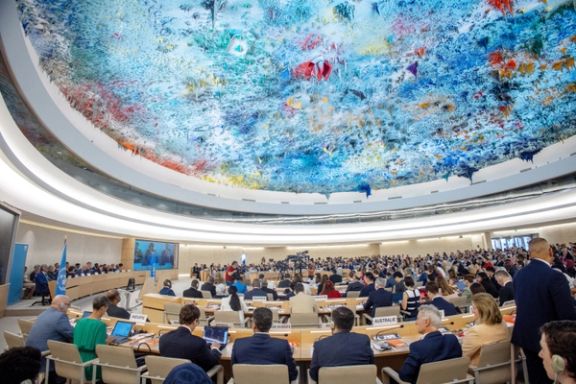
Delegates attend the Human Rights Council at the United Nations in Geneva, Switzerland September 11, 2023.

The prospect of Iranian officials facing criminal charges under human rights law took a big step forward in the current session of the UN’s Human Rights Council meeting in Geneva.

The two reports presented to the Council mark a watershed for Iran, giving impetus to the ending of impunity and new emphasis on legal accountability for those IR officials implicated in human rights abuses.

The sixth and last report from Javaid Rehman, the Special Rapporteur on Human Rights in Iran together with the meticulously detailed 400-page report from the Fact Finding Mission on Iran have opened a path to the formation of international tribunals and greater use of existing international jurisdiction to prosecute Iranians. Central to that is the collection of evidence which can stand up in a court.

That path is not yet named, but it has been signposted by the Special Rapporteur and the FFM. And being the UN, nothing will be speedy. But the change in direction signalled at the HRC has given a tremendous boost to the Iranian human rights activists in their many NGOs gathered in Geneva. And a unity of purpose among many of them.

Their mood is upbeat, Spring-like. In short, their hope is that if and when the current authority in Iran changes, IR officials will not be able to hide from the law, wherever they are. Flight to the West should the IR collapse would be hugely unattractive to those who might have once looked for visas to Canada and elsewhere if they face prosecution for crimes for which bodies like the FFM collect the detailed evidence. As one activist put it, “the threat of prosecution is more alarming than sanctions to the torturers and their agents”.

The Islamic Republic is on the backfoot in Geneva, as regards the HRC. The IR has always refused to recognise the UN mandate given to the Special Rapporteur since it began in 2011. And neither does it recognise the UN mandate given the FFM in the aftermath of the death of Mahsa Amini. But the protests following her death has changed everything for Iran at the UN. What was always a standoff, is now an impasse.

Special Rapporteur of the Human Rights in Iran Javaid Rehman (undated)
100%
Special Rapporteur of the Human Rights in Iran Javaid Rehman

This mirrors the historic antagonisms between the IR and the West. Under the vast, moulded and coloured stalectite ceiling of the grandly-named Human Rights and Alliance of Civilisations Chamber where the HRC meets, Iranian diplomats sit expressionless listening to a catalogue of IR oppression, torture and killing. The standard response of IR diplomats in these sessions is to ignore the points made and attack the integrity of the Rapporteur. The IR response in this time was to veer off the subject altogether or make statements which in the circumstances could only be considered as bizarre. Thus for Somayeh Karimdoost, the IR deputy head of mission, Rehman is merely a British “pen-holder” for Western attacks on Iran. His report, she said, was not "reflective of Iran’s constant progress and promotion and protection of human rights”. Similarly, Gharib Abadi, head of Iran’s High Council for Human Rights, kicked off his response to the FFM report by singling out Germany as having supplied Saddam Hussein with the weapons to fight Iran. Germany, he claimed, was thus at the forefront of a campaign against Iran using a humanitarian veneer to cover a politically charged mechanism.

While Iran is a signatory to various international treaties which underpin international humanitarian law, it clearly does not share the same definition of human rights as understood in the Western democracies, even if the same term is used. To any observer, the lack of irony or self-contradiction in the IR response to the HRC Iran reports is striking (although not without unexpected humour. On the landing outside the 'Human Rights and Alliance of Civilisations’ chamber, right where TV. journalists do their lives, the Iranian Mission had put up an enormous banner celebrating ‘Iran: 100 Years of Multilateralism”, showing the IR flag fluttering over the Palais des Nations. Last year, the Mission put on an exhibition of headless models of women displaying Iranian national costume - headless, as that avoided the troubled issue of headgear).

Looking back at the past six years of his tenure as UN Rapporteur, Javaid Rehman told Iran International, “during those years of my tenure...we’ve gone through an unprecedented time; I hope that you and your viewers would agree that Iran and the Iranian people do not feel the same way as they felt six years ago. Iran is transforming, it’s a changing society.”

There is no going back. Rehman says that "After the Gina Mahsi Amini movement, the international community was galvanised and my mandate was very active to all perpetrators responsible for crimes. So we made a lot of effort. One of my achievements I would say is the work to establish an international mechanism.”

“Rehman put the issue of impunity and accountability on the table,” says Mahmood Amiry-Moghaddam of Iran Human Rights, a point echoed among other prominent human rights campaigners and many well-known lawyers. In that sense Rehman paved the way for the FFM, whose work he says, is to "conserve evidence for eventual accountability mechanisms and trials. I would encourage states to use universal jurisdiction wherever they find individuals who are alleged to have committed very serious crimes under international law."

What happens now depends on the votes on mandates for the post of Special Rapporteur and extending the FFM which happen on the 4th and 5th April, at the close of the 55th HRC Session. The Islamic Republic of Iran will be delighted to see the back of Rehman, but it looks unlikely that the UN will end the mandate as such for the role of Special Rapporteur for Human Rights in Iran. Speaking to Iran International, Rehman points out that anyone can apply for the job, but did not reveal whether he knew of any likely candidates. A new candidate will be selected and voted ion by the UN in July. Rehman says he really hopes the mandate is extended. “You see the seriousness of the human rights crisis in Iran, which requires a good repoprting mechanism to highlight all of this for the Iranian people,” he says. "I would love my successor to be able to have access to Iran, which the Iranian authorities denied me.”

That is unlikely. Iran will campaign hard for the vote against the mandate renewal and will have backing from such champions of human rights as the Russian Federation, Venezuela, Cuba and Zimbabwe. The FFM mandate extension is not guaranteed, as Sara Hossain, the chair of the FFM tribunal, told us, pointing out that Iran has a lot of friends. But its supporters are hopeful that there will be sufficient votes for the extension, which will allow it time to finish compiling the detailed evidence which would provide the basis of prosecutions and legal actions for redress and compensation for the victims of IR state oppression. When asked whether she would continue to serve as Chair of the FFM, Ms Hossain indicated she’d certainly consider it as she’d invested to much of herself in it so far.

The future for the IR cannot be predicted, but there is a fairly common view among the concerned UN community in Geneva that its current situation cannot continue, faced as it is with such internal opposition. Until that situation changes, the role of the HRC and its mandates for investigating human rights in Iran will remain a highly influential on the policies of the UN governments and many groups within Iran. The response of the IR at this session shows clearly the threat that poses for the IR itself.


Most Viewed

Iran negotiators ordered to return after internal rift over Islamabad talks
1
EXCLUSIVE

Iran negotiators ordered to return after internal rift over Islamabad talks

2
ANALYSIS

US blockade enters murky phase as tankers spoof signals and buyers hesitate

3
ANALYSIS

Why the $100 billion Hormuz toll revenue is a myth

4

US tightens financial squeeze on Iran, warns banks over oil money flows

5
ANALYSIS

US blockade targets Iran oil boom amid regional disruption

Banner
Banner

Spotlight

  • Hardliners push Hormuz ‘red line’ as US blockade tests Iran’s leverage
    INSIGHT

    Hardliners push Hormuz ‘red line’ as US blockade tests Iran’s leverage

  • Ideology may be fading in Iran, but not in Kashmir's ‘Mini Iran'
    INSIGHT

    Ideology may be fading in Iran, but not in Kashmir's ‘Mini Iran'

  • War damage amounts to $3,000 per Iranian, with blockade set to add to losses
    INSIGHT

    War damage amounts to $3,000 per Iranian, with blockade set to add to losses

  • Why the $100 billion Hormuz toll revenue is a myth
    ANALYSIS

    Why the $100 billion Hormuz toll revenue is a myth

  • US blockade targets Iran oil boom amid regional disruption
    ANALYSIS

    US blockade targets Iran oil boom amid regional disruption

  • Iran's digital economy battered by prolonged blackout
    INSIGHT

    Iran's digital economy battered by prolonged blackout

•
•
•

More Stories

Activists Call For Support To Oust Iranian Regime In New Year

Mar 20, 2024, 23:59 GMT+0

In a message marking Norouz, the Iranian New Year, two prominent activists called for the overthrow of the Islamic regime.

Former political prisoner Hossein Ronaghi shed light on the government's approach to quelling dissent in a video released on social media, emphasizing intimidation as a primary tool.

Ronaghi stated, “The government aims to subdue the protesting society and dissenting individuals through intimidation, threats, suppression, and executions."

Acknowledging the resilience of the Iranian people, Ronaghi remarked, “What we witnessed was the courage of women and men, the unity of the people, and the crumbling of the wall of fear at the cost of bitter and heavy experiences.”

He also paid tribute to anonymous people who stood steadfast in the face of adversity, asserting, “Each of us has a duty to support all these anonymous heroes, and victims.”

Meanwhile, Nobel Peace Prize laureate and political prisoner Narges Mohammadi expressed hope for change, stating, "I believe that we, the people of Iran, with resistance and perseverance, will ultimately overthrow the despotic religious regime."

“Today, if we have hope for change in the new year, a significant part of it is owed to the anonymous heroes, their resilience, and their struggles.”

Ronaghi and Mohammadi's messages reflect a continued struggle against oppression and a call for unity in pursuit of democratic change.

As Iran grapples with economic challenges and societal unrest, the voices of dissent grow louder, advocating for fundamental freedoms and justice.


Iran Continues Social Media Crackdown, 42 Accounts Blocked

Mar 20, 2024, 21:22 GMT+0

Authorities in Iran's Kish Island have banned 42 Instagram accounts with a collective following over two million in the latest crackdown on social media, branding the accounts “norm breakers”.

The recent move follows the blocking of an Instagram page featuring an elderly man whose singing and dancing videos garnered widespread attention. Iranian authorities labeled the content as "criminal" and subsequently arrested 12 individuals involved in its production and dissemination.

In response to growing dissent and criticism, Iran has intensified its crackdown on social media platforms, aiming to control the flow of information and suppress opposition voices.

The government has implemented censorship measures, including blocking access to popular social media sites such as Twitter, Facebook, and Instagram.

Additionally, authorities have targeted those who express dissenting views online, arresting and prosecuting activists, journalists, and ordinary citizens for their online activities.

The crackdown reflects the government's determination to maintain control over the narrative and silence dissent, despite facing widespread criticism from human rights organizations and the international community for infringing on freedom of expression.


Iran's Renewables Ambitions Dwindle Amidst Regional Surge

Mar 20, 2024, 20:52 GMT+0
•
Dalga Khatinoglu

Iran fell significantly short of its renewable energy capacity expansion target for the last fiscal year, which ended on March 19.

The country only managed to add less than 75 megawatts (MW) of renewable energy capacity, whereas the initial projection had aimed for an addition of 2,500 MW – realizing just 3% of its renewables growth goal.

The latest statistics from the Energy Ministry indicate that there was a relatively small increase in new renewable energy infrastructure during the last fiscal year, with less than 11 MW of new wind farms and 64 MW of photovoltaic solar farms installed.

Interestingly, 37% of these installations became operational within the past week.

Iran’s total renewable energy capacity currently amounts to 879 MW, which represents less than 1% of the country's total nominal electricity generation capacity.

The country currently confronts a substantial electricity deficit of 14,000 MW during peak summer demand. Compelled by severe droughts and escalating air pollution, the nation has little recourse but to prioritize the expansion of renewable energy sources as its sole viable solution.

During the last fiscal year, Iran produced approximately 380 terawatt-hours (TWh) of electricity. Among the sources of electricity generation, nuclear power and renewables each contributed 1%, while hydropower plants accounted for 4.4%. The majority of electricity generation, 93.5%, came from thermal power plants. Notably, Iran's thermal power plants are substantial consumers of natural gas, using over 70 billion cubic meters annually, as well as significant quantities of dirty mazut and diesel fuels, totaling 20 billion liters per year.

Iran's greenhouse gas emissions have doubled since 2000, soaring to approximately one billion tons annually. As the sixth-largest emitter of greenhouse gases worldwide, Iran grapples with significant air pollution challenges, especially in major cities like the capital, Tehran. Clean air remains a rarity, with only 3-4 days of such conditions experienced throughout the last year.

Despite benefiting from 300 sunny days annually and vast windy mountainous and coastal areas, the Islamic Republic has not prioritized the flourishing of clean energy sources.

Iran Trails as Neighbours Forge Ahead

In 2023, Turkey increased its renewables capacity by 2,840 MW, while Saudi Arabia tripled its figure to 2,800 MW during the same period. Additionally, Turkey aims to add 7,000 MW of renewables capacity in 2024.

Currently, renewables (solar, wind, biomass, geothermal) and hydropower collectively account for approximately 59% of Turkey's nominal power generation capacity. In contrast, in Iran, this figure stands at about 15%.

It's worth noting that Iran's actual hydropower generation only contributes 4.4% to electricity generation, significantly lower than its nominal capacity of 12%, largely due to drought conditions.

power-generation-Iran-turkey
100%
Source: Iran’s energy ministry, Turkey Energy Market Regulatory Authority

The Energy Information Administration recently predicted that renewable capacity expansion in the Middle East and North Africa is set to increase by 62 gigawatts (GW) between 2023 and 2028.

Over the next five years, the pace of growth is expected to accelerate to more than three times that of the previous five-year period, with solar photovoltaic (PV) installations accounting for over 85% of the increase.

More than one-third of the growth will occur in Saudi Arabia alone, with significant contributions also expected from the United Arab Emirates, Morocco, Oman, Egypt, Israel, and Jordan. Together, these seven countries are projected to account for over 90% of the region's growth in renewable energy capacity.

GCC countries renewable generation share, 2020 - 2035
100%

Additionally, Saudi Acwa Power and the UAE's Masdar companies have signed major projects with Iran's northern neighbors to develop their renewable energy projects.

In November 2023, Masdar launched Azerbaijan's 230 MW solar farm and entered into a joint project with Acwa and Azerbaijan's state-run oil company, Socar, to develop 500 MW of renewable energy in the Nakhchivan Autonomous Republic of Azerbaijan.

ACWA Power is currently in the process of developing a 240 MW wind power plant in Azerbaijan. Additionally, the company signed four implementation agreements in early 2023 for the development of a 1 GW onshore wind farm and a 1.5 GW offshore wind farm with Azerbaijan.

Azerbaijan has also inked numerous contracts with companies such as French Total and British Petroleum to expand the capacity of solar and wind farms to 10,000 MW by 2030.

The Saudi company has also entered into multiple renewable energy contracts with Uzbekistan, including the construction of a 2400-MW wind power plant. Additionally, agreements have been made for the development of a plant with a 3000-ton/year hydrogen production capacity and another plant with a 500,000-ton/year green ammonia production capacity. It launched the first wind turbine in Bukhara during the previous summer.

Acwa Power also secured an agreement with Kazakhstan last year to construct a 1000- MW wind farm.

In 2023, Kazakhstan inaugurated 16 renewable energy facilities with a total capacity of 496 MW. The country's current renewables capacity stands at close to 3000 MW, with plans to ramp it up to 6,700 MW by 2027.

Iran's southern neighbor, Oman, has initiated the development of its large-scale hydrogen project. As per the International Energy Agency, Oman intends to produce a minimum of 1 million tons of renewable hydrogen annually by 2030, scaling up to 3.75 million tons by 2040, and potentially reaching 8.5 million tons by 2050. This ambitious plan would surpass the current total hydrogen demand in Europe.

Qatar meanwhile has commenced the construction of a blue ammonia project with a capacity of 1.2 million tons per year in 2022.

Iran Must Brace For 67% Inflation In Coming Year

Mar 20, 2024, 17:23 GMT+0

Hassan Sadeghi, the head of the Union of Veteran Workers, has predicted a 67% inflation rate in the coming year (beginning March 20) as the economy spirals downward.

He warned of the likelihood of intensified protests as a result of the economic crisis unless salaries are increased and policies more suited to Iran are implemented.

"In the past year, the prices of consumer goods in Iran have skyrocketed several times, but wages have remained stagnant,” he pointed out as more and more Iranians fall below the poverty line.

In a bold statement, Sadeghi blamed government inefficiency. "This year, they [the government] have budgeted based on taxation, so people are bracing for a 67% inflation. This is while even if wages are doubled, it will have no effect on reducing inflation."

Furthermore, Sadeghi accused the government of “copy paste versions” of IMF policies without considering Iran's unique economic challenges.

"They don't care about the principle that we are a third-world country and our people earn in rials but spend in dollars. The government should not implement IMF policies with Iran's flawed and inefficient economic structure,” he added.

Iran's inflation trends have been on a rise in recent years, with rates soaring from around 10% in 2016 to nearly 50% in 2023.


White House Warns About Iranian Ceyberattack On Infrastructure

Mar 20, 2024, 16:24 GMT+0
•
Iran International Newsroom

Iran may be attempting cyberattacks on US water infrastructure, the Biden administration warned state governors Tuesday, in yet another sign that US deterrence is inadequate to limit the Iranian regime's aggression beyond its borders.

In a letter bearing the names of National Security adviser Jake Sullivan and Environmental Protection Agency administrator Michael Regan asked governors to help the administration take measures to “secure water systems against the increasing risks from and consequences of these attacks.”

In the past few years, Iran has grown more aggressive in its relations with the United States, targeting American forces and bases through its proxies in the Middle East, and even plotting to assassinate former US officials on American soil.

Targeting water infrastructure is perhaps more brazen than all other actions, as it affects not just the armed forces or politicians, but ordinary Americans.

"Disabling cyberattacks are striking water and wastewater systems throughout the United States,” Sullivan and Regan wrote. “These attacks have the potential to disrupt the critical lifeline of clean and safe drinking water, as well as impose significant costs on affected communities."

The warning letter –made public Tuesday– may suggest that the administration perceives the threat to be serious and substantive. Hackers associated with Iran and China have already attacked water systems, according to Sullivan and Regan

The letter notes that Iran’s Revolutionary Guards (IRGC) “has targeted and disabled a common type of operational technology used at water facilities where the facility had neglected to change a default manufacturer password."

The letter doesn’t have much more on the specifics of those attacks, not even their nature . But it does offer an overview of the relationship between the Biden administration and the Iranian regime, which seems to be emboldened enough to attempt such an attack, potentially harming a large number of Americans on American soil.

"Drinking water and wastewater systems are a lifeline for communities, but many systems have not adopted important cybersecurity practices to thwart potential cyberattacks," Regan said in a press release announcing a virtual meeting on the subject for Thursday.

“We need your support to ensure that all water systems in your state comprehensively assess their current cyber security practices to identify any significant vulnerabilities,” Sullivan and Regan wrote in their letter to state governors.

They also demanded each state to exercise plans to prepare and recover from a potential cyber incident. The water system in the US is known to be vulnerable, lacking proper funding and facing staffing shortages.

According to Bloomberg, hackers related to the Iranian regime attacked Israeli-made digital controls in the water industries in the US last November, affecting several states without affecting water supply.

Many in Washington blame the Biden administration for not confronting Iran in a meaningful way that would establish deterrence. President Biden and his team have made it clear on several occasions, however, that they don’t want escalation with Iran, allowing the IRGC and its regional allies to plot with not much to fear.

It remains to be seen how this policy changes –if at all– during the 2024 presidential campaign and afterwards.