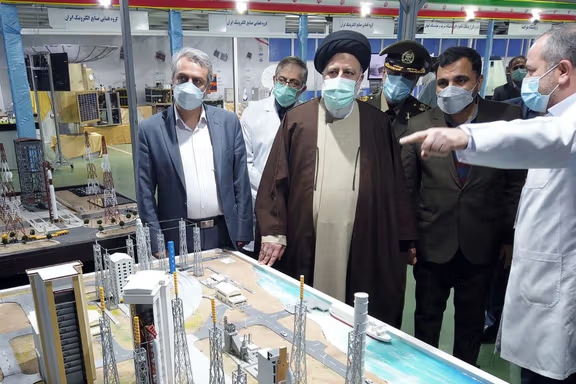
A diorama of the Chabahar Space Center on display during a visit by Iranian President Ebrahim Raisi
Iran asserts that its space program is geared towards fostering scientific advancement, yet it undeniably bolsters its regional influence, and could enhance its hard power capabilities.
Space is viewed as the paramount strategic vantage point, stemming from Iran's missile program, whose advancement holds significant geopolitical implications. The inclusion of military satellites in the space program, overseen by the IRGC, underscores Iran's fusion of civilian and military initiatives in space endeavors, mirroring its broader strategic objectives.
Iran uses the Safir and Simorgh launchers and intends to improve its satellite and rocket technology. The funding of the space agency has increased, and extra technical help is provided through partnerships with nations like North Korea, China, and Russia.
Though the Iranian Space Agency is a division of the Ministry of Communication and Information Technology, the Iranian Ministry of Defense, especially through the IRGC, has significant control over the space program. The importance of the program to Iran's military, security, and economic interests is highlighted by this dual supervision.
Iran’s satellite launch vehicles
A noteworthy achievement is the building of the Chabahar Space Centerin southeast Iran, which is slated to grow to be the biggest space launch location in West Asia. Its completion sometime in the next decade would further solidify Iran's position as a major actor in regional space operations and is anticipated to improve Iran's space capabilities and promote international collaboration.
Iran's space program is poised for a significant advancement with the establishment of the Chabahar Space Center, strategically located in a southern-most region. This center's proximity to the equator offers a key advantage, providing more speed by harnessing the Earth's rotational speed, which enhances spacecraft lift-off and reduces fuel consumption. Designed to propel Iran's space aspirations, the facility aims to deploy satellites into both geosynchronous and low Earth orbits (LEO). Equipped with cutting-edge launch platforms, processing complexes, and assembly facilities, the Chabahar Space Center represents Iran's ambitious endeavor to overcome geographical limitations and bolster its space capabilities. Expected to surpass existing facilities like the Imam Khomeini Space Center, this new center marks a significant leap forward in Iran's space infrastructure.
Iran ten-year space program
The Iranian Space Agency began its massive ten-year space program in January 2023 with the goal of making Iran a space technology development and launch services leader in the coming years. The program highlights Iran's will to support its space industry by building launch pads, developing satellite infrastructure, and conducting research missions.
With its expansive 14,000 hectares, the Chabahar Space Center is ideally positioned to become the focal point of Iran's space activities. Its advantageous position and special qualities allow for the launching of several kinds of satellites, including as sun-synchronous and low-orbit satellites. The facility is expected to play a crucial role in furthering Iran's aspirations in space research and technology, enhancing its standing in the international space community, and bolstering its standing in the region as the main launch location for future missions.
Models of Iran’s satellite launch vehicles on display during a visit by Iranian President Ebrahim Raisi
The international community and Iran’s space program
Concerns over Iran's space program have been raised by Western countries, especially by the US and European powers. The program's possible dual-use character, which links it to the advancement of long-range missile technology, worries the United States. Similarly, believing that Iran's space launch vehicles (SLVs) could serve as intercontinental ballistic missiles (ICBMs), the EU has voiced concerns about these vehicles. Concerns over Iran's ambitions in space research, nuclear energy, and missile technology also surround its space program agreements with China and Russia.
The United States and its allies have accused Iran of using satellite activities as a cover for its intercontinental ballistic missile program, so endangering the Middle East and Europe, in violation of UN Security Council Resolution 2231. Nonetheless, Iran insists that the missiles it has built are not for carrying nuclear warheads and in line with Resolution 2231, which formalized the 2015 JCPOA nuclear agreement.
Challenges
Iran's space program faces a wide range of technical, geopolitical, and economic challenges.
Dual-Use Nature: There have been questions over the Iranian space program's possible dual-use nature due to the similarities in technology between intercontinental ballistic missiles and satellite launchers. Technological developments in satellite launchers can also be advantageous for the development of ICBMs, resulting in tensions and international attention.
International Concerns: Iran's space program has sparked worriesabroad, especially considering the possible military uses of its scientific developments. These worries have been exacerbated by the deployment of military satellites and the advancement of rockets manufactured domestically.
Technological Restrictions: Iran's space program has made progress, although there are still technological limitations. There have been unsuccessful efforts to launch satellites, demonstrating that there are still difficulties in developing dependable and regular space launch capabilities. To address worries about proliferation, the international community has slapped sanctions on organizations connected to Iran's space program. Iran also faces serious financial difficulties as US oil export and banking sanctions reduce its main source of income from crude exports.
A diorama of the Chabahar Space Center
Conclusion
Iran's space program may evolve significantly with the Chabahar Space Center, mainly because of its advantageous location and planned state-of-the-art facilities. Because of its closeness to the equator, it can launch satellites more effectively, using less fuel and improving overall performance. This benefit, together with more advanced facilities than the Imam Khomeini Space Center, will enhance the center's significance in furthering Iran's space goals.
Iran's determination to launch satellites from its territory, demonstrated by the establishment of the Chabahar space port, is met with regional and international opposition due to possible dual-use technology and Western uneasiness with Iran's alliances with China and Russia. Iran claims to be conducting a purely scientific program, but questions regarding potential military uses of the program remain, which might affect how the space program develops in the future.
A Reformist politician in Tehran highlights a concerning trend where a hardliner minority wields disproportionate influence over the fate of the entire Iranian nation.
Gholamreza Zarifian, a prominent political activist, underscored in an interview with Rouydad24 website that this authoritarian minority poses a significant political challenge by promoting radical agendas, ultimately undermining the government's social capital.
Zarifian asserted that four decades post the 1979 Islamic Revolution, Iranian conservatives persist in disregarding historical lessons. They cling to the belief that they are divinely ordained to dictate the course of Iran's destiny. This mindset instills a sense of inferiority among the populace, shifting Iran from a nation that propelled the constitutional Revolution in 1905 to one devoid of influence over its own future, largely due to the conservative elite's monopolization of power.
As parliamentary election approach on March 1, there is general apathy among the population, especially after hundreds of regime loyalist candidates were banned from running for no clear reason. In the absence of real competition at least among regime politicians, everyone is aware that hardliners will win the vote.
Zarifian argued that the public mood resembles the same feeling of inferiority among the people that led to the downfall of monarchy and the coming to power of the Islamic Republic in Iran in 1979. He explained: Under the monarchy, the appearance of a modern society existed in Iran as the three powers of the government had been separated from each other, but the people's vote were ignored in furthering the political dynamics of the society. At that time, a minority undermined the interests of the nation and a chosen few imposed their will on the whole society.
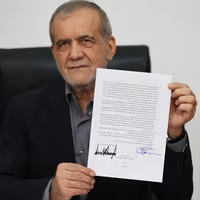
Gholamreza Zarifian, a prominent political activist
Forty-five years after the revolution, the Iranian nation is once again back to the same situation, Zarifian said, adding that the difference is that this time the ruling class of the Islamic Republic uphold none of the rights of the society.
Addressing the flawed electoral process, another reformist figure, Rasoul Montajabnia, urged the government to either ensure free and fair elections or rename the Islamic Republic to reflect its religious governance. He criticized the biased vetting of candidates, emphasizing the stark disparity between the people's expectations and the government's archaic election practices.
He said that Iranians are way ahead of their government and laugh at the backward way the elections are being held. Referring to the lies officials have told the people during the past 45 years. "We have treated the people in a way that if we tell them it is daylight, they would become convinced that it is definitely the nighttime," he said. The cleric said that the arbitrary vetting of candidates by the Guardian Council has left no trace of democracy in Iran.
Montajabnia argued that in some of the constituencies there is no competition as the number of candidates endorsed by the Guardian Council is exactly the same as the number of seats in that constituency.
As an example of how this method of governance affected individuals in the Iranian society, Tehran City Councillor Zahra Nezhad Bahram told the press that some 67 percent of highly educated personnel of the country's knowledge-based companies are planning to leave Iran for good and have already started their emigration process.
This systemic flaw exacerbates frustrations among Iran's educated populace, as evidenced by the significant exodus of skilled professionals seeking opportunities abroad. She emphasized the urgent need for policy reforms to retain and harness the potential of Iran's intellectual capital for sustainable progress.
A protest against the Islamic Republic by Iranian expatriates on February 11, 2024
Iranians in many European and North American cities took to the streets to protest against human rights abuses in Iran, and against the Islamic Republic on the anniversary of the 1979 Revolution.
Demonstrations took place in Belgium, Sweden, Australia, Germany, France, the United States, Britain, and Denmark.
In Belgium, a group of Iranians gathered in Antwerp, chanting slogans demanding justice. Similar rallies took place in Copenhagen, Denmark, and in front of Iran's embassy in Brussels. Protesters in Brussels displayed banners featuring images of Toomaj Salehi, a jailed dissident rapper.
Meanwhile, Iranians and Israelis in Sydney called for designating the Islamic Revolutionary Guard Corps as a terrorist organization by Australia. Iranians in Cyprus also held a demonstration in front of Iran's embassy in Nicosia. In Bern, Switzerland, protesters gathered in front of the Iranian embassy to denounce human rights violations.
In the United States, a rally was held in Washington DC, on Saturday, protesting against the anniversary of the revolution. In Paris, France, Iranians marched towards Iran's embassy, demanding justice for Mahsa Amini and chanting slogans for women's rights and freedom.
Reports from Iran indicated limited participation in government-organized rallies on February 11, despite relaxing enforcement of compulsory hijab and providing recreational activities on the streets.
Rasoul Shahriari, a prominent 'maddah' or religious eulogist in Iran close to the Islamic government, was gunned down in Esfahan province by unidentified assailants.
Government media reported that the motive for the murder is unknown and is currently being investigated by intelligence agencies.
Afaq-Azar's lifeless body, bearing gunshot wounds, was discovered in a city neighborhood, hinting at a premeditated act. Like Afaq-Azar, Shahriari’s ties to the regime and his role in promoting its propaganda domestically and abroad raise questions about the motives behind his assassination.
Meanwhile, in recent years maddahs, once known for their poignant lamentations in cemeteries and during the mourning month of Muharram, transitioning into influential political figures in Iran's clerical regime.
Under the guise of religion, some maddahs have been involved in subversive activities, prompting neighboring countries like Azerbaijan to take action against Iranian espionage networks.
During election seasons, eulogists' associations emerge as key players in propaganda campaigns, with fees escalating based on their perceived closeness to Iran's Supreme Leader Ali Khamenei.
Figures like Mahmoud Karimi, one of Tehran's wealthiest and most renowned eulogists, exemplify this trend, with their endorsements carrying substantial weight in political circles.
Iranian President Ebrahim Raisi addressing a demonstration at Tehran’s Azadi square to commemorate the 45th anniversary of the establishment of the Islamic Republic, February 11, 2024
In the lead-up to the 45th anniversary of the 1979 revolution and the March 1 elections, Iranian officials have escalated their rhetoric, resorting to outrageous statements and unfounded claims.
This surge in exaggeration and falsehoods appears directly correlated with the regime's mounting desperation to achieve its short-term objectives. As the engineered parliamentary and Assembly of Experts elections draw near, the regime has intensified its assertions of remarkable achievements, inflated claims of popularity reaching as high as 97 percent, and exaggerated portrayals of economic and scientific advancements.
Mass production of nonsense
During election season, an abundance of superlatives and claims of "firsts" flood the discourse:: Iran is the most independent country in the world, Iran is the first in the production of science, and Iran is the most important global power. Facing a serious economic crisis and lack of popularity, authorities are turning to such statements on a daily basis.
"Today, Iran is among the top 20 countries in the world in terms of economy, and according to statistics, the people of Iran today have good purchasing power," said the Interior Minister.
"More than 97 percent of the people accept the regime and the revolution and will never abandon it," said the Judiciary Minister.
"The people still adhere to the ideals of the regime and the revolution after 45 years," said the Sports Minister.
"Islamic Iran is the most independent country in the world and the whole world accepts this," said the Fars Province governor.
"The Islamic revolution after the Prophet's mission... was the most important event in the history of mankind... the enemies know that no country is as important as Iran," said the deputy commander of IRGC.
These are clear signs of self-aggrandizement, delusion, and living in a self-made bubble in these statements. According to a Goman Institute poll, in response to the question if a free referendum was held today with the inquiry "Islamic Republic: Yes or No?", %75 answered "No to the Islamic Republic" and only 16% said that their answer was positive.
These statements are indicative of self-aggrandizement, delusion, and a detachment from reality. According to a Gamaan Institute poll published on Sunday, when asked in a hypothetical free referendum whether they support the Islamic Republic, 75 percent of respondents answered "No," while only 16 percent expressed support for it.
People taking photos during regime-sponsored demonstrations to mark the 45th anniversary of Islamic Republic establishment, Tehran, February 11, 2024
Heating the election oven
To draw parallels with the 1979 revolution, officials invited people to come to the rooftops on Saturday evening, which was the anniversary of the revolution and chant “Allahu Akbar.” Also, on this night, they set off fireworks all over the country, which met with a cold reaction from the people.
Seizing the moment, many people took to the balconies and behind the windows to shout slogans of the Mahsa movement. Notably, the voices of women and young girls resonated prominently among these chants, underscoring their active participation in the opposition's message.
Despite relentless calls for public participation in the anniversary march, the photos and videos circulated depict a significantly limited turnout. Figures ranging from several thousand to tens of thousands of attendees are exaggerated to portray figures in the millions or tens of millions. But evidently, even the use of Qasem Soleimani’s name to bring out a million people did not succeed.
For the 86 seats in the Assembly of Experts elections, only 144 candidates have been allowed to run. It is clear that the elections are a sham and people are aware of this fact.
Nihilist regime
Waiving the hijab requirement during the anniversary march was a surprising deviation also observed last year during the anniversary of the occupation of the American embassy. This move was even reported by hardline media as a good initiative. Additionally, earlier this month and American adult film actress was allowed to visit the country and tour important landmarks. As the founder of the Islamic Republic Ruhollah Khomeini famously stated, "To protect the regime, even Islamic rulings could be suspended."
A Houthi policeman stands on a banner with pictures of Israeli Prime Minister Benjamin Netanyahu, British Prime Minister Rishi Sunak and US President Joe Biden during a parade by Houthi recruits in Sanaa, Yemen, February 8, 2024.
The US Central Command (CENTCOM) has announced the successful execution of self-defense strikes against Iran-backed Houthi vessels and missiles.
The announcement claimed that on Saturday, US forces "successfully conducted self-defense strikes against two unmanned surface vessels (USV) and three mobile anti-ship cruise missiles (ASCM) north of Al Hudaydah, Yemen, that were prepared to launch against ships in the Red Sea".
CENTCOM clarified that the vessels and missiles were identified in Houthi-controlled areas of Yemen and posed an imminent threat to US Navy ships and merchant vessels in the region. The operation was conducted with the aim of safeguarding freedom of navigation and ensuring the safety and security of international waters for both US Navy and merchant vessels.
Yemen’s Houthi militants have caused huge trade by targeting shipping lanes in key maritime areas such as the Red Sea, the Gulf of Aden, and the Bab el-Mandeb Strait in support of Hamas's war against Israel.
Iran-backed Hamas invaded Israel on October 7 and the Jewish state's retaliatory attacks have seen large swathes of Gaza destroyed. The Houthis' actions aim to force a ceasefire on Israel.
The Houthis claim to target exclusively Israeli and Israel-bound ships, citing a campaign initiated following a call by Iran's Supreme Leader, Ali Khamenei, in early November, but global shipping has suffered and international vessels have been victim to attacks.
Saturday's defensive attacks are the lastest in a series of actions from the US as the Biden administration comes under increasing pressure to take action against Iran's proxies which have launched over 180 attacks on US targets in the Middle East since October 7, including a deadly attack killing troops in Jordan.
The Biden administration listed the group as specially designated global terrorists (SDGT) last month in response to their rising threats in the region. However, when the administration assumed office in early 2021, it delisted the Iran-backed Houthi designation as both a foreign terrorist organization and as a specially designated global terrorist.