• العربية
  • فارسی
Brand
  • Iran Insight
  • Politics
  • Economy
  • Analysis
  • Special Report
  • Opinion
  • Podcast
  • Iran Insight
  • Politics
  • Economy
  • Analysis
  • Special Report
  • Opinion
  • Podcast
  • Theme
  • Language
    • العربية
    • فارسی
  • Iran Insight
  • Politics
  • Economy
  • Analysis
  • Special Report
  • Opinion
  • Podcast
All rights reserved for Volant Media UK Limited
volant media logo

Ali Karimi: Iranian Soccer Star Dribbling In Politics
Majid Mohammadi

Contributor

Jan 6, 2024, 17:12 GMT+0Updated: 11:15 GMT+0
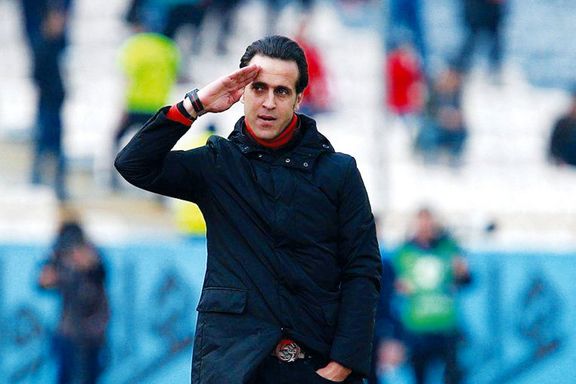
Iranian former football (soccer) star Ali Karimi

Former football star, Ali Karimi, is now a social heavyweight in Iran, with 15 million Instagram followers - no longer as a soccer hero but as a political influencer.

Living in exile in Europe, Karimi became one of the influential voices during anti-regime protests in 2022, using his influence on social media to defend young women and men, who were facing heavily armed vigilante and security forces.

For years, soccer spectators have been loudly chanting his name in stadiums, despite the authorities' disdain for him. His messages prove remarkably effective and influential during critical moments, to the extent that state television hosts have officially insulted him, labeling him as dishonorable and unworthy.

As an example of his style, on January 3, Karimi posted a twelve-word Persian tweet and received 103,000 likes, more than most famous Western politicians can ever dream of. It simply said, “Have you ever seen an honorable and decent person support this regime? I haven’t seen one.”

Ali Karimi, as a social phenomenon, prompts three questions for observers of Iran: How did a soccer player emerge as the voice of opposition in a country where professional soccer is state-owned? Why can't the government simply ignore him? And what are the underlying themes of Karimi's messages that have elevated him to a position of greater influence than even the most renowned artists, politicians, and religious authorities in the country?

100%

Message: expressing the feelings of the main streets

Let's begin with the last question. Ali Karimi has attained an intuitive grasp of conveying the sentiments of ordinary people on the streets, in bazaars, taxis, shops, barbershops, gatherings, and even at funerals. His messages mirror the conversations that take place among people in these everyday settings, resonating like precious gems in their hands. Millions of individuals share and transmit his messages among themselves. He adeptly seizes the moment, creating opportunities for dialogue or progression, and hands the metaphorical ball to the people, allowing them to take shots at the government's policies.

Karimi transmits his messages, often in very brief format, vis social media to people in Iran. The impact that his messages and posts by other activists have among the people is the reason why Iran had blocked almost all global social media platforms. Islamic Republic’s leaders, including its 84-year-old ruler Ali Khamenei detest the Internet and messaging apps mainly for this reason.

Upgrade to the voice of the voiceless

Over a span of 15 years, Ali Karimi evolved into a prominent advocate for the non-elite population in opposition to the government. During the waves of the Green Movement protests in 2009, he was among the players who sported green wristbands during a match against South Korea. Renowned for his dazzling dribbling skills, Karimi enjoys popularity among Iranians and stands as an emblematic figure in Asian soccer. He has harnessed his popularity to engage in charitable endeavors and express his political dissent.

Karimi in 2009 wearing green wristbands to show support for the Green Movement against the government.
100%
Karimi in 2009 wearing green wristbands to show support for the Green Movement against the government.

Karimi gradually transformed from a national soccer star into an influential figure in the national public spotlight. His open criticism of Mohammad Javad Zarif's anti-Israel positions, the ban on women entering stadiums, the role of IRGC commanders in managing soccer in the country, the downing of the Ukrainian airliner in 2020, and the nationwide protests in 2019 gradually made him a civil and political activist.

Government’s concern

The substantial number of followers, reposts, and likes garnered by Karimi's messages in the digital realm, coupled with the fact that there are over 60 million smartphones in the hands of Iranians, has granted him a platform that the government cannot disregard. With the official state radio and television news website receiving approximately just 124,000 monthly visitors, it is evident that authorities are apprehensive about Ali Karimi's influence, and they cannot afford to overlook him. His exceptional reach has prompted the propaganda machinery and government officials to issue threats against him.

Reza Naqipour, deputy head of the presidential office and the former Head of Security of the Football Federation threatened Ali Karimi with the hashtag of "Ruhullah Zam" (journalist, kidnapped in 2019 by IRGC intelligence and executed in 2020). "One day you will return the way that we like, not the way you like!" which means the threat of kidnapping and execution.

This week, Iran’s state television tried to discredit Karimi for a tweet he posted on January 3, following a deadly twin bombing in Kerman, where around 90 people visiting the gravesite of Qasem Soleimani were killed. Karimi said, "Go for free food and drink, but you will get a hard revenge," referring to regime’s policy of feeding people who attend its events. But what officials do not understand is that people receive Karimi's messages directly from him and pay little attention to the government television. Tens of thousands on social media came to his support by posting comments or liking and re-posting other messages.


Most Viewed

Iran negotiators ordered to return after internal rift over Islamabad talks
1
EXCLUSIVE

Iran negotiators ordered to return after internal rift over Islamabad talks

2
ANALYSIS

US blockade enters murky phase as tankers spoof signals and buyers hesitate

3
ANALYSIS

Why the $100 billion Hormuz toll revenue is a myth

4

US tightens financial squeeze on Iran, warns banks over oil money flows

5
ANALYSIS

US blockade targets Iran oil boom amid regional disruption

Banner
Banner

Spotlight

  • Hardliners push Hormuz ‘red line’ as US blockade tests Iran’s leverage
    INSIGHT

    Hardliners push Hormuz ‘red line’ as US blockade tests Iran’s leverage

  • Ideology may be fading in Iran, but not in Kashmir's ‘Mini Iran'
    INSIGHT

    Ideology may be fading in Iran, but not in Kashmir's ‘Mini Iran'

  • War damage amounts to $3,000 per Iranian, with blockade set to add to losses
    INSIGHT

    War damage amounts to $3,000 per Iranian, with blockade set to add to losses

  • Why the $100 billion Hormuz toll revenue is a myth
    ANALYSIS

    Why the $100 billion Hormuz toll revenue is a myth

  • US blockade targets Iran oil boom amid regional disruption
    ANALYSIS

    US blockade targets Iran oil boom amid regional disruption

  • Iran's digital economy battered by prolonged blackout
    INSIGHT

    Iran's digital economy battered by prolonged blackout

•
•
•

More Stories

Iran Faces Severe Drought, Particularly In Tehran Province

Jan 6, 2024, 17:03 GMT+0

The already critical precipitation situation in Iran has significantly deteriorated, especially in Tehran Province, according to a report from the Ministry of Energy.

More than one hundred days into the current water year, nationwide rainfall remains unsatisfactory, with a 44.3% decrease compared to the long-term average.

In Tehran Province, there has been a staggering 67% reduction in precipitation compared to the long-term average for the current water year. The available water volume in the reservoirs of the five dams supplying water to Tehran Province has dropped to less than 300 million cubic meters, posing a significant risk given the current climatic conditions.

Mohsen Ardekani, CEO of Tehran Province Water and Wastewater Company, noted that despite meteorological predictions, this year's autumn rainfall in Tehran has fallen by 55%. He stressed the importance of effective demand and consumption management in securing Tehran's water supply. Ardekani urged citizens in Tehran to actively participate in water consumption management, calling for a 10% reduction in consumption and the avoidance of unnecessary usage to ensure a sustainable water supply in the province.

The persistent drought in Iran has led to criticism of the government's environmental mismanagement. Reports indicate that a quarter of Iran's farmers have lost their livelihoods in the past seven years due to water scarcity, resulting in economic impacts, soil erosion, desertification, and hazardous dust storms affecting approximately half of Iran's population, according to the country's health ministry.

Iranian Christian Convert Faces Imprisonment

Jan 6, 2024, 15:11 GMT+0

A 60-year-old Iranian Christian convert will begin serving a six-year prison sentence for purportedly "acting against national security by promoting 'Zionist' Christianity".

Mina Khajavi was arrested in 2020, and the sentencing took place in 2022, involving two other individuals: Christian convert Malihe Nazari, who received a six-year sentence, and Iranian-Armenian pastor Joseph Shahbazian, sentenced to 10 years.

While Shahbazian and Nazari began serving their sentences a few months later, Khajavi was initially considered unfit for incarceration due to a car accident resulting in a severely broken ankle, necessitating the insertion of metal plates.

Despite enduring ongoing physical challenges, such as walking with a limp and developing arthritis, Khajavi was instructed on January 3, 2024, to report to Evin Prison within five days.

Both Shahbazian and Nazari, convicted on similar charges, secured early release. Shahbazian's sentence was initially reduced to two years by an appeal-court judge citing insufficient evidence under Article 498 of the Islamic Penal Code, related to organizing groups deemed a threat to national security. In September 2023, Shahbazian was fully pardoned and released. Nazari, freed earlier in 2023, reportedly gained her release due to her son's declining health, who was hospitalized with leukemia.

Activists are demanding the immediate and unconditional exoneration of Khajavi, who faces imprisonment solely based on her Christian faith. They are also urging Iran to cease the harassment of the Christian community and adhere to the November 2021 Supreme Court ruling that explicitly stated, "the promotion of Christianity and formation of a house-church is not criminalized in law" and should not be considered a threat to national security.

Biden Defends US Military Action In Iraq

Jan 6, 2024, 12:09 GMT+0

President Joe Biden, in a letter to Congress, has defended the recent air strike carried out by the US military on a headquarters of Iran-backed militias in Iraq.

Biden asserted that the attack was conducted in line with national security and the foreign policy interests of the United States.

“I directed this military action consistent with my responsibility to protect United States citizens both at home and abroad and in furtherance of United States national security and foreign policy interests,” reads the statement from President Biden in his letter on Friday.

In response to the attacks, the Iraqi government declared that the justification for the presence of international coalition forces, led by the US, in the country has come to an end. President Biden, on January 5, emphasized Washington's preparedness for potential further actions.

The US targeted a logistical support center of the Popular Mobilization Forces, an Iranian-backed paramilitary group, in eastern Baghdad on Thursday, resulting in casualties.

The Iraqi Prime Minister's office held the US-led coalition responsible for the attack, asserting that targeting their headquarters weakens agreements and understandings with the coalition.

Amidst the ongoing Middle East conflict following the Israel-Hamas war that began on October 7, Iran's proxy forces in Iraq, Syria, and Yemen have repeatedly targeted US and international interests, as retaliation for Washington’s support for Israel. The current Gaza conflict, initiated by unprecedented attacks by Hamas on Israel, resulted in more than 1,000 civilian casualties. In recent years, Iran-backed groups have carried out drone and missile attacks against American forces and international coalition forces stationed in Iraq and Syria.

Iran Suppresses Dissent Instead Of Preventing Terror, Critics Argue

Jan 6, 2024, 12:08 GMT+0
•
Maryam Sinaiee

Iran's government uses public resources to repress dissidents and to enforce hijab rather than ensuring the safety of borders and citizens, critical voices say.

Those responsible for defending the country and its borders “have strayed from their main responsibility” which has created suitable grounds for terrorists, Heshmatollah Falahatpisheh, the conservative former head of the parliament's National Security and Foreign Relations Committee, told the reformist Etemad newspaper about the January 3 terrorist attack in Kerman that killed at least 90 and injured over 200.

“What happened is that the enemies of Iran and Martyr Soleimani were much more prepared than the security officials inside Iran. While the relevant officials in Kerman were preoccupied with propaganda work, the enemies were doing operational planning,” he added.

“There is very high possibility of incidents like this given that Iran has many enemies,” he said while pointing out that local authorities had also failed in planning for Soleimani’s burial ceremony in January 2020 when a stampede killed around sixty participants and injured over two hundred others.

Veteran politician and regime insider Heshmatollah Falahatpisheh. Undated
100%
Veteran politician and regime insider Heshmatollah Falahatpisheh

In a statement posted on its affiliate Telegram channels Thursday, a branch of the Islamic State (ISIS or Daesh) in Afghanistan claimed responsibility for the explosions. The statement named two suicide bombers as Omar Al-Mohed and Saif Allah Al-Mujahid and said they had detonated their explosive belts in the middle of the crowd, “resulting in the death and injury of more than 300 polytheists”.

Earlier Thursday, the official news agency IRNA had cited an informed source as saying that conclusive evidence, including CCTV footage, indicated that suicide bombing was responsible for the first of the two explosions.

Calling the Iranian government “inefficient and corrupt”, Mahmood Amiry-Moghaddam, director of the Norway-based Iran Human Rights (IRH) criticized the regime for using its resources to persecute people for hijab and dissent instead of guaranteeing their security and warned about an increase in “executions and repression of citizens under the pretext of this terrorist act as in the past.”

Ahmad Zahedi-Langaroudi, a prominent journalist and member of Iran's banned Writers’ Association, in a tweet said the government should be held responsible irrespective of who perpetrated the terrorist attack. "They have employed numerous audacious mercenaries to oppress women. Both provincial and national security and military officials have not only failed to take responsibility, apologize, or resign, but they have also been boasting and deflecting responsibility!" he wrote.

Many on social media accused Iran's own security and intelligence agencies of perpetrating the bombing to buy sympathy for the regime. They claimed Soleimani’s own family and high-ranking Revolutionary Guards (IRGC) officials were warned not to attend the ceremony.

“The government should have at least explained the absence of Qassem Soleimani's family and IRGC commanders at the Kerman ceremony,” Turkmen Sahra, an account dedicated to Iran's Sunni Turkmen region tweeted. “The Kerman scenario is an excuse for executions and new arrests.’

Citing various scenarios after the bombing, an IRGC-linked news agency, Tasnim, had claimed Wednesday that the two bombs in handbags or backpacks that tore through the crowd 300 meters apart were hidden inside trash cans and remotely detonated.

Hardliners including some lawmakers and Kayhan daily, known as the voice of Khamenei, had pointed fingers at Israel while others held the Taliban, and various ethnic militants such as the Baluchi Jundullah responsible for the attack.

In a brief message Wednesday, Supreme Leader Ali Khamenei condemned the attack and threatened a hard response and punishment. Accordingly, banners have sprung up all over Iranian cities promising “hard revenge”.

Iran's Defense Minister Calls For Israelis 'To Leave' The Region

Jan 6, 2024, 09:59 GMT+0

In a radical statement amounting to ethnic cleansing, Iran's Defense Minister, Mohammad-Reza Ashtiani, has asserted that "Israelis must vacate the region."

The defense minister's call is an intensification of Iran's rhetoric against Israel's existence. Previously, officials were targeting "Zionists" but this is the first time a high-ranking person has called for expelling Jews from the region.

Former ultraconservative president Mahmoud Ahmadinejad on a few occasions had called for Europe "to take back" Jews that he said were sent to Palestine by European powers.

The statement appears to be a reaction to the Israeli Defense Minister Yoav Gallant's remark that after the war, Hamas would no longer have control over Gaza. Gallant stated that non-Hamas Palestinians would govern the enclave as long as there was no threat to Israel.

While Supreme Leader Ali Khamenei and other Iranian officials have commended Hamas for initiating the attack on Israel and their goal of eradicating the Jewish state, they deny any direct involvement in the attack. Initially, the Iranian government celebrated the invasion on October 7, praising it and ordering street celebrations. Large banners were erected promptly, suggesting foreknowledge of the attacks, resulting in 1,200 deaths, mostly civilians, and 240 or more taken hostage in Gaza.

However, as the conflict escalated and the US dispatched warships to the region, Tehran officials tempered their public rhetoric. Ali Khamenei, among others, repeatedly denied the Islamic Republic's role in Hamas's attack, stating during a military event in Tehran that "This was carried out by Palestinians themselves."

Many Iranians find it unacceptable that the country's resources are directed toward supporting proxy forces in the region, including those in Lebanon, Palestine, Syria, and Yemen.