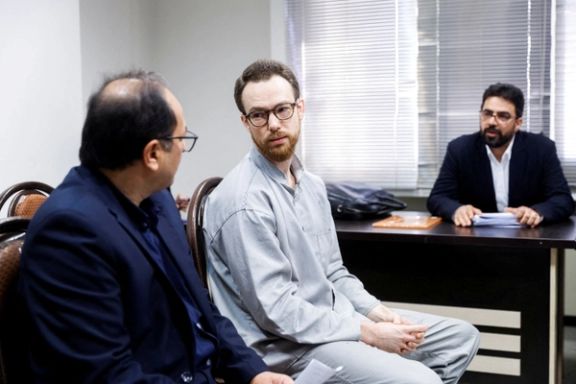
Swedish EU employee Johan Floderus attends a court session in Tehran, Iran, December 10, 2023.
Iran's foreign ministry says there is “sufficient evidence” for the charge of espionage brought against a Swedish EU diplomat whose trial began in Tehran Saturday.
Iran's judiciary on Sunday accused Johan Niels Floderus, a 33-year-old Swedish citizen and EU diplomat of extensive intelligence collaboration with Israel against the Islamic Republic.
The foreign ministry spokesman Naser Kanaani on Monday backed the hardliner Judiciary that has accused other foreigners in the past for similar crimes. Kanaani insisted that charges and crimes committed by Floderus have been clearly defined by the judiciary and sufficient evidence has been provided.
However, similar trials against foreigners in the past were held behind closed doors, without due process of law.
Judicial process will be followed in Floderus’ case, Kanaani said, implying that there could be no intervention by the foreign ministry or other authorities to secure his release from prison. “The judiciary will perform its duties as an independent authority,” he said.
Swedish EU employee Johan Floderus attends a court session in Tehran, Iran, December 10, 2023.
Kanaani added that the Swedish government has been informed of the details of the case, but there is no evidence of that.
“The defendant has been active against the Islamic Republic of Iran in the field of information collection for the benefit of the Zionist regime in the form of subversive projects conducted by well-known American, Israeli and European institutions active in this area,” a statement by the prosecutor read at the first session of Floderus’ trial Sunday alleged.
The prosecutor has demanded sentencing Floderus in accordance with article 286 of Iran's Islamic Penal Code. This article stipulates that anyone found guilty of extensive crimes against the Islamic Republic’s domestic or international security leading to “serious disruption in public order and security in the country” should be sentenced to death for “corruption on earth”.
"Johan Floderus has been arbitrarily detained and every accusation and charge is false," a spokesperson for Sweden's foreign ministry said in an emailed comment to Reuters on Sunday.
Top EU foreign policy chief Josep Borrell also urged Iran on Sunday to free Floderus immediately. "I persistently raise the case at every occasion and contact with the Iranian authorities, since his detention, requesting his liberation," he said.
"We are seeking clarification and more information from them, in closest coordination with the Swedish authorities who bear the consular responsibility," he added.
Many believe that the Swedish EU diplomat whose family and friends say was on holiday in Iran is a victim of the Islamic Republic’s ‘hostage policy’.
The Islamic Republic has widely been accused of routinely arresting foreigners and dual citizens to use them as bargaining chips against Western countries and can demand the release of its own nationals held in Sweden such as Hamid Nouri, a former deputy prosecutor, in return for freeing Floderus, a citizen of Sweden and the European Union in danger of execution.
Nouri is serving a life sentence in Sweden for human rights violations as a prison official in 1980s when thousands of detainees were hanged in Iranian prisons after summary trials that sometimes lasted only minutes.
Iran's judiciary recently called on Swedish authorities to ensure “fair and appropriate procedures” regarding Nouri’s appeal which started in January. The verdict of the appeals court is scheduled to be announced on December 19.
The unfreezing of $6b by the United States a few months ago was widely interpreted as the cost of freeing five American-Iranian hostages that Iran had held for several years.
Floderus, who previously worked on the Afghanistan desk of the EU’s external services department, was detained on April 17, 2022, at Tehran’s Imam Khomeini Airport while waiting to depart Iran.
He was covertly detained for over 500 days before a report by The New York Times in September brought his circumstances to public attention. .
The fall in mosque attendance in Iran is now “highly alarming”, according to a senior government minister.
Speaking on Tuesday, Minister of Culture Mohammad Mehdi Esmaili was commenting on the number of active mosques, which figures earlier this year revealed have gone down by a third.
He said: "Today, the figures and statistics circulating regarding active mosques are highly alarming. Active mosques are not merely places where congregational prayers are held three times a day. It seems a significant number of our mosques lack even this minimal function."
His remarks come at a time when Iranians are increasingly critical of the regime's alignment with Islam, with protests erupting since September 2022 following the death of Mahsa Amini in custody for a hijab-related offense.
In February, a senior Iranian cleric, Mohammad Abolghassem Doulabi, revealed that 50,000 out of 75,000 mosques nationwide had been closed due to a significant decline in attendance. Doulabi, an intermediary between President Ebrahim Raisi's administration and the country's seminaries, expressed concern over the fall and its implications for a state founded on Islamic principles.
Also a member of the influential Assembly of Experts, Doulabi suggested that the way in which Islamic practices are enforced in Iran have led to people distancing themselves from religion. He highlighted factors including "the humiliation of people in the name of religion," "falsification of religious concepts and teachings," and "depriving people of a decent life and creating poverty in the name of religion" as reasons for the decline.
The minister of culture had called for more mosque-based events in August to rekindle faith and draw Iranians back to mosques. Esmaili said: "The majority of cultural and artistic activities should take place in mosques."
Participants listening to President Ebrahim Raisi’s speech at the Iranian Economy Conference in Tehran (December 2023)
The scale of the latest financial corruption case in Iran has been so huge that officials and media see no harm in revealing and discussing previous cases.
Faraz daily and Rouydad24 are only two of the well-informed and well-connected Iranian news websites that have offered timelines and background on major cases of financial corruption in Iran since 1979.
However, both websites have carefully stated that there were no instances of corruption during Prime Minister Mir-Hossein Mousavi's tenure in the 1980s. This cautious stance is understandable because Mousavi served as the Prime Minister under President Ali Khamenei from 1981 to 1989. Khamenei has held the position of Iran's Supreme Leader for more than three decades, and he has been officially portrayed as being as pure as saints and angels. Consequently, it may seem inconceivable for corruption to have occurred under his leadership. Nonetheless, as the Supreme Leader, he bears ultimate responsibility for any corruption within his regime and should be held accountable for it.
Rouydad24 has listed 12 major cases of financial corruption with a total value of $94.3 billion. Just to keep the list short, Rouydad did not cover embezzlements under $500 million. According to Rouydad, there is at least one court hearing about a corruption case in Iran every month.
An infographic representing large-scale corruption cases in Iran
The total value of the 12 cases covered by Rouydad24 is twice as much as the total budget of all of Iran's government-owned companies in 2021. The most important characteristic of these cases (from 2011 to 2023) is lack of transparency. The website wrote that no one knows what became of the case involving Former President Mahmoud Ahmadinejad's vice president and the case involving former President Hassan Rouhani's brother.
Just to make the cases more ambiguous, the Iranian judiciary mentions the amount of money involved in each case in Iranian currency rial, or in US dollars or in Euros. Sometimes there is a mixture of these currencies only to make it worse for journalists and their readers.
The biggest cases among the 12, are the $59 billion embezzlement in Padideh Company (2013), the $11 billion case at the Petrochemical Industries (2019), the 5.3 billion Tat Bank case (2018), and the $3.3 billion corruption case in Debsh Tea Company (2023).
According to Rouydad24, most of these cases are linked to the international sanctions against Iran. For instance, the Petrochemical Industries case is about individuals and companies who circumvented the sanctions on behalf of the Iranian government, but pocketed hundreds of millions of dollars.
The website noted that there is no difference between successive Iranian governments in the past two decades as these cases date back to the governments of Presidents Ahmadinejad, Hassan Rouhani and Ebrahim Raisi. A majority of those involved in these have fled the country.
According to Faraz Daily, which offers different figures, the extent of embezzlements under Prime Minister Mousavi (President Khamenei) was zero, while $3.5 million dollars was embezzled under President Akbar Hashemi Rafsanjani, $5 billion under President Mohammad Khatami, $16.7 billion under President Mahmoud Ahmadinejad, $2.7 million under President Hassan Rouhani, and $3.3 billion under President Ebrahim Raisi.
Interestingly, the cases mentioned by Faraz Daily, which is closer to the Iranian regime, add up to just over $20 billion, that is more than $70 billion less than the amount quoted by Rouydad for a shorter period of time.
In a report by Khabar Online shedding light on corruption and financial irregularities during President Ahmadinejad's tenure, Iran's former ambassador to Baku, Afshar Soleimani, has revealed shocking details. According to Soleimani, Ahmadinejad and his associate, Sadeq Mahsouli (currently the leader of the ultraconservative Paydari party), were allegedly transporting dollars acquired from oil swaps with the Republic of Azerbaijan in suitcases. Furthermore, Soleimani asserted that approximately 90 percent of Mahsouli's fabled wealth can be traced back to his involvement in the oil swap project.
Afsoon Najafi (left), the sister of slain protester Hadis Najafi, and Saleh Nikbakht, the lawyer of Mahsa Amini's family during the European Parliament Sakharov Prize ceremony in Strasbourg, eastern France, December 12, 2023
Mahsa Amini was given the 2023 Sakharov Prize for Freedom of Thought posthumously at a ceremony in Strasbourg on Tuesday.
The European Parliament awarded the prestigious prize to both the student who was killed by Iranian police, and the Woman Life, Freedom protest movement.
Saleh Nikbakht, an academic and lawyer representing Mahsa Amini's family, along with Afsoon Najafi, and Mersedeh Shahinkar, Iranian women's rights defenders who left Iran in 2023, stood as representatives for the laureates.
Opening the award ceremony, European Parliament President Roberta Metsola announced: “This years’ Sakharov prize… serves as a tribute to all the brave and defiant women, men and young people in Iran, who despite coming under increasing pressure, are continuing the fight for their rights and push for change.ʺ
On September 13, 2022, Mahsa, a 22-year-old Iranian Kurdish woman, was apprehended by Tehran police for purportedly defying Iran's mandatory hijab. She succumbed to injuries inflicted during her time in custody, dying in the hospital three days later.
The death of Amini sparked nationwide protests predominantly led by women.
En route to France to accept the Sakharov Prize for Freedom of Thought on December 8, the parents and brother of Amini were met by a roadblock at Tehran airport where Iranian authorities halted them and confiscated their passports.
In Strasbourg, the family was represented by their attorney, Saleh Nikbakht, who relayed a message from Amini's mother, Mozhgan Eftekhari saying: “Mahsa’s grief is eternal to me, and she is undying for people all over the world. I firmly believe that her name, beside that of Joan of Arc, will remain a symbol of freedom.”
Established in 1988, the Sakharov Prize for Freedom of Thought, named in honor of Soviet physicist and political dissident Andrei Sakharov, is awarded each year by the European Parliament to honor individuals and organizations defending human rights and fundamental freedoms.
Iran's top Sunni cleric Mowlavi Abdolhamid during a religious graduation ceremony in Zahedan
Iranian security forces have raided two Sunni schools in Zahedan and arrested tens of students from the religious minority.
Mowlavi Abdolhamid, the outspoken Friday Prayers Imam of Zahedan, denounced the attack in a tweet on Monday night, calling it a "provocative move by military and security forces" of the Islamic Republic.
He said "dozens of religious students" were arrested during the raid, which he claimed shows that provincial authorities are not genuinely concerned about the peace of the people in the province.
Halvash, a news outlet covering the province, has reported the detention of "at least 253 students."
The “pretext” for the raids was the “expulsion of foreign nations”, according to a statement from the Zahedan Seminary Teachers' Society.
The authorities of the Islamic Republic have not yet issued a response to the reports.
Over the past four decades, the Islamic Republic has imposed extensive restrictions on religious minorities in Iran, including Sunni communities.
Mowlavi Abdolhamid had previously criticized the Islamic Republic for prohibiting the establishment of Sunni mosques in major cities in Iran. He has also expressed support for the nationwide protests titled Woman, Life, Freedom over the past year, a stance that has provoked discontent from the authorities of the Islamic Republic.
Iran’s Supreme Leader Ali Khamenei in a meeting with Turkish President Recep Tayyip Erdogan with President Ebrahim Raisi in attendance, Tehran, July 19, 2022
The Islamic Republic in Iran and the Erdogan regime in Turkey act with remarkable similarity in using religion to gain loyal followers in the West.
What the Shiite regime in Iran did over four decades to make religious institutions state-owned entities with success, Atatürk did in a secular regime and made all religious institutions officially state-owned by establishing the Department of Religion (1924).
The Grand Mufti of Turkey is appointed by the executive branch. Diyanet organization has more than 150 thousand employees and about two billion dollars of government budget. The imams of around 85,000 mosques in Turkey and 2,000 mosques abroad (under the supervision of this department) are recruited by this organization and the contents of their speeches are also sent weekly, which is done in Iran by the Friday Prayer Office in Tehran.
Until the 1970s, the Diyanet organization operated within Turkey, but after that, it expanded its network to countries with Turkish immigrants. Since the 1990s and with the rise of the Islamists, this organization has expanded its facilities and staff and received tremendous funding by quadrupling its budget in one decade. It has become a tool for expanding Turkey's ideological, political, and even security sphere of influence in the Balkan Peninsula, Central Asia, Western Europe, and the United States. Thus, civil and independent religion neither exists in Iran under the Islamist regime nor in Turkey under the Erdogan regime.
When the government claims to promote religion as a tool to shape social and political life, and religion is a means of gaining and maintaining power, it harms both religion and the state. It is for this reason that the behavior of the Khamenei and Erdogan regimes in using religious institutions to consolidate their power and expand their influence are very similar, while they operate in two different political systems.
Worshippers attend Friday prayers outside Hagia Sophia Grand Mosque in Istanbul, Turkey August 7, 2020.
When religious institutions become state-owned, religion becomes a tool of power and it doesn't matter if you have an Islamist or a secular political system. This is why the Diyanet organization acts in the same way as the Mustafa University and the Shiite regime's Islamic Culture and Communication Organization in terms of political-religious propaganda abroad. Erdogan and Khamenei are acting in the same way in financing and expanding religious institutions worldwide. They have formed a network of mosques and religious centers that serve as venues for the gathering of religious followers who are residents of other countries. Using their religious networks these governments promote their political and ideological agendas.
It is important to pay attention to the organizational structure, funding, and programs of these centers. Turkey's state mosques are managed in the US by an organization called "Dyianet Center of America" with its headquarters in Maryland and its 29 mosques scattered all over the United States. The Dyianet Center of America website mentions these mosques under the title of its branches. As of 2018, Diyanet was operating in 36 countries with 61 branches.
All the Turks who attend the mosques linked to Diyanet Center of America did not immigrate to America from Turkey, but some of them immigrated to the United States from countries such as Georgia, Russia, Ukraine, Kazakhstan, and Azerbaijan. What brings these people together is their religious orientation and cultural background. Using the tendency of these Turkish-speaking peoples to worship and congregate, the Turkish government subjects them to political propaganda and buys their loyalty.
The budget for the construction, maintenance, and programs of thousands of mosques affiliated with the Diyanet Center of America and European countries is provided by the Turkish government; missionaries and managers of these centers are sent by the government and receive government salaries, and all programs are approved, funded, and implemented by the Turkish government. Any program that does not fit into the government’s political Islam agenda and the expansion of its influence in the world (especially in Western countries where there is freedom of religion) is not tolerated and immediately canceled in these centers and mosques.
The Diyanet- and the government which manages it- see Islam as one of the features of the identity of Turkish citizens living abroad. The macro-political strategy of Erdogan and Khamenei regimes is to rebuild Ottoman and Iranian empires with a cover of Islamism based on a mixture of religious beliefs and national-historical pride. Therefore, Diyanet is “committed to protecting the Muslims’ religious and cultural roots in the face of assimilationist policies.” Based on this statement, Turkish diaspora’s integration into host societies is something that should never happen.
Due to the author’s observations in mosques under the administration of Diyanet in the New York/New Jersey area, the authority and legitimacy of the political regime of Turkish Islamists are promoted in three ways:
1. The presence of political officials of the regime in religious ceremonies and giving prizes to children and financing religious centers and mosques with public resources;
2. Using these mosques and centers for political mobilization in favor of the government in areas such as voting for the ruling party candidates in elections; and
3. Recruiting forces for networking, gathering information from the opposition, and distributing positions, rents, and facilities available to the government.
President Tayyip Erdogan and Head of Turkey's Directorate of Religious Affairs Ali Erbas pray as they stand next to the President of Court of Cassation Mehmet Akarca during the opening ceremony of a top judicial court building in Ankara, Turkey, September 1, 2021
The activities of the Turkish Directorate of Religious Affairs (Diyanet Isleri Baskanligi) are based on multi-purpose missions. The main mission is to promote Sunni Islam, but without other missions, this department would not have expanded to this extent it has and would not have received huge funding.
The main content of religious centers and mosques is holding religious ceremonies (such as Friday and congregational prayers, Eid al-Adha and Fitr, and the celebration of the birth of the Prophet), delivering various religious services such as Hajj and Umrah as well as various religious educational activities for Turkish migrants, children's religious education (recitation of the Qur'an, the principles of religion) and the establishment of religious classes and schools (for the teaching of jurisprudence and theology). What is really presented in this content is a kind of political perception of Islam and injecting it into the minds of Muslim children to internalize the ideology of political Islam. It is used as a tool for Turkey’s propaganda and indoctrination. The main discourse of the content of these programs is not human rights articles based on the equality of rights of all people, including men and women, Kurds and Turks, Muslims and non-Muslims, homosexuals, and non-homosexuals.
There have been accusations of Diyanet personnel gathering intelligence and spying on behalf of the Turkish state. In January 2017, the Turkish-Islamic Union for Religious Affairs (DİTİB) admitted that some of its imams in Europe had spied for the Turkish government and supplied Ankara with intelligence on people supposedly linked to the Gülen movement, a religious group the Turkish government accuses of masterminding a coup attempt in July 2016.