• العربية
  • فارسی
Brand
  • Iran Insight
  • Politics
  • Economy
  • Analysis
  • Special Report
  • Opinion
  • Podcast
  • Iran Insight
  • Politics
  • Economy
  • Analysis
  • Special Report
  • Opinion
  • Podcast
  • Theme
  • Language
    • العربية
    • فارسی
  • Iran Insight
  • Politics
  • Economy
  • Analysis
  • Special Report
  • Opinion
  • Podcast
All rights reserved for Volant Media UK Limited
volant media logo

Iran Hangs Former Leader Of Separatist Group, A Swedish Dual National

Maryam Sinaiee
Maryam Sinaiee

Iran International

May 6, 2023, 10:24 GMT+1Updated: 17:41 GMT+1
Separatist activist Habib Chaab (Asyud) during his trial. Undated

Iran has executed Iranian-Swedish political activist and former leader of the Arab Struggle Movement for the Liberation of Ahwaz (ASMLA) Habib Chaab (Asyud).
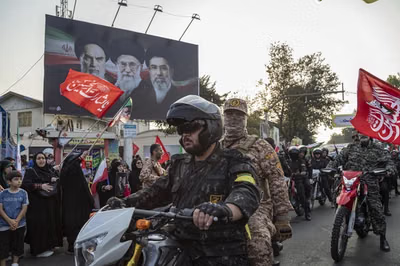

The judiciary said in a statement published by Mizan News, its official news website, that the execution sentence for “corruption on earth” passed on Chaab in 2022 was carried out Saturday morning. The judiciary had announced the confirmation of the death sentence on March 12.

Chaab, 49, was put on trial by a revolutionary court in Tehran in December. He was not allowed to choose his own defense attorney and was represented in his trial by a court-appointed lawyer. He was also forced under duress to make self-incriminating confessions.

Iranian authorities say Chaab was found guilty for leading ASMLA (Harakat al-Nidal in Arabic), a movement which advocates the separation of southwestern Khuzestan Province and for plotting "numerous bombings and terrorist operations" in the oil-rich province with a large Arabic speaking population.

Tehran classifies the ASMLA as a ‘terrorist’ organization responsible for acts of terror including an attack on a military parade in Ahvaz on September 22, 2018, which killed 25 military and civilians. ASMLA accepted responsibility for the bombing.

Iranian authorities accused Chaab of receiving funding for the operations of the rebel group from Saudi Arabia and claimed that he was “protected” by Israel’s Mossad and the Swedish intelligence (SAPO). The prosecution also claimed that other ASMLA leaders are based in other European countries, namely Denmark, Sweden and the Netherlands.

An undated photo of Chaab before his abduction by Iranian intelligence
100%
An undated photo of Chaab before his abduction by Iranian intelligence

On March 14 2022, a day after the confirmation of Chaab’s death sentence, Sweden summoned Iran's ambassador to the Ministry for Foreign Affairs “to receive Sweden’s protest against the death penalty issued against detained Swedish citizen Habib Chaab.”

“The Government has demanded that the death penalty not be enforced and recalled the EU’s common position, which condemns all use of the death penalty, wherever it is applied. The Ministry has also reiterated its demand for consular access to Mr. Chaab, which Minister for Foreign Affairs Tobias Billström had also previously conveyed to Iran’s Minister of Foreign Affairs,” the Swedish foreign ministry said in a statement at the time.

Iran's relations with Sweden have been strained since July 2022 when a Swedish court sentenced a former Iranian jailor, Hamid Nouri, to life imprisonment over executions of political prisoners in 1988.

Iran's foreign ministry spokesman Naser Kanani in a statement “strongly condemned” the Swedish court’s “politically-motivated and unacceptable” verdict against Nouri, saying the Stockholm government would be responsible for the damage the verdict would cause in bilateral relations.

In November 2020, a few days after ASMLA told Al Arabia that its leader was abducted in Turkey by Iranian security forces during a visit, Iran’s intelligence ministry issued a statement confirming that Chaab had been captured outside Iran and taken to Tehran, without mentioning where he was captured.

Ankara said in December 2020, when relations with Iran were tense just after the Nagorno-Karabakh war between Azerbaijan and Armenia, that it had arrested 13 people led by an Iranian for operations including assisting Iranian security forces in the abduction of Chaab in October of the same year on Turkish soil and delivering him to Tehran.

In March, Iran's judiciary said the Revolutionary Court of Ahvaz had sentenced six Arab activists to death for the killing of two Basij militia members, a policeman, and a conscripted soldier in two separate operations. Six others received long prison terms between 5 to 35 years by the same court. The accused belonged to the armed branch of ASMLA, the judiciary said, adding that the sentences could be appealed.

Most Viewed

Iran negotiators ordered to return after internal rift over Islamabad talks
1
EXCLUSIVE

Iran negotiators ordered to return after internal rift over Islamabad talks

2
ANALYSIS

US blockade enters murky phase as tankers spoof signals and buyers hesitate

3
ANALYSIS

Why the $100 billion Hormuz toll revenue is a myth

4

US tightens financial squeeze on Iran, warns banks over oil money flows

5
ANALYSIS

US blockade targets Iran oil boom amid regional disruption

Banner
Banner

Spotlight

  • Hardliners push Hormuz ‘red line’ as US blockade tests Iran’s leverage
    INSIGHT

    Hardliners push Hormuz ‘red line’ as US blockade tests Iran’s leverage

  • Ideology may be fading in Iran, but not in Kashmir's ‘Mini Iran'
    INSIGHT

    Ideology may be fading in Iran, but not in Kashmir's ‘Mini Iran'

  • War damage amounts to $3,000 per Iranian, with blockade set to add to losses
    INSIGHT

    War damage amounts to $3,000 per Iranian, with blockade set to add to losses

  • Why the $100 billion Hormuz toll revenue is a myth
    ANALYSIS

    Why the $100 billion Hormuz toll revenue is a myth

  • US blockade targets Iran oil boom amid regional disruption
    ANALYSIS

    US blockade targets Iran oil boom amid regional disruption

  • Iran's digital economy battered by prolonged blackout
    INSIGHT

    Iran's digital economy battered by prolonged blackout

•
•
•

More Stories

Sociologists Say Many Iranians Lost Hope, Facing Perpetual Crises

May 6, 2023, 06:51 GMT+1
•
Iran International Newsroom

A Sociologist says that Iranian society is suffering from a deep sense of injustice, inequality, being entangled in a political impasse and worried about the future. 

Political bottlenecks and crises are causing troubles for everyone, Hadi Khaniki told Etemad Online Thursday. But all this can hopefully lead to some kind of renovation and rejuvenation, he added. "In other words, there is hope in some kind of transformation." 

Meanwhile, another prominent Iranian sociologist, Mohammad Fazeli, says "man needs to understand plurality in order to create hope." Referring to a turbulent period since September, he said, "As new dimensions in the relations between the government and the people became evident during the past year, Iran experienced a lot of days full of hope and despair."

Sociologist Hadi Khaniki (undated)
100%
Sociologist Hadi Khaniki

In a sense, said Fazeli, Iranians were looking for their lost rights during the 2022 protests. He explained that society continues to live on a series of fault lines which reinforce each other. There is an economic fault line which has been activated because of various sanctions imposed on Iran. Citizens experienced deep economic problems in the 2010s with the economic growth flat, amid rising inflation. 

At the same time, there has also been a social fault line. Between 84 to 86 percent of Iranians were born during the years after the 1979 Islamic revolution. They have been living with a different value system. In the meantime, new values have emerged, and many Iranians believe in those new values. 

Fazeli was referring to the new generation rejecting the clerical regime’s interference in their personal lives, and their higher awareness of conditions in other countries.

Still at the same time, there is another fault line that has emerged as a result of the government's inefficiency, which has created a host of unresolved problems the population has to deal with. 

The people see that the problems with environment, water, transportation, brain drain and immigration, rising inflation and so on have never been solved. At the same time, people are concerned about Iran’s rising tensions with the world. 

“This is a society that lives with the tension of an uncertain future which could potentially lead to a popular revolt. Even if you failed to see this in the 2000's, you must have seen and felt it during the crises of mid 2010s. If not, you could not miss it during the protests since 2018. In that year, I called the Iranian society "a society that has lost everything it used to have," Fazeli said.

One person lost his hope, another one lost his job or business, yet another one lost the hope for living in a better world while others felt they have lost the lifestyle they were used to. Every one of them represented a large part of the Iranian society. 

Even the religious people thought they lost something when they saw that commitment to religious values have declined. 

Iranian sociologist, Mohammad Fazeli (undated)
100%
Iranian sociologist, Mohammad Fazeli

Fazeli reiterated that the critical situation in Iran is caused by a series of crises as they have all converged at the same time and at the same point. He explained that in every society there are satisfied people and those who are disenchanted. But when dissidents dramatically outnumber those who are happy, then a serious political crisis will emerge. 

"I saw a research paper recently in which some 24 percent of the population said their financial situation had improved during the past two years, more than 60 percent said their situation has worsened and a small number said there has been no difference for them. When the number of those who are dissatisfied is three times more, there is trouble on the horizon. 

Referring to the government’s inability to deal with multiple crises he said, "If you are not improving the situation, you cannot tell the people that they have to tolerate it. The people might listen to you only if you are prepared to give something to them. And let us note that their threshold of tolerance now is extremely low."

US Commission, Special Envoy Condemn Possible Executions In Iran

May 6, 2023, 00:01 GMT+1

US Commission on International Religious Freedom (USCIRF) is outraged over reports that Iran may execute two political prisoners for “insulting the prophet."

Yousef Mehrad and Sadrollah Fazeli-Zare', jailed for insulting religious entities in Arak prison, were transferred to solitary confinement, raising fears their execution was imminent.

USCIRF Commissioner Sharon Kleinbaum tweeted Friday, “USCIRF is outraged and alarmed by indications that Iran may imminently execute Yusef Mehrdad and Seyyed Sadrullah Fazeli Zare in the religious charge of ‘insulting the Prophet.’ Execution for blasphemy is a grave violation of religious freedom.”

UNCIRF is an independent, bipartisan federal government entity that monitors and reports on threats to religious freedom.

US Special Envoy for Iran Robert Malley echoed the statement in a tweet, expressing his outrage. “Iran must stop persecuting and killing people for exercising their freedom of religion.

Mehrad, father of three, and Fazeli-Zare' were arrested in May 2020 over blasphemy-related charges after authorities accused them and five others of being a member of a Telegram channel entitled "Critique of Superstition and Religion." Members of the group reportedly expressed opinions about Islam and its Prophet Muhammad that were deemed insulting by the Islamic Republic.

In April 2021, Branch 1 of the Arak Criminal Court sentenced Mehrad and Fazeli-Zare' to death for "insulting Islamic sanctities" and "insulting the Prophet".
In June 2021, the Arak Revolutionary Court reportedly sentenced Mehrdad to eight years in prison in a separate criminal case for "propaganda against the state", "founding or leading an organization that aims to disrupt national security", and “insulting the Supreme Leader”.

Israel Hoping For Breakthrough With Saudis During US Security Advisor Visit

May 5, 2023, 23:36 GMT+1

Israel is hoping for a breakthrough this weekend in efforts to normalize ties with Saudi Arabia during US national security adviser Jake Sullivan's visit there, a senior security official said on Friday.

The head of Israel's National Security Council, Tzachi Hanegbi, spoke on Wednesday with his counterpart Sullivan, who is set to travel to Saudi Arabia on Saturday. Sullivan is expected to meet with Saudi Crown Prince Mohammed bin Salman, Hanegbi said.

Announcing his trip on Thursday, Sullivan said Washington was working hard to normalize relations between Israel and Saudi Arabia - a major goal set by Israeli Prime Minister Benjamin Netanyahu who briefly joined Sullivan's video call with Hanegbi.

"We are very, very hopeful that there will be a breakthrough during his visit there," Hanegbi told Reshet 13 News.

Asked whether a breakthrough would be a phone call between Saudi leaders and Netanyahu, Hangebi said: "There are those who say that there have been more than phone calls between Saudi and Israeli leaders. But what is important is that the United States lead a move adding Saudi Arabia to the Abraham Accords - normalization and peace with Israel. If that happens it will be a historic turning point."

The US in 2020 brokered the historic Abraham Accords deal, which included the normalization of diplomatic relations between the United Arab Emirates and Bahrain with Israel, all of which share security fears over Iran.

While Riyadh signaled approval of the accords, it has held off on following suit, saying Palestinian goals for statehood should be addressed first.

Any such prospects have been clouded, however, by Riyadh's strains with US President Joe Biden, its recent fence-mending with regional rival Iran, and the rise of Netanyahu's hard-right Israeli government.

Report by Reuters

Economists Warn About Iran’s Pension Fund Bankruptcy

May 5, 2023, 19:37 GMT+1
•
Iran International Newsroom

An Iranian official was fired after he said this week the government may have to sell a few islands and the oil-rich Khuzestan Province to pay the pensioners.

The director general of social insurance in Iran’s Ministry of Labor, Sajjad Badamforoush, said: “Even if we sell two to three million barrels of oil with sanctions removed, we still cannot solve the pensioners' issues."

Although most observers in Iran took the director's statement with a pinch of salt as typical Iranian exaggeration, yet, what he said shed light on the fact that the country's Pension Fund, once one of the richest institutions in Iran is on the verge of bankruptcy because of corruption and mismanagement.

Iran’s Social Security Organization is a public institution that provides health insurance, pension and unemployment benefits to its members. They range from workers and government employees to self-employed individuals. More than half the population receive some type of benefit from the organization.

The official said that not only the Pension Fund is unable to pay the pensioners, it also does not have enough resources to cover its debts to domestic and foreign creditors. 

Iranian economist Ahmad Maydari noted that the idea of selling islands to make up for the Pension Fund's deficits comes as a movie based on a true story that took place in Greece. This, he said cannot happen Iran. Instead, he suggested that the government needs to change the laws that allow ad hoc withdrawals from the fund. 

Iranian economist Ahmad Maydari (undated)
100%
Iranian economist Ahmad Maydari

Lawmaker Mohsen Pirhadi has said that 15 percent of this year's budget will be spent on the repayment of loans taken by the Pension Fund. 

A pessimistic report in Rouydad24 website, however, pointed out that the crisis concerning the Pension Fund will paralyze Iran and will plunge its economy into a new crisis in less than two decades. 

A former chief of the Pension Fund, Mahmoud Eslamian says the problem is the result of successive governments failing to pay social security premiums to the fund for tens of millions of people. 

What the presidential administrations have done with the massive amount of money is not clear. One observer likened the problem to a clock bomb that will surprise everyone when it is detonated. 

A former vice-president under President Hassan Rouhani said 8 years ago that the problem of the Pension Fund is one Iran's three major looming crises along with water shortage and damage to the environment. 

However, most officials who speak about the problem ignore corruption and mismanagement as the underlying reason for waste and embezzlement of financial resources. 

One thing which is clear, political appointees, especially since the presidency of populist Mahmoud Ahmadinejad, invested funds in Iran’s state-controlled unprofitable companies managed by cronies, with a high potential of corruption.

Economist Mohammad Khoshchehreh accused Iranian officials for delaying the crisis rather than solving it for decades. "They did not solve a small problem and instead simply watched it as it grew into a major crisis," said Khoshchehreh, adding that it is now turning into a super crisis. The economist pointed out that solving this crisis needs efficient strategic management.

Economist Mohammad Khoshchehreh (undated)
100%
Economist Mohammad Khoshchehreh

A quick temporary solution is increasing the age of retirement, he said, noting like many others that some Iranians retire even between the ages of 40 and 50 and that adds more burden on the Pension Fund. 

Labor market specialist Hamid haji Esmaili got closer to the main problem and told Khabar Online that political appointees are using the Pension Fund as their personal backyard, referring to past scandals about government officials channelling funds to the wrong direction for personal or political gain. This crisis, he warned, will ruin all of the country's economic structures. 

Meanwhile, Haji Esmaili observed that part of the current crisis would have not happened if the government was not facing a budget deficit and did not have to put its fingers in the pensioners' pockets. He regretted that "Unfortunately, like its predecessors, the current government has no plans whatsoever to tackle the problem." 

Iran Expels Four Azerbaijani Diplomats In Retaliatory Measure

May 5, 2023, 17:31 GMT+1

The Islamic Republic has expelled four Azerbaijani diplomats as tensions simmer between Tehran and Baku.

The Iranian state news agency IRNA reported the move on Friday, saying that four diplomats in Tehran and Tabriz have been declared as “persona non grata” and should leave the country immediately.

Describing the measure as a tit-for-tat action, the report said it was a response to Azerbaijan's expelling four Iranian diplomats in early April.

Azerbaijan had said it was expelling the Iranian diplomats over "provocative actions" referring to a series of actions in recent months including military exercises carried out by Iran's armed forces on the border. Baku's decision was announced shortly after it arrested six Iran-funded agents accused of a coup plot.

In January, a gun attack at the Azerbaijan embassy in Tehran left one man dead and last month, there was an attempted murder by what is believed to be an Iranian cell, of Azerbaijani MP, Fazil Mustafa.

The move was seen in part due to Baku's improving relations with Tehran's archnemesis Israel, the dispute spiking when Baku opened an embassy in Israel in late March, slammed by Iran as an anti-Iranian move, a claim denied by Azerbaijan.

Tehran accuses Baku of harboring Israeli intelligence and military elements that plan to use its territory in a possible attack against Iran’s nuclear installations.

Around a quarter of Iran’s population is Azari, with analysts and activists disagreeing over the closeness of their cultural and linguistic links to their neighbors to the north.