• العربية
  • فارسی
Brand
  • Iran Insight
  • Politics
  • Economy
  • Analysis
  • Special Report
  • Opinion
  • Podcast
  • Iran Insight
  • Politics
  • Economy
  • Analysis
  • Special Report
  • Opinion
  • Podcast
  • Theme
  • Language
    • العربية
    • فارسی
  • Iran Insight
  • Politics
  • Economy
  • Analysis
  • Special Report
  • Opinion
  • Podcast
All rights reserved for Volant Media UK Limited
volant media logo

Renowned Iranian Filmmaker Tragically Takes His Own Life
Iran International Newsroom
Apr 5, 2023, 20:24 GMT+1Updated: 17:46 GMT+1
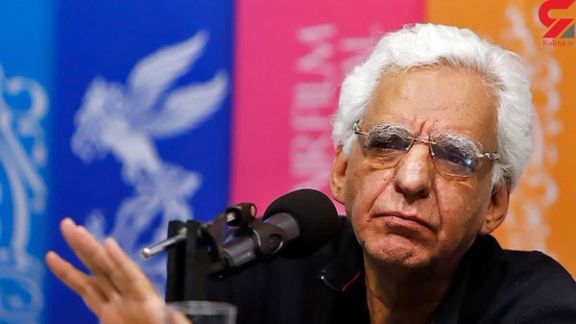
Iranian filmmaker Kyumars Pour-Ahmad

A popular and highly respected Iranian film director, Kyumars Pour-Ahmad, 74, has tragically taken his own life.

The news comes amid reports of the cultural icon’s sense of hopelessness in the face of the country’s dire political and economic situation having led to his death.

Pour-Ahmad had described the popular protests that started last September as “bloody and painful” and wrote: “With all the scorching we have on our souls, what festival, what festivity?”

Initially, reports had claimed Pour-Ahmad died of a heart failure, but the Iranian magazine, Today’s Film, reported that he ended his life because of “depression, despair, the feeling of uselessness and lack of hope in future. Simply so terrible, unbelievable, horrible and shocking,” citing sources close to the star.

The verdict of the 74-year-old’s suicide was ruled by Mehdi Fallahmiri, the prosecutor in northern Gilan Province, who initially dispatched a murder investigation team on hearing the news of Pour-Ahmad's death.

Though the suicided was confirmed, Fallahmiri said “further investigation” is needed. The body has been transferred to the coroner’s office.

Unconfirmed reports say that he left an eight-page letter explaining his decision. However, the content of the note has not been disclosed.

Mehdi Kouhian, an attorney who has been close to the legal cases of detained artists during recent protests recently warned of the toll the unrest and subsequent crackdowns on the cultural community were having in a chilling foreboding of the fate of Pour-Ahmad.

Pour-Ahmad during an interview. Undated
100%
Pour-Ahmad during an interview. Undated

Just days ago, he publicly recommended that the community of artists should help those who were being persecuted by the government by providing secure therapy services.

In a tweet Thursday, he said: “As a result of close contacts I had with dissident artists in the past seven months, I warned less than a month ago about their psychological condition.”

The veteran filmmaker was not a revolutionary and once admitted that before the 1979 revolution he had a beard, but when he saw protesters burning a bookstore, he shaved it off.

Although he was not an outspoken critic of the regime, like some other famous artists who have been jailed, he had become critical of the clerical regime’s intrusion into artistic works.

He had spoken out against censorship and Iran’s annual Fajr Film Festival, where the government increasingly intervenes to ban films it deems “unsuitable”.

Some have already labeled Pour-Ahmad’s death as “government murder” with tributes pouring in from around the world.

Journalist Noushabeh Amiri, who is now in Europe, Tweeted: “Pour-Ahmad was killed by the filthy Islamic Republic, yes, killed.”

She went on to say, “Killing can take different forms. When you chock off the air from an artist, when you pressure him every day, when you take his unfinished film and give it to security agents to complete it, when…This is how they killed Kyumars.”

He will go down in history as one of Iran’s greats. His most famous production was a TV serial called Majid’s Stories, about a boy living with his grandmother, which captivated children, teenagers and adults alike.

Film critic Mehrsa Rahnema told Iran International TV that Pour-Ahmad was one of the few Iranian filmmakers whose films and serials captured the hearts of people of all ages, because he was so close to the real lives of ordinary people.


Most Viewed

Iran negotiators ordered to return after internal rift over Islamabad talks
1
EXCLUSIVE

Iran negotiators ordered to return after internal rift over Islamabad talks

2
ANALYSIS

US blockade enters murky phase as tankers spoof signals and buyers hesitate

3
ANALYSIS

Why the $100 billion Hormuz toll revenue is a myth

4

US tightens financial squeeze on Iran, warns banks over oil money flows

5
ANALYSIS

US blockade targets Iran oil boom amid regional disruption

Banner
Banner

Spotlight

  • Hardliners push Hormuz ‘red line’ as US blockade tests Iran’s leverage
    INSIGHT

    Hardliners push Hormuz ‘red line’ as US blockade tests Iran’s leverage

  • Ideology may be fading in Iran, but not in Kashmir's ‘Mini Iran'
    INSIGHT

    Ideology may be fading in Iran, but not in Kashmir's ‘Mini Iran'

  • War damage amounts to $3,000 per Iranian, with blockade set to add to losses
    INSIGHT

    War damage amounts to $3,000 per Iranian, with blockade set to add to losses

  • Why the $100 billion Hormuz toll revenue is a myth
    ANALYSIS

    Why the $100 billion Hormuz toll revenue is a myth

  • US blockade targets Iran oil boom amid regional disruption
    ANALYSIS

    US blockade targets Iran oil boom amid regional disruption

  • Iran's digital economy battered by prolonged blackout
    INSIGHT

    Iran's digital economy battered by prolonged blackout

•
•
•

More Stories

Majority In Iran’s Sistan Province In Dire Poverty, Lawmaker Says

Apr 5, 2023, 17:30 GMT+1

An Iranian lawmaker representing the mainly Sunni Muslim southeastern Sistan-Baluchestan Province says the poverty in the region has reached extreme levels.

Member of Parliament, Mohammad Sargazi, said most citizens consume water, tomato paste and bread as their main meal.

Sistan and Baluchestan is the poorest province of Iran with a population of around 4 million, including 700,000 Afghan nationals.

During the past years, this region has experienced many crises, including shortage of fuel, bread, and drinking water, as well as drought, widespread unemployment and increasing poverty.

Despite frequent promises to improve the situation, successive administrations have done little to invest in the region, create jobs, build housing or even decent schools. Some children study outdoors, while teenagers smuggle small quantities of fuel to neighboring Pakistan to make some money.

Narcotics smuggling from Afghanistan is also a serious problem in the region, with hundreds of small-time traffickers executed each year according to Iran's tough criminal laws.

In the recent popular protests following the death in custody of Mahsa Amini, Sistan-Baluchestan has had the highest number of victims among 31 provinces.

The Islamic Republic has been struggling with high inflation since 2019, but the raging inflation in the past Iranian year which ends on March 20, was seriously different from previous years.

Food prices continue to climb as the national currency declined by 50 percent in the past six months. According to the report of the Statistical Center of Iran (SCI), in some months, the food and beverages inflation hit 87%.

As Iran's Regime Sticks To Its Guns, Women, Voters Demand More

Apr 5, 2023, 15:51 GMT+1
•
Iran International Newsroom

As Iran’s financial crisis continues, former President Hassan Rouhani has claimed that his pragmatic government would have handled the situation more efficiently.

Rouhani alluded to a temporary rise in the value of Iran’s rial in late March when news emerged that his former nuclear negotiator and deputy foreign minister Abbas Araqchi (Araghchi) had gone to a diplomatic tour of Syria and Lebanon.

"If former Foreign Minister Zarif went for that mission rather than his deputy, the rate of exchange would have possibly dropped [more] by 50,000 rials," he told former aides in a Nowruz gathering this week.

Rouhani and Iran’s reformists have been blaming conservatives and hardliners who control both the presidency and the parliament of squandering the chance to reach an agreement with the West over Iran’s nuclear program, or the inability to manage the economy amid US sanctions.

Hardliners offer contradictory responses. They blame the sanctions when pressed to explain their economic failures, but also claim economic progress is not dependent on sanctions when they want to justify their anti-West ideology or defend their pro-China and pro-Russia policies.

Rouhani dismissed his successor's claim about lack of any connection between foreign policy and economy as "baseless." He said, "at least twice Iranian governments managed to reduce the inflation rate; once between 2003 and 2005 under [moderate] President Mohammad Khatami, and again in the years 2016 to 2018 in my own government."

He reminded that following the 2015 nuclear deal with the West, Iran's economic growth was strong.

Former President Hassan Rouhani and his key aides in February 2021
100%
Former President Hassan Rouhani and his key aides in February 2021

Meanwhile, he once again called for a referendum in Iran to determine foreign and domestic policies.

In a related development, conservative pundit Mohammad Mohajeri wrote in a commentary in Etemad newspaper that Iranians will no longer take part in elections just out of a sense of religious or national responsibility.

He added that the undecided [grey] part of the Iranian population now calculates whether to take part in the elections based on how it might affect its livelihood.

However, the emergence of political alliances in the conservative camp and the discussions about impeaching some of the cabinet ministers show that the issue of elections is not totally out of the people's agenda. By discussing impeachments, the government's political rivals signal their presence.

He recalled that the previous parliamentary election was affected by Trump's withdrawal from the nuclear deal with Iran, the Covid pandemic and the people's disillusionment about the possibility of any change in the structure of the government. The result, he said, was unprecedented low turnout which was lower than 20 percent in some of Iran's big cities.

"Now the people are waiting for a move [in the top layer of the political structure] that would indicate there is a will for change," Mohajeri said, reminding that the weakness of the current parliament, possibly the weakest one in the history of Iranian parliaments, leaves no hope in the legislative body. Meanwhile, the regime’s increasing willingness to bar the candidacy of even loyal politicians leaves very little hope for participation in the elections.

Mohajeri expressed regret that although following the shock of the 2022 protests disconcerted officials talked about reforms, but a few weeks after relative calm, they seem to have forgotten their promises. Politicians and regime insiders might be happy even with small changes, but those who took to the streets for over five months and the women who are staging a spectacular show of civil disobedience by rejecting compulsory hijab may have big ideas in mind.

900 Killed In Iran's Nowruz Car Accidents, Including 300 Children

Apr 5, 2023, 13:37 GMT+1

Iranian Traffic Police say more than 85 thousand car accidents occurred during the Nowruz holidays, with 871 people killed, one third of those, children.

The statistics, which cover the period since from March 20 to April 2, are dominated by two Iranian made cars, notorious for their poor quality, in addition to the poor infrastructure of Iran’s roads.

Deputy Commander of the traffic police, Teimour Hosseini said the two Iranian car manufacturers’ vehicles, made by Iran Khodro and Saipa, constituted half of the deaths.

While families drive long distances across the country to visit family and take vacations, Hosseini said other factors were also at play, attributing to the high death rate, typical of the holiday season.

He said “over speeding, not paying attention, tiredness and sleepiness" were the main reasons for accidents, but he ignored the issue of non-standard roads and unsafe cars made in Iran.

The regime in Iran tries to convince citizens that the “human factor,” or the drivers, is the main reason for this massive amount of fatalities on the country’s roads.

Iran has one of the worst world’s statistics in terms of road accidents -- at its worst during Nowruz.

Between March 2021 and March 2022, Traffic-related accidents claimed the lives of nearly 17,000 Iranians. Local media says One person dies in a road accident every half hour in Iran.

IRGC Say Drone Downed Near Military Site Amidst Governorate Denials

Apr 5, 2023, 10:12 GMT+1

Amid mounting tensions between the Islamic Republic and Israel, there are contradictory reports about the downing of a drone approaching a military site in Esfahan.

Iran's semi-official Tasnim news agency reported Wednesday that the Amir al-Momenin complex was “the target of a failed attack” by a small drone.

The IRGC-affiliated website confirmed the incident and claimed it did not cause any damage. However, there have been no eyewitness accounts or reports among local citizens corroborating the news.

Countering the IRGC, the security deputy of Esfahan governorate, Mohammad-Reza Jan-Nesari, denied any attack on the complex in the area subject of a series of explosions at an Iranian government weapons factory in January. At the time, Iran claimed the explosions were unsuccessful and perpetrated by "mercenaries of the Zionist regime”.

It is also believed that Israel recently carried out the drone attack on the Iranian military center for research and development.

Tehran has repeatedly blamed its arch-foe Israel for such attacks though Israel has neither confirmed nor denied responsibility.

The incident comes days after Israeli air strikes in Syria hit Iran-linked targets that killed at least two Iranian Revolutionary Guards Corps (IRGC) members that served as military advisers in Syria.

This week, Israeli Prime Minister Benjamin Netanyahu told a meeting of intelligence officials that Iran remained the nation’s “supreme mission”.

”In every generation there are those who rise up to destroy us and in this generation Iran has risen up to destroy us,” he said.

Saudi, Iranian Foreign Ministers To Meet In Beijing Thursday

Apr 5, 2023, 08:05 GMT+1

Saudi and Iranian foreign ministers will meet in Beijing Thursday, sources in both countries said, as the two continue rapprochement amid a China-brokered deal.

The meeting between Prince Faisal bin Farhan Al Saud and his Iranian counterpart, Hossein Amir-Abdollahian, will be the first formal meeting between Saudi Arabia and Iran's most senior diplomats in more than seven years.

After years of hostility that had fueled conflicts across the Middle East, Tehran and Riyadh agreed to end their diplomatic rift and re-open embassies in a major deal facilitated by China last month.

"The top envoys agreed to meet on April 6 in Beijing as the deal was facilitated by China," a senior Iranian official told Reuters.

Choosing China "came as an extension of Beijing's positive role in reaching the agreement and facilitating communication between the two countries," Saudi-owned Asharq al-Awsat newspaper cited an unidentified source in Riyadh as saying.

The resumption of relations and arrangements for the exchange of ambassadors will be discussed in the meeting, it added.

Saudi Arabia cut ties with Iran in 2016 after its embassy in Tehran was stormed during a dispute between the two countries over Riyadh's execution of a Shi'ite Muslim cleric.

The relationship had worsened since 2015, after Saudi Arabia and the United Arab Emirates intervened in the Yemen war, where the Iran-aligned Houthi movement ousted a Saudi-backed government and took over the capital Sanaa.

The kingdom has blamed Iran for arming the Houthis who carried out missile and drone attacks on its cities and oil facilities. Iran has denied the charge, although there is plenty of material evidence of Iranian weapons being used by Houthis.

With reporting by Reuters