• العربية
  • فارسی
Brand
  • Iran Insight
  • Politics
  • Economy
  • Analysis
  • Special Report
  • Opinion
  • Podcast
  • Iran Insight
  • Politics
  • Economy
  • Analysis
  • Special Report
  • Opinion
  • Podcast
  • Theme
  • Language
    • العربية
    • فارسی
  • Iran Insight
  • Politics
  • Economy
  • Analysis
  • Special Report
  • Opinion
  • Podcast
All rights reserved for Volant Media UK Limited
volant media logo

Iran Looks To Shanghai Roadmap Amid Isolation From West
Iran International Newsroom
Sep 16, 2022, 17:49 GMT+1Updated: 17:37 GMT+1
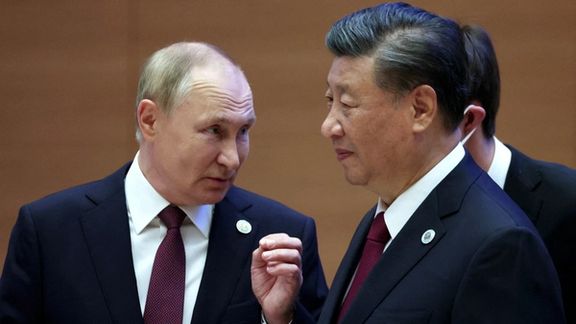
Russian President Vladimir Putin speaks with Chinese President Xi Jinping in SCO summit. September 16, 2022

Leaders at the Samarkand summit of the Shanghai Cooperation Organization (SCO) have emphasized a long-term global economic shift away from the United States.

A global trend away from using the dollar has been more pronounced in SCO states, with non-dollarized Russia-China trade rising about 50 percent in early 2020 after being 10 percent in 2015.

But the trend has accelerated between at least some SCO states with US and western European sanctions against Russia over the Ukraine crisis. Gazprom, the Russian gas major, last week said China would pay for gas in roubles and yuan rather than in dollars and euros.

An SCO declaration Friday said that “interested SCO member states” had agreed a “roadmap for the gradual increase in the share of national currencies in mutual settlements.” The SCO – comprising China, India, the Kyrgyz Republic, Kazakhstan, Pakistan, Russia Tajikistan, and Uzbekistan – is in the process of admitting Iran.

President Ebrahim Raisi has been more positive about SCO opportunities than predecessor Hassan Rouhani, whose efforts to increase trade with Europe – including bringing energy majors to Iran – were thwarted by the US. In 2018 Washington left the 2105 Iran nuclear deal and imposed ‘maximum pressure’ sanctions that threatened punitive action against any third parties dealing with Tehran.

Thwarting ‘draconian’ sanctions

Raisi’s made his first foreign trip as president to an SCO summit in Dushanbe, Tajikistan, October 2021, when he hailed “a new area” where “unilateralism and hegemony are failing.”

Russian President Vladimir Putin shakes hands with Iranian President Ebrahim Raisi during a meeting on the sidelines of the Shanghai Cooperation Organization (SCO), September 15, 2022
100%
Russian President Vladimir Putin shakes hands with Iranian President Ebrahim Raisi during a meeting on the sidelines of the Shanghai Cooperation Organization (SCO), September 15, 2022

Raisi told the Samarkand SCO summit Thursday the organization needed to improve ways to thwart “draconian” US sanctions. On Thursday, meeting Putin, Raisi stressed the “strategic nature” of cooperation with Russia that could “be developed in the political, commercial and economic fields, as well as in space.” While US ‘maximum pressure’ restricted Iran-China trade after 2018 with Chinese companies wary of punitive US actions, China has remained Tehran’s largest trading partner and is easily its biggest market for crude oil.

In its economic and diplomatic isolation, Iranian officials emphasize the importance of ties with Russia and China, although Moscow has little to offer Iran as both countries face economic hardship and China is happy to buy discounted oil from both sanctioned energy exporters.

Global change

Putin and China’s President Xi Jinping both portrayed the SCO as part of a global change. “Fundamental transformations have been outlined in world politics and the economy, and they are irreversible,” Putin said. The Russian president presented the SCO as half the world’s population and responsible for a quarter of global gross domestic product.

But in fact, Putin’s invasion of Ukraine has led to NATO’s expansion, and more Western solidarity. This is what Beijing has on mind as Putin alluded to China’s concerns over the war in Ukraine during his meeting with Xi on Thursday.

Seven months after the Russians launched military operations in Ukraine, Putin acknowledged unease or reservations expressed by both India and China. “I know your position on the conflict in Ukraine, the concerns that you constantly express,” Putin told India’s Prime Minister Narendra Modi during a televised meeting. “We will do everything to stop this as soon as possible.”

Turkey offers further mediation

Turkish President Turkish President Tayyip Erdogan told the SCO summit Friday that Ankara would continue its efforts to mediate an end to the war “as soon as possible.” He urged the holding of direct talks in Turkey between Putin and Ukrainian President Volodymyr Zelensky, who has said he will never accept a peace allowing Russia to keep any Ukrainian land, including Crimea.


Most Viewed

Iran negotiators ordered to return after internal rift over Islamabad talks
1
EXCLUSIVE

Iran negotiators ordered to return after internal rift over Islamabad talks

2
ANALYSIS

US blockade enters murky phase as tankers spoof signals and buyers hesitate

3
ANALYSIS

Why the $100 billion Hormuz toll revenue is a myth

4

US tightens financial squeeze on Iran, warns banks over oil money flows

5
ANALYSIS

US blockade targets Iran oil boom amid regional disruption

Banner
Banner

Spotlight

  • Hardliners push Hormuz ‘red line’ as US blockade tests Iran’s leverage
    INSIGHT

    Hardliners push Hormuz ‘red line’ as US blockade tests Iran’s leverage

  • Ideology may be fading in Iran, but not in Kashmir's ‘Mini Iran'
    INSIGHT

    Ideology may be fading in Iran, but not in Kashmir's ‘Mini Iran'

  • War damage amounts to $3,000 per Iranian, with blockade set to add to losses
    INSIGHT

    War damage amounts to $3,000 per Iranian, with blockade set to add to losses

  • Why the $100 billion Hormuz toll revenue is a myth
    ANALYSIS

    Why the $100 billion Hormuz toll revenue is a myth

  • US blockade targets Iran oil boom amid regional disruption
    ANALYSIS

    US blockade targets Iran oil boom amid regional disruption

  • Iran's digital economy battered by prolonged blackout
    INSIGHT

    Iran's digital economy battered by prolonged blackout

•
•
•

More Stories

Iranian-Backed Forces Withdrawing From Bombed Syrian Areas

Sep 16, 2022, 17:05 GMT+1

Israeli military says Hezbollah and other Iran-backed militia groups are withdrawing from areas in Syria that were targeted by Israel in recent months.

A senior Israel Defense Forces officer said on Thursday that the apparent withdrawal of these forces from some regions is “a result of the IDF strikes” in recent weeks. He did not say which parts of Syria he was referring to.

Israeli defense officials have made such claims before, most recently in 2020.

The withdrawal of the forces detected by the IDF comes after the Saudi-owned London-based newspaper Asharq Al-Awsat reported that Russian officials have asked the Iranians to leave several sites in Syria, including its military headquarters in the western Hama province, situated next to the Syrian army’s Regiment 49 base. The Regiment 49 site is one of the most important military sites in western Hama as it houses long-range S-200 missiles and other Russian-made military equipment.

According to the report, Russia’s call was meant to deprive Israelis of excuses or pretexts to continue the bombing of targets where Russian forces are present.

“The Russian officers also demanded that the Iranians evacuate a second military site in the Hamidiya area, south of Tartus governorate on the Syrian coast,” a source told the paper. 

Israel has intensified strikes on Syrian airports to disrupt Tehran's increasing use of aerial supply lines to deliver arms to allies in Syria and Lebanon including Hezbollah. 

Israel conducted several airstrikes against the Aleppo International Airport in northwestern Syria, hours before its missiles struck targets southeast of capital Damascus on August 31.

Iranian Social Media Explodes Over Young Hijab Victim

Sep 16, 2022, 13:59 GMT+1
•
Maryam Sinaiee

A young woman who had received a severe head injury in the custody of Iran's hijab police, died on Friday, further enraging Iranians who flooded social media.

Social media posts with the hashtag ‘Mahsa Amini’ have continued to be retweeted and liked thousands of times since Wednesday when it was revealed that she had been taken to hospital from a detention center in northern Tehran only two hours after her arrest and was in a coma. Authorities deny any violence against Amini while she was in custody.

A photo of the 22-year-old Mahsa Amini on the hospital bed shows her unconscious with very clear signs of bleeding from her right ear. Several doctors including Mahdiar Saeedian, editor of a health magazine, have pointed out on social media that brain strokes do not cause otorrhagia (hemorrhage from ears) which proves that her coma was caused by trauma to the head.

The young girl – originally from Saqqez in Kurdistan province -- was arrested in her brother’s car on a visit to the capital to see their relatives by hijab enforcement officers. The morality or Islamic religious police told her brother she was being taken to the detention center for a brief admonitory session about the Islamic dress code, hijab, and would be released soon after.

Iran’s government which is now fully controlled by hardliners has adopted a harsher than usual approach amid economic crisis and hardship for tens of millions. Government and military officials have warned the population against disobeying hijab rules and hijab enforcement patrols have detained many women, sometimes violently, on the streets.

A hijab patrol police van stopping women on the street and detaining many
100%
A hijab patrol police van stopping women on the street and detaining many

Hijab patrols have increased on the streets in recent months and videos of violent arrests of women and teenage girls as well as confrontations between people and hijab enforcers arevfrequently posted.

Many social media users have also pointed out that when George Floyd was killed because of police violence in the United States, in a televised speech Iran’s leader Ali Khamenei called it a “brutal” act that exposed “the true nature of the rulers of the United States.”

“The Islamic Republic never pays the cost of its brutality. Where are those [hardliners] now who lit black candles for George Floyd and made the hashtag ‘I can't breathe’ trending [in Persian social media],” one of the tweets retweeted hundreds of times asked.

Khamenei has always expressed support for strict hijab enforcement. In a speech in July, he alleged that Iranian women’s anti-hijab movement is nothing but a Western plot. The speech was made ten days after an anti-hijab protester identified as 28-year-old writer Sepideh Rashno was arrested in Tehran after an encounter with a hijab enforcer on a city bus.

Social media users have also highlighted the deaths in custody of other ordinary people and activists, including women's rights activist Haleh Sahabi in 2011, blogger Sattar Beheshti in 2012, Iranian-Canadian environmentalist Kavous Seyed-Emami in 2018, andZahra Bani-Yaghoub, a medical doctor who died in prison in 2007 after being arrested by the morality police. Iranian authorities attributed all these deaths in custody to strokes without taking any responsibility for them despite undeniable evidence of violence.

“Sattar Beheshti had a ‘stroke’. Haleh Sahabi had a ‘stroke’. Kavous Seyed-Emami had a ‘stroke’. Nobody gets killed by beating in the Islamic Republic,” another very popular tweet said.

Several Iranian celebrities including outspoken former national team soccer player Ali Karimiwho has nearly ten million followers on Instagram have posted about the young woman's tragic fate on social media. American actress and author Leah Remini’s tweet about the incident has also drawn much attention to Amini’s case and state violence against Iranian women for hijab.

Iran Can Thwart US Sanctions Via Shanghai Organization

Sep 16, 2022, 11:21 GMT+1

Iranian President Ebrahim Raisi said on Friday that the Shanghai Cooperation Organization (SCO) can help thwart “US unilateralism” and solve the problems created by sanctions. 

Raisi made the remarks during his meeting with his Chinese counterpart Xi Jinping on the sidelines of the SCO summit in the Uzbek city of Samarkand on Friday, adding that "the Islamic Republic has not been and won't be stopped despite all the enmities, and will not give up in the face of US' bullying."

During the summit, he reiterated that foiling "draconian" US sanctions required new solutions, stressing the need for expanding the central Asian security organization.

Raisi also called for expanding free trade among SCO member countries, alongside financial and banking cooperation, noting that Tehran and Beijing have enormous capacities in the fields of oil and energy, transit, agriculture, and trade. 

Xi, for his part, pointed out that the longstanding friendship of China and Iran have stood the test of a changing international landscape, adding that their common strategic choice is consolidating and growing their comprehensive partnership. 

The two sides should make active efforts to implement their 25-year comprehensive cooperation plan, advance China’s Belt and Road initiative -- a global infrastructure development strategy by the Chinese government to invest in various countries -- and strive for more deliverables of cooperation, Xinhua quoted Xi as saying.

Tehran, which seeks to overcome economic isolation imposed by US sanctions, on Thursday signed a memorandum of obligations to become a permanent member of the SCO, formed in 2001 as a talking shop for Russia, China and ex-Soviet states in Central Asia, and expanded four years ago to include India and Pakistan.

Pressure Builds Againt Iran's Raisi Before Trip To New York

Sep 16, 2022, 10:50 GMT+1
•
Iran International Newsroom

Days before Iran’s president is scheduled to attend the UN General Assembly, three former prisoners in Iran are launching a civil lawsuit against him in New York.

The hardliner president Ebrahim Raisi’s scheduled trip to the United States, together with a large entourage, has been the subject of controversy. Human rights activists, Iranian dissidents, former political prisoners and hostages in Iran have urged the Biden administration not to issue a visa to Raisi.

Raisi served as Iran’s Judiciary chief before becoming president in August 2021, but he spent most of life in the Islamic judiciary and is accused by human rights groups of taking part in gross violations of human rights. He was a member of a death committee that ordered the killing of thousands of political prisoners in 1988, an involvement he has proudly admitted.

The US sanctioned him, along with other Iranian officials in 2019 for human rights violations.

A former prisoner in Iran, Mehdi Hajati and two former hostages, Hamid Babaei and Australian-British academic Kylie Moore-Gilbert, who was held hostage for two years in Iran announced Thursday that they will launch a civil lawsuit.

The National Union for Democracy in Iran (NUFDI), an American Iranian advocacy group is assisting the plaintiffs in their legal action. NUFDI said in a statement that human rights attorney Shahin Milani will represent the three plaintiffs.

Former Iranian president Mahmoud Ahmadinejad speaking at the UN General Assembly in September 2005
100%
Former Iranian president Mahmoud Ahmadinejad speaking at the UN General Assembly in September 2005

Mehdi Hajati was an elected local official in the Iranian city of Shiraz who was sentenced to prison for his defense of the persecuted Baha’i community in 2019. Hamid Babaei, a resident of Belgium was also held hostage in Iran.

Moore-Gilbert, a lecturer in Islamic studies at the University of Melbourne was arrested on bogus charges in Iran in September 2018 and held until November 2020, when she was exchanged with Iranians jailed in Thailand on terrorism convictions. They received a hero’s welcome upon their return to Iran.

A bipartisan group of 52 US lawmakers urged President Joe Biden on September 9 to deny visas for Raisi and his delegation.

"The United States cannot overlook Ebrahim Raisi’s direct involvement in gross violations of internationally recognized human rights, including the 1988 organized mass murder of thousands of political prisoners, among whom were women and children, by the Iranian regime,” the lawmakers wrote to Biden.

So far the Biden Administration appears to be determined to issue the visas, arguing that it is legally obligated as host nation of the United Nations to allow officials of other government to conduct their UN business in New York.

Critics who urge a visa denial say that “As the host country for UN headquarters, the United States has a general obligation to grant visas to those conducting UN business. However, as lawmakers noted in their letters to Biden, U.S. law authorizes a denial of visas to individuals responsible for torture and extrajudicial killings.” They cite the example of Austrian President Kurt Waldheim who was denied entry into the US in 1987 for his responsibility for the persecution of Jews and others during World War II.

Iranian Americans have organized a protest outside the UN headquarters in New York City on September 21, the day Raisi is scheduled to speak at the General Assembly and at the same time NUFDI will unveil the details of the lawsuit against him.

Iran Says Determined To Boost Ties With Russia 'At All Levels'

Sep 16, 2022, 08:45 GMT+1
•
Maryam Sinaiee

Relations between Tehran and Moscow are strategic and Tehran aims to boost ties at all levels, Iran's president said Thursday in a meeting with Vladimir Putin.

On the sidelines of the Shanghai Cooperation Organization (SCO) summit in the Uzbek city of Samarkand Thursday,President Ebrahim Raisi assured his Russian counterpartthat Tehran will never recognize the sanctions against Russia and will strengthen and develop its trade and economic relations with Moscow.

“Our relations are not ordinary; they are of a strategic nature. Iran wishes to expand its strategic relations with Russia and all political, economic, trade, and aerospace areas,” he told the Russian President. Raisi Also stressed that Tehran- Moscow cooperation can “neutralize” the effects of US sanctions on both countries.

President Raisi and his government consider relations with Moscow and Beijing and Iran’s full membership in SCO a powerful tool in overcoming US sanctions and their effects which have hugely affected the Iranian economy since 2018 when former US President Donald Trump pulled out of the 2015 nuclear agreement (JCPOA) and slapped crippling sanctions on the country.

"The relationship between countries that are sanctioned by the US, such as Iran, Russia or other countries, can overcome many problems and issues and make them stronger," Raisi told Putin in the meeting.

"The Americans think whichever country they impose sanctions on, it will be stopped, their perception is a wrong one."

That is exactly what critics of the Biden Administration policy of reviving the JCPOA argue. Freeing Iran from US sanctions will open a back door for Russia to violate Western sanctions imposed on its energy exports and international banking. Already the two countries have deals for natural gas and oil swaps, which can help disguise Russian energy exports.

Putin meeting Iran's ruler Ali Khamenei in Tehran on July 19, 2022
100%
Putin meeting Iran's ruler Ali Khamenei in Tehran on July 19, 2022

Iran has also supported Russia's invasion of Ukraine and has delivered military drones to Moscow. Recent images from Ukraine show Iranian suicide drones being used in the war.

For his part, Putin announced in the meeting that a Russian delegation of 80 large companies are to visit Tehran next week now that Iran has signed documents pertaining to full membership in SCO.

The Russian President said Tehran and Moscow actively cooperate on the international arena and their positions “coincide” on many issues. He added that many joint projects are moving forward “thanks to Supreme Leader Ali Khamenei’s support.” “We are interested in his further support,” he said.

Referring to Iran’s membership in SCO, Iranian foreign ministry spokesman Nasser Kanaani said in a tweet Wednesday that Iran “acts dynamically, intelligently and balanced in realizing the strategic goals of its foreign policy and expanding its foreign relations” but “does not wait for the JCPOA and the return of the United States to its JCPOA commitment” despite adhering to the talks for the restoration of the deal.

The SCO summit which brings together leaders of China, Russia, India, Pakistan and four ex-Soviet Central Asian countries together will ends on Friday. The Eurasian political, economic and security organization was founded by China, Russia, and four former Soviet republics in 2001 and has since expanded its membership to include India and Pakistan.

SCO approved Iran's application for accession last year at a conference in Dushanbe, Tajikistan, in September after many years of a slow process.

In a tweet Wednesday, Foreign Minister Hossein Amir-Abdollahian who is accompanying the president said he had signed a memorandum of commitments to join the organization as a full member, calling a "new phase" of economic, trade, transit, energy, and other cooperation with the body.

According to SCO deputy secretary-general Grigory Logvinov, it may take some time for Iran to complete the accession procedure.