• العربية
  • فارسی
Brand
  • Iran Insight
  • Politics
  • Economy
  • Analysis
  • Special Report
  • Opinion
  • Podcast
  • Iran Insight
  • Politics
  • Economy
  • Analysis
  • Special Report
  • Opinion
  • Podcast
  • Theme
  • Language
    • العربية
    • فارسی
  • Iran Insight
  • Politics
  • Economy
  • Analysis
  • Special Report
  • Opinion
  • Podcast
All rights reserved for Volant Media UK Limited
volant media logo

Iran Spokesman Calls Stabbed Rushdie ‘A Pawn Of Empire’
Iran International Newsroom
Aug 12, 2022, 22:13 GMT+1Updated: 17:38 GMT+1
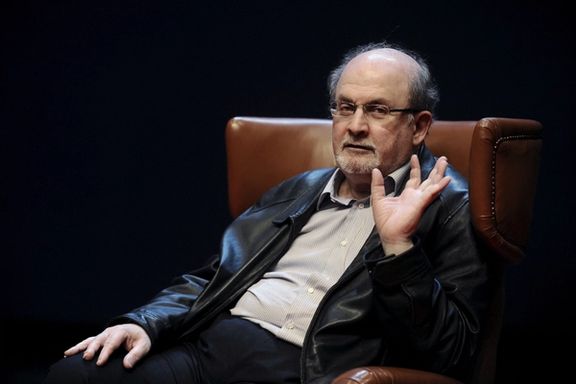
Salman Rushdie, condemned to death by a religious edict by Iran, in 2015

Author Salman Rushdie was on a ventilator in Erie, Pennsylvania, Saturday after being knifed at a literary event in New York state.

“The news is not good,” Andrew Wylie, Rushdie’s agent, said late Friday. “Salman will likely lose one eye; the nerves in his arm were severed; and his liver was stabbed and damaged.”

Rushdie, the subject of a ‘death sentence’ issued by Iranian leader Ruhollah Khomeini in 1989, was airlifted to hospital after being stabbed repeatedly at around 11am local time as he was about the deliver a lecture at the Chautauqua Institution, New York state.

Police reported that a state trooper at the event took the attacker into custody after what witnesses said was an assault lasting 20 seconds. An endocrinologist in the audience told the New York Times that Rushdie had multiple stab wounds, including one to the right side of his neck.

Police later named the suspect as Hadi Matar, a New Jersey resident aged 24, and said they were investigating his motive.

While the official news agency IRNA reported the attack only briefly, Mohammad Marandi, an American-born academic who has acted as a spokesman-cum-advisor for Iran in nuclear talks in Vienna, tweeted he would not be “shedding tears for a writer who spouts hatred & contempt for Muslims & Islam.”

Marandi called Rushdie a “pawn of empire” and suggested it was “odd” the attack should occur just as agreement on restoring the 2015 Iran nuclear deal was “near.”

Fuel to the flames

Khomeini’s edict was February 14, 1989, after the publication of Rushdie’s third novel, The Satanic Verses. While the book had already produced protests in Islamabad, Pakistan, in which at least six people died, Khomeini’s ‘fatwa’ added fuel to the flames, with widespread protests.

While Rushdie went into hiding for six years, his Japanese translator Hitoshi Igarashi was stabbed to death in 1991, while his Italian translator survived a knife attack the same year. Tehran’s Behesht Zahra cemetery has a shrine for Mustafa Mahmoud Mazeh, born in Guinea, was died in London in August 1989 when priming a book bomb in London apparently for an attack on Rushdie.

Reformist president Mohammad Khatami in 1998 assured London that the Iranian authorities would not assist anyone attempting to carry out the death sentence. But Ali Khamenei, who succeeded Khomeini in 1989 as supreme leader, made clear on several occasions the edict remained in force.

Best foreign novel

Ironically, Khamenei, when president in 1985, had announced Iran’s award of its best foreign novel prize for Rushdie’s third novel, Shame. But Iran’s leader has not wavered over Khomeini’s edict, including endorsing it in a tweet in 2019, which led to the temporary suspension of his account.

Semi-official bodies have never forgotten Rushdie. In 2012, it was widely reported that the 15 Khordad Foundation, a quasi-official religious body in Iran, had increased an existing bounty offered for killing the novelist from $2.8 million to $3.3 million, an amount raised by $600,000 by Iranian media bodies in 2016.

Iran Daily in February praised the “deep understanding, true attitude and reliable future vision” of Khomeini in issuing the edict, which had encouraged Muslims to show that “if they are led properly, can be the pioneers of the revival of religious values ​​and stand up against the hatred spread by the West against Muslims.”

Rushdie, who was born in Kashmir and grew up a Muslim, has lived in New York for the past 20 years. When he was knighted by the British Queen Elizabeth in 2007, Ayman al-Zawahiri, the al-Qaeda leader killed July 31 by an American drone stroke in Kabul, promised “a very precise response.”

‘Stupidly optimistic’

In an interview last year with the Guardian newspaper, Rushdie called himself “stupidly optimistic”and suggested the “first people to suffer” from “censorship…are underprivileged minorities.”

“One thing I feel, well, proud of, let’s say, is if you knew nothing about my life, if all you had were my books, I don’t think you would feel that something traumatic happened to me in 1989,” Rushdie said. “I’m glad I had the brains to think, in the middle of all that, I don’t want to be the victim of this. I could write frightened or revenge books, and both would make me a creature of the event. So, I thought, Be the writer that you want to be.”

Most Viewed

Iran negotiators ordered to return after internal rift over Islamabad talks
1
EXCLUSIVE

Iran negotiators ordered to return after internal rift over Islamabad talks

2
ANALYSIS

US blockade enters murky phase as tankers spoof signals and buyers hesitate

3
ANALYSIS

Why the $100 billion Hormuz toll revenue is a myth

4

US tightens financial squeeze on Iran, warns banks over oil money flows

5
ANALYSIS

US blockade targets Iran oil boom amid regional disruption

Banner
Banner

Spotlight

  • Hardliners push Hormuz ‘red line’ as US blockade tests Iran’s leverage
    INSIGHT

    Hardliners push Hormuz ‘red line’ as US blockade tests Iran’s leverage

  • Ideology may be fading in Iran, but not in Kashmir's ‘Mini Iran'
    INSIGHT

    Ideology may be fading in Iran, but not in Kashmir's ‘Mini Iran'

  • War damage amounts to $3,000 per Iranian, with blockade set to add to losses
    INSIGHT

    War damage amounts to $3,000 per Iranian, with blockade set to add to losses

  • Why the $100 billion Hormuz toll revenue is a myth
    ANALYSIS

    Why the $100 billion Hormuz toll revenue is a myth

  • US blockade targets Iran oil boom amid regional disruption
    ANALYSIS

    US blockade targets Iran oil boom amid regional disruption

  • Iran's digital economy battered by prolonged blackout
    INSIGHT

    Iran's digital economy battered by prolonged blackout

•
•
•

More Stories

Israeli Woman Accused Of Spying For Iran Attempts Suicide

Aug 12, 2022, 18:31 GMT+1

A Jewish Israeli woman who is accused of spying for Iran has attempted suicide and is now hospitalized in critical condition.

The woman, who was arrested for spying for Iran in December, attempted to take her own life while under house arrest at her home in Holon on Thursday, Hebrew media reported. Paramedics arrived at her home and found that she had tried to overdose on pills.

The Shin Bet security service said in January that five Jewish Israelis had been detained on charges of assisting an Iranian operative in gathering intelligence and making connections in Israel. The operative, going by the name of Rambod Namdar, maintained profiles on social media sites and pretended to be Jewish. What could be more worrying for the Israeli authorities is that some of the suspects seem to have known or suspected that Namdar was an Iranian operative, but agreed to cooperate for small sums of money, ranging from $900 to $5,000, a Shin Bet official said at the time.

Two of the suspects -- all of Iranian heritage -- include the woman from Holon and her husband, whose names are barred from publication. The wife, who worked as a presenter at a radio station, was in contact with Namdar and passed along photos of government offices over the course of several years, while her husband was accused of being aware of the connection, speaking with the Iranian operative himself, as well as transporting her to the US Consulate to photograph it.

The husband denied the accusations during an interview with Channel 12 news on Thursday evening following his wife’s suicide attempt, and accused the Shin Bet of extracting a false confession from her, saying, “For the past eight months, our life has turned into hell.”

Rushdie, Under Iran Death Edict, Suffers ‘Multiple Stab Wounds’

Aug 12, 2022, 18:28 GMT+1
•
Iran International Newsroom

Salman Rushdie, author of the 1988 novel Satanic Verses, was assaulted in New York state Friday, apparently stabbed in the neck, and helicoptered to hospital.

Rushdie, 75, was in 1989 the subject of a death sentence in an edict issued by Ruhollah Khomeini, then leader of Iran. In 2012, it was widely reported that the 15 Khordad Foundation, a quasi-official religious body in Iran, had increased an existing bounty offered for killing Rushdie from $2.8 million to $3.3 million.

Witnesses, including a reporter for Associated Press, reported that the attack on Rushdie, just as the author was about to begin a lecture at the Chautauqua Institution, lasted around 20 seconds. Police reported that a state trooper at the event took the attacker into custody as others held up Rushdie’s legs, presumably to maintain blood flow to the chest.

The New York Times reported that Rita Landman, an endocrinologist also in the audience, said Rushdie had multiple stab wounds, including one to the right side of his neck, and that there was a pool of blood under his body.

‘He has a pulse…’

She said he was still alive, however, with people saying “He has a pulse, he has a pulse he has a pulse.”

Moments after the attack on Rushdie in NY State. August 2, 2022
100%
Moments after the attack on Rushdie in NY State. August 2, 2022

Nothing has yet emerged about the attacker or his motivation.

While Iran’s reformist president Mohammad Khatami in 1998 assured Britain the Iranian authorities would “neither hinder nor assist assassination operations on Rushdie,” Ali Khamenei, leader after Khomeini’s death in 1989, has several times said the edit, or ‘fatwa,’ was still in place.

In 2019 Twitter deleted a message on Khamenei’s account reiterating this.

Suzanne Nossel, head of PEN America, of which Rushdie is a former president, said she could think of “no comparable incident of a public violent attack on a literary writer on American soil.”

‘Full accountability’

Chuck Schumer, who represents New York state and leads Senate Democrats, said the “attack on freedom of speech” was “shocking and appalling” and called for “full accountability and justice.”

The attack on Rushdie comes two days after the US Justice Department announced charges against an alleged Iranian Revolutionary Guard over a plan to kill John Bolton, the former national security adviser.

Ukraine Ships Corn To Iran As Tehran Plans Sending Drones To Russia

Aug 12, 2022, 16:40 GMT+1

A ship carrying 60,000 tons of corn has left a Ukrainian Black Sea port to deliver the first batch of the much-needed food to Iran since the Russian invasion of Ukraine.

The Marshall Island-flagged Star Laura departed from the port of Pivdennyi on Friday, along with the Belize-flagged Sormovsky that left Ukraine's Chornomorsk port laden with 3,050 tons of wheat bound for Turkey's northwestern Tekirdag province.

While Ukraine has restarted its food exports to Iran, the Islamic Republic is said to have plans to export drones to Russia to be used during the war. The US Thursday that Russian officials have undergone training in Iran in recent weeks as part of an agreement on the transfer of drones from the Islamic Republic.

A total of 14 ships – most loaded with grain for animal feed or for fuel -- have now departed from Ukraine over the past two weeks, following the UN-brokered deal with Russia in Turkey to allow a resumption of grain exports from three Ukrainian Black Sea ports, after they were stalled for five months due to the war.

As part of the UN deal, all ships are inspected in Istanbul by the Joint Coordination Centre, where Russia, Ukrainian, Turkish and UN personnel work.

Ukraine has some 20 million tons of grain left over from last year's crop, while this year's wheat harvest is also estimated at 20 million tons. Ukraine and Russia accounted for nearly a third of global wheat exports and nearly a fifth of corn before February 24, when Russia launched its invasion.

Iran Eyes Large Russian Gas Imports Amid Falling Output

Aug 12, 2022, 15:45 GMT+1
•
Dalga Khatinoglu

Iran's deputy oil minister says negotiations for Russian natural gas imports are in their final stages as Iran faces falling output in the Persian Gulf.

Mohsen Khojasteh-Mehr, who also serves as the head of National Iranian Oil Company (NIOC), told Fars news agency that converting the memoranda of understanding (MoUs), sealed between NIOC and Russian Gazprom cover various fields, including petroleum and gas swaps.

Iran and Russia in July agreed to $40 billion in trade and investment projects.

A swap means that Iran would import gas from Russia and deliver a certain quantity to another country that has a gas purchase deal with Moscow if it makes sense geographically or in terms of available infrastructure. In this case, among Iran’s neighbors only Turkey has a gas deal with Russia, but it has its own pipelines, much shorter in distance than a 2,000-kilometer longer route from Iran.

Buying Russian gas to cover shortages

This makes the Iranian claim of a gas swap strange. What appears to be more likely is Iran buying Russian gas to cover its own production shortages.

Russia, in turn, which has been buying gas from Central Asian countries as a middleman and exporting it, has a shrinking market after sanctions following its invasion of Ukraine. Existing pipelines that send the cheap gas from Central Asia to Russia can now be reversed and pump it to Iran.

Last year, Russia imported 10.5 billion cubic meters (bcm) of Turkmen and 4.6 bcm of Kazakh gas through these pipelines, according to BP statistics.

There are also two pipelines, connecting Turkmenistan to Iran's northeastern regions with 20 bcm/yr capacity together. Currently Turkmenistan delivers only 1.5 bcm/yr of its gas via these routes.

Fars news agency says Iran can import 20 bcm/yr of Russian gas for both domestic consumption and delivery to Iraq and Turkey.

Part of Iran South Pars gas production infrastructure
100%
Part of Iran South Pars gas production infrastructure

It seems the first variant is feasible, because Iran had 250 mcm/d gas deficit last winter (equal to Turkey's total daily gas demand in 2021) and every year the gap between its gas production and demand is growing.

Fars says Iran has consumed 9 billion liters of diesel and 6 billion liters of mazut in electricity generation last year, due to gas shortage. Iran can consume Russian gas in power plants to be able to export more diesel and mazut, making more profit, if the Russian gas is below regional prices.

Russia helping Iran in gas production?

Fars reported that another important MoU between NIOC and Gazprom is related to pressure enhancement of South Pars gas field in the Persian Gulf, shared between Iran and Qatar.

In the absence of Western technology, Iran has been unable to keep up production at the field, steadily losing out as its domestic consumption has increased.

Fars said if the sides finalize the MoU and sign an agreement, the contract value would be $10bn.

According to the NIOC, the Iranian section of South Pars gas field would pass the half-mark point of its life by 2023 and every year its production would decline 10 bcm. Iran and a consortium headed by French Total signed a $5-bn contract in 2016 to develop the South Pars, including the installation of a 20,000-ton platform with two giant compressors to prevent production decline.

Iran needs at least 10 to 15 such giant platforms (15 times bigger than the current active platforms) in South Pars. Each new platform costs $2.5 billion.

It is not clear how Gazprom would enhance the pressure of the gas field as only large Western energy companies can build the giant platforms with huge compressors.

When Total left the South Pars contract due to US sanctions, Chinese CNPC also abandoned the project due to its inability to build larger platforms. Gazprom also has no experience or the technology for such a project in the sea.

Qatar installed huge platforms, through contracts with Western companies, especially Total, and not only prevented a decline in production, but it has started new drillings to increase gas output by 30% in the next five years.

Regarding Iran's inability to prevent production decline from South Pars - a field that accounts for 70% of Iran's total gas output- it seems the country eyes Russian imports to compensate for the decline in South Pars and prevent further gas shortages in cold seasons.

Turkey Kills Senior Kurdish Commander In Syria With Iran’s Help

Aug 12, 2022, 15:17 GMT+1

Iran’s intelligence apparatus has cooperated with Turkey to kill an Iranian-born senior leader of the Kurdistan Free Life Party (PJAK) which seeks self-determination for Iran's Kurdish minority.

The so-called Amude-Derbesiye provincial leader of the PKK/YPG, Yusif Mehmud Rebani (Youssef Rabbani), code-named Rezan Cavit, was killed in a drone strike in the Syrian city of Qamishli by Turkey’s National Intelligence Organization (MIT) on August 6, Turkish media announced on Friday. 

The drone struck his car and killed at least four other people, including Mazlum Esat, code-named Ruhaz Amude, and wounded two more. 

"Commander Youssef Rabbani who was in Qamishil for a visit was confirmed dead in the attack," Hamrin Ali, the co-president of the local council of the Jazira region in the Kurdish-led Autonomous Administration of North and East Syria (AANES) said.

He joined the PKK in the 1990s, and in 2010 was part of the "Coordination Committee", the highest executive body of the Iranian branch of the organization, PJAK. MIT claimed he had also ordered the attacks against the Turkish armed forces during the period when the PKK was in charge of the Haftanin province. 

Generally, the Kurdish parties in Iran − including Komala and the Kurdistan Democratic Party of Iran (KDPI) − favor Kurdish autonomy within a federal Iran. Pejak (the Free Life Party of Kurdistan), an affiliate of the Kurdistan Workers Party (PKK), formed in Turkey but also based in northern Iraq, has generally favored a unified, independent Kurdistan uniting Kurds in Syria, Iraq, Turkey, and Iran.