• العربية
  • فارسی
Brand
  • Iran Insight
  • Politics
  • Economy
  • Analysis
  • Special Report
  • Opinion
  • Podcast
  • Iran Insight
  • Politics
  • Economy
  • Analysis
  • Special Report
  • Opinion
  • Podcast
  • Theme
  • Language
    • العربية
    • فارسی
  • Iran Insight
  • Politics
  • Economy
  • Analysis
  • Special Report
  • Opinion
  • Podcast
All rights reserved for Volant Media UK Limited
volant media logo

Iran Hardliners Silent After Israeli Raid Closes Damascus Airport
Iran International Newsroom
Jun 11, 2022, 08:18 GMT+1Updated: 17:43 GMT+1
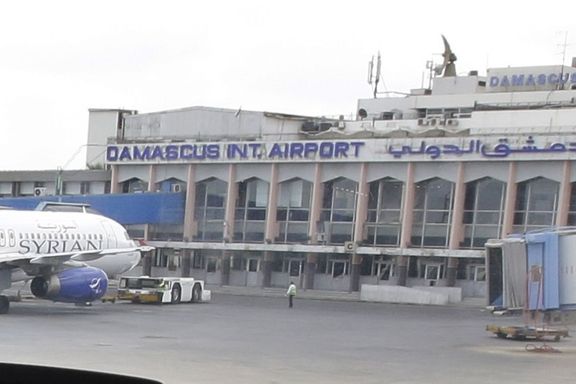
A photo from 2020 showing the Damascus International Airport

Iranian military officials and hardliner media have largely stayed silent over an Israeli attack on Damascus airport targeting Tehran’s assets on the ground.

Syria closed the Damascus International Airport on Friday “until further notice” after Israeli air strikes damaged the airstrip and a terminal, the transport ministry said.

Hardliner media in Tehran Saturday morning barely mentioned the attack, excpet carrying the condemnation of the Iranian foreign minister.

As the news about the Israeli raid spread, Mohsen Rezaei, a former chief commander of the Revolutionary Guard (IRGC) and a vice president in the government, said at a ceremony in Tehran Friday morning that “I wish Israel would dare to take a wrong step and give us an excuse, so we could eradicate it from this earth.”

But Rezaei, known for his boisterous comments, was not referring to the attack on the Damascus airport. His comments were a reaction to recent Israeli statements threatening to take action against the Islamic Republic.

The only Iranian reaction to Friday’s attack worth noting was the response of the foreign ministry. Foreign Minister Hossein Amir-Abdollahian condemned the attack as a "clear violation of Syria's sovereignty and territorial integrity... (and) contrary to international law and human principles", in a phone call with his Syrian counterpart Faisal Mekdad, Iran's state media reported.

Israeli attacks against the Damascus airport and targets in its vicinity said to house weapons and Iran-backed forces have been a regular occurrence in recent years.

But this time the attack seems to have been more direct and punishing. The transport ministry on Friday said the airport had stopped all flights, and a later statement said Israeli air strikes damaged the runway and one of the terminals.

“As a result of this damage, all arriving and departing flights at the airport have been suspended until further notice,” the ministry’s second statement said.

Maria Zakharova, Russia’s foreign ministry spokesperson, condemned the Israeli attack. “In this regard, we are forced to emphasize again that the ongoing Israeli shelling of the Syria territory … is absolutely unacceptable. We strongly condemn Israel’s provocative attack on critical Syrian civilian infrastructure,” Sputnik quoted a published statement as saying.

Last month, there were reports that Russia is withdrawing forces from Syria and possibly handing control of some bases to Iranian forces, because of its hard-pressed military situation in Ukraine.

There were also speculations if Israel will become more emboldened in taking action against Iran in Syria.

The Syrian Observatory for Human Rights said on Friday the Israeli bombing had damaged the runway after targeting "warehouses of Iranian militias" near the airport.

An Israeli military spokesperson declined to comment, Reuters reported.

For several years, Israel has been attacking what it has described as Iranian-linked targets in Syria, where Tehran-backed forces, including Lebanon's Hezbollah, have deployed to help President Bashar al-Assad. But there was clear political coordination with Russia, as former Israeli prime minister Benjamin Netanyahu visited Moscow multiple times and held long discussions with President Vladimir Putin.


Most Viewed

Iran negotiators ordered to return after internal rift over Islamabad talks
1
EXCLUSIVE

Iran negotiators ordered to return after internal rift over Islamabad talks

2
ANALYSIS

US blockade enters murky phase as tankers spoof signals and buyers hesitate

3
ANALYSIS

Why the $100 billion Hormuz toll revenue is a myth

4

US tightens financial squeeze on Iran, warns banks over oil money flows

5
ANALYSIS

US blockade targets Iran oil boom amid regional disruption

Banner
Banner

Spotlight

  • Hardliners push Hormuz ‘red line’ as US blockade tests Iran’s leverage
    INSIGHT

    Hardliners push Hormuz ‘red line’ as US blockade tests Iran’s leverage

  • Ideology may be fading in Iran, but not in Kashmir's ‘Mini Iran'
    INSIGHT

    Ideology may be fading in Iran, but not in Kashmir's ‘Mini Iran'

  • War damage amounts to $3,000 per Iranian, with blockade set to add to losses
    INSIGHT

    War damage amounts to $3,000 per Iranian, with blockade set to add to losses

  • Why the $100 billion Hormuz toll revenue is a myth
    ANALYSIS

    Why the $100 billion Hormuz toll revenue is a myth

  • US blockade targets Iran oil boom amid regional disruption
    ANALYSIS

    US blockade targets Iran oil boom amid regional disruption

  • Iran's digital economy battered by prolonged blackout
    INSIGHT

    Iran's digital economy battered by prolonged blackout

•
•
•

More Stories

Venezuela, Iran Pioneers Of New World Order, Maduro Says In Tehran

Jun 10, 2022, 21:07 GMT+1

Venezuelan President Nicolas Maduro says his country and Iran are in the vanguard of the emerging global order, sharing a common goal of fighting colonialism and imperialism.

Maduro, who arrived in Tehran on Friday one day ahead of the announced schedule, made the remarks in an interview with Iran's state-run Spanish-language television channel Hispan TV.

He also announced that a 20-year cooperation plan with Iran will be signed between the two countries.

Describing Venezuela and Iran as the pioneers of shaping a world free of imperialism and dominant powers, Maduro said, “The era of the United States' military dominance of the world is over.”

He also urged sharing know-how with Iran in all fields, and hailed the Islamic Republic's “courageous move” to send fuel tankers to his energy-hungry nation despite US sanctions and threats.

He added that the delegation accompanying him to Tehran is aiming at facilitating further investments from Iran, noting that Iranians’ willingness to work in Venezuela indicates that resisting the US sanctions will eventually bear fruit.

Iran and Venezuela have been slapped with sanctions by the US, which doesn’t currently import oil from either nation, and has in recent years reimposed sanctions on Iranian state entities, including the national oil company NIOC, and in 2019 blacklisted PDVSA.

The two countries strengthened their cooperation in 2020, with Venezuela importing condensate from Iran, key to thinning its extra-thick crude oil. Iran has also stepped in to help its South American ally with engineers, refined products and spare parts for its oil industry.

Iranian Police Adds $10 Million Worth Of Equipment For Riot Control

Jun 10, 2022, 17:07 GMT+1

Amid a growing wave of protests across Iran, the country’s police have added about $10 million worth of anti-riot equipment to law enforcement forces, including special armored vehicles.

The deputy commander of the Iranian police, Brigadier-General Ghasem Rezaei, made the announcement during a ceremony where some of the equipment was handed over to special units, including 527 vehicles and motorcycles.

Rezaei said that the new equipment and vehicles will help the operational units better execute their missions and is aimed at "strengthening the security of the country." 

In addition to enhancing operational mobility, some of the new equipment provides police forces with “self-protection” during missions, he added. 

Iran has tens of thousands of special police and security units that are often deployed to break up antigovernmental protests that have become more frequent since 2017.

In November 2019, when a sudden government price increase for fuel was announced and nationwide demonstrations began, these security forces were ordered to shoot unarmed protesters, killing at least 1,500 people in a matter of a few days.

Last year, special forces were used in two provinces to quell protests during which more than ten people were killed and hundreds wounded.

Iranian Teachers Plan New Round Of Nationwide Strikes, Protests

Jun 10, 2022, 16:24 GMT+1
•
Iran International Newsroom

While many cities across Iran are scenes of protests by various union activists, Iranian teachers have announced a nationwide protest slated for next week.

The Coordination Council of Iranian Teachers’ Trade Associations issued a statement on Thursday, calling on teachers all over the country to take to streets on June 16 from 10:00 AM to 12:00 PM local time and demand their legal rights.

Teachers have been often holding protests for nearly a year, but the political situation in Iran has worsened in recent months, with rising food prices and a growing perception of government inefficiency and corruption.

The statement said their demands include better salaries, freedom of their colleagues arrested during the previous rounds of demonstrations as well as standard education facilities and free education for students. They also demand the implementation of decade-old legislation that would bring the salaries and pensions of 750,000 teachers in line with other civil servants.

Emphasizing that holding protests for their demands is among their basic rights, the statement added that the authorities are charging union activists with fabricated accusations of endangering the security of the country, as a last resort to repress the protests and ignore teachers’ demands.

“We declare loudly that if our colleagues are not released immediately and unconditionally, and the legitimate demands of Iranian teachers are not fulfilled, the protests will continue,” the statement read.

The teachers’ restlessness coincides with protests by Iranian retirees, which started Monday and continued Thursday in several cities across the country.

The pensioners, who are protesting the meager rise in their pensions while the inflation rate is hovering at over 40 percent, gathered in front of the offices of the Social Security Organization in the cities of Karaj, Zanjan and Arak among others. Just a few days ago the government announced that pensions for most retirees will increase by just 10 percent.

On Monday, enraged protesters chanted slogans such as “Death to Raisi”, directing their anger at President Ebrahim Raisi and denounced “empty promises” by the government. Videos surfaced on social media Thursday showing people cheering for the Pahlavis, who ruled Iran before the 1979 Islamic revolution, praising the Shah’s government for taking care of them.

On Tuesday, videos showed the bazaar in the northwestern city of Tabriz was on strike with merchants shutting down their stores and businesses in protest to a sudden increase in sales tax.

On Wednesday, similar strikes and protest rallies were reported by merchants in the southern city of Bandar Abbas.

Strikes in Bazaar, or traditional retail market, have a deep historical root in Iran and signal a serious political and economic crisis. The bazaar strikes played a major role both in the Constitutional Revolution of the early 20th century and the 1979 revolution against the monarchy.

Four years of deep economic crisis in Iran following the introduction of United States ‘maximum pressure’ sanctions in 2018 has led to sharp increases in living costs and to labor unrest. In January hundreds of firefighters and staff from the judiciary took to the streets in several cities. Prison guards have also picketed to protest their salaries.

People from different walks of life, including teachers, nurses, firefighters, and even judiciary department employees and prison guards, have held protest rallies or strikes to demand higher salaries.

Right Groups Urge Instagram Not To Censor Iranian Dissidents’ Content

Jun 10, 2022, 15:19 GMT+1

Three human rights groups called on Meta, the owner of the social networks Instagram and Facebook, to review its Persian-language content review procedures for Iran.

Digital civil rights group Access Now, London-based rights organization Article 19, and New York-based Center for Human Rights in Iran met with a senior official from Meta on Thursday to convey their concerns over the company censoring content by Iranian dissidents and democracy advocates.

The groups said they made recommendations to Meta and Meta’s Oversight Board in an effort to streamline processes to ensure freedom of expression is protected for users who rely on their platform in Iran, especially during protests. 

The groups initiated action following allegations that Instagram content moderators are deleting accounts that have documented the regime’s rights abuses during the latest wave of protests, including content showing Iranian security forces beating protesters and firing tear gas into crowds.

BBC’s sources alleged that pro-regime employees of the German branch of Telus International, a Canadian contractor, which provides content moderation to Instagram with over 400 Iranian employees for reviewing Persian-language content, are responsible for restricting anti-government content of Iranian users.

In an investigative report, Deutsche Welle Farsi revealed that Mehdi Norouzi, the son of a former Islamic Republic envoy to Bulgaria -- Abdollah Norouzi, works at the Telas International branch in Sofia.

US lawmakers have also launched a probe into the Meta’s restrictions on Iranian dissidents’ contents.

US Senate Foreign Relations Committee Approves ‘Stop Iranian Drones Act’

Jun 10, 2022, 12:00 GMT+1

The US Senate Foreign Relations Committee has approved the Stop Iranian Drones Act (SIDA), which seeks to prevent Iran and Iran-backed militia groups from acquiring lethal drones.

In line with efforts to stop Tehran’s flourishing drone program, “the bipartisan legislation would amend the Countering America’s Adversaries Through Sanctions Act (CAATSA) to make clear that supporting the supply, sale or transfer to or from Iran of UAVs, or providing other assistance related to UAVs, is sanctionable under US law,” the committee Chairman Senator Bob Menendez (D-N.J.) and Ranking Member Jim Risch (R-Idaho) said in a statement on Thursday.

“As evinced by Iran’s drone attacks on Israeli shipping, Houthi attacks on Saudi Arabia and the UAE, and Iran-backed militia attacks on US facilities across Iraq... Iran’s reckless use and export of lethal drones to proxies and terrorist actors across the Middle East represents a significant threat to US national security and that of our allies and partners,” Menendez said, adding that “I look forward to working with my colleagues to ensure swift passage on the Senate floor and ultimate enactment of this bipartisan legislation into law.”

The House of Representatives passed the legislation late in April but it requires approval from the Senate and a presidential signature to become law.

“Iran’s regional terrorism continues to threaten not only the safety and security of our partners in the Middle East, but also American national security interests. Drones have rapidly become Iran’s weapon of choice,” Risch noted.