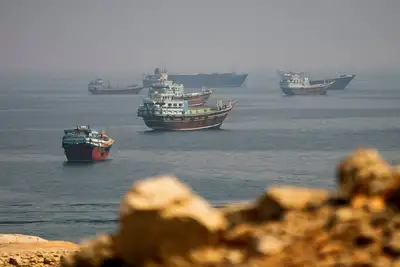
A symbolic graphic image published by government's official IRNA news website on Wednesday aims to portray Iran's power.
Hardliner officials and media in Tehran say a new power triangle consisting of Iran, Russia and China has formed against the United States in the world.
"In the new world order, a triangle consisting of three powers – Iran, Russia, and China – has formed in Asia. This new arrangement heralds the end of the inequitable hegemony of the United States and the West," Mahmoud Abbaszadeh-Meshkini, spokesman of the National Security and Foreign Policy Committee of the Iranian parliament, said Wednesday.
In his interview with the government news agency IRNA, published as President Ebrahim Raisi was preparing to leave Tehran for an official visit to Moscow, Abbaszadeh-Meshkini also claimed that the Raisi administration has succeeded in turning Tehran into "the center of political and diplomatic consultations and arrangements in the region, Asia, and the world."
Raisi's visit to Moscow is taking place in an atmosphere of heightened public debateover Iran's now official policy of aligning with Russia and China against the West despite the once promoted "Neither East, Nor West" slogan of the founder of the Islamic Republic, Ayatollah Ruhollah Khomeini. The slogan has been inscribed over the entrance of the foreign ministry building in central Tehran.
Hardliners claim that closer economic and political relations with the East and Asian countries, which Iran's Supreme Leader Ali Khamenei has promulgated with the catchphrase "Looking East", will help Iran's development and strengthen it against Western powers, particularly the United States. Since 2018, and Khamenei's advocation of the policy, "Looking East" has become one of the centerpieces of a 'revolutionary economy' which hardliners have been hard at work to theorize and promote.
Hardliners accuse the former moderate president, Hassan Rouhani, and his reformist allies of sacrificing the potentials of expansion of relations with the East, Russia in particular, during the eight years of his presidency in favor of relations with Europe and the US.
In a note entitled "Expansion of Foundations of National Interests" Wednesday, Javan newspaper which is affiliated to the Revolutionary Guards (IRGC) alleged that Rouhani knowingly sabotaged relations with Moscow, cold-shouldered some of Putin's initiatives, and that his government never acted on the 15 cooperation agreements signed during his visit to Moscow in 2017.
"[President] Ebrahim Raisi's visit to Russia … can once again draw Tehran-Moscow relations out of a state of suspension and endow it with a strategic quality," Javan said of the importance of Raisi's visit.
Insisting that the Pentagon and liberals at home are worried about the visit, Javan added that "political conjunction with Russia and China" will elevate relations with the two Eastern powers from "seasonal and occasional" to a strategic level. "These developments in the Tehran-Beijing-Moscow axis will fundamentally change security arrangements in the region," Javan wrote.
In another article Wednesday, Javan said important economic agreements over a bilateral monetary arrangement to eliminate the need for going through the international banking system would be discussed with Russian officials.
Javan claimed that Raisi's visit, a few days after Foreign Minister Hossein Amir-Abdollahian's visit to Beijing, has born "tangible results in economic, political and social arenas" in the past few months and predicted that stronger relations with Russia will bear significant results in the process of the Vienna nuclear talks to restore the 2015 nuclear agreement with world powers and in neutralizing US sanctions.