• العربية
  • فارسی
Brand
  • Iran Insight
  • Politics
  • Economy
  • Analysis
  • Special Report
  • Opinion
  • Podcast
  • Iran Insight
  • Politics
  • Economy
  • Analysis
  • Special Report
  • Opinion
  • Podcast
  • Theme
  • Language
    • العربية
    • فارسی
  • Iran Insight
  • Politics
  • Economy
  • Analysis
  • Special Report
  • Opinion
  • Podcast
All rights reserved for Volant Media UK Limited
volant media logo

Ukraine Plane Trial Opens In Iran Under Barrage Of Criticism

Maryam Sinaiee
Maryam Sinaiee

Iran International

Nov 22, 2021, 11:55 GMT+0Updated: 17:36 GMT+1
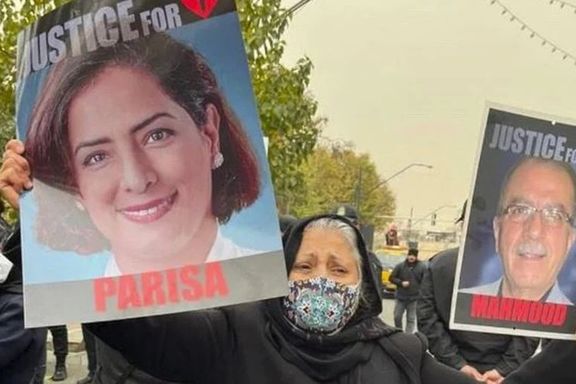
Families of those killed in the shooting down of a Ukrainian airliner in Iran protest. November 21, 2021

The trial of ten military personnel involved in shooting down a Ukrainian airliner in 2019 began in Tehran Monday with some parents boycotting the proceedings.

Families of some of those killed in Iran’s downing of Ukrainian Airlines Flight PS752 on January 8, 2019 say the trial of those allegedly responsible lacks transparency and due process. "This a shameful show with ten low-ranking officers on trial," said Hamed Esmaeilion, the Canada-based spokesman for some of the families, Sunday.

Abbas Abdi, a reformist politician, in a tweet Monday also criticized the authorities. "Make the trial transparent,” he wrote. “It will be in everyone's interest," he wrote.

The passenger plane was hit by two surface-to-air missiles in the tense aftermath of Iran's missile attack on United States military bases in Iraq in retaliation for the US killing of Iranian general Ghasem Soleimani and nine others in Baghdad. All 176 onboard died.

Among those protesting outside court were family members either barred from attending or refusing to acknowledge the court. Protesters held photos of victims and chanted slogans, while surrounded by police and security forces who kept others away.

Names, ranks, and positions of the suspects were not disclosed. Victims' families and critics say those on trial are not responsible for decisions taken at a higher level on the night of the incident. They say Amir-Ali Hajizadeh, the Revolutionary Guards aerospace commander was responsible because he did not “clear the airspace.”

Hajizadeh commented last week on the tragedy, which Iran attributed to the misalignment of a mobile surface-to-air missile battery at a time of high alert. "How is it possible that a plane so huge cannot return to the airport and land [after being hit] by a few kilos of explosives?" Hajizadeh asked a gathering of Sharif University students November 15.

In response Abolfazl Najafi-Tehrani, a dissident cleric and publisher in Tehran tweetedNovember 17: "It is not too far-fetched that few years from now Hajizadeh and Co. ask there is a question of why the Ukrainian plane placed itself in the path of our missile to cause this incident and to demand the families of the victims and the Ukrainian airliner to pay for the missiles that the plane hit itself against!"

In another reaction reformist politician Mostafa Tajzadeh tweeted: "The nation's question is why you couldn't tell the difference between the Ukrainian passenger flight and an enemy missile [to shoot at it]? Why two [missiles]? Why did you lie to the world for several days?"

The Ukrainian ambassador refused an invitation to attend the trial. Ukrainian journalist Anna Rajskaya tweeted Sunday that the ambassador did not want to legitimize the trial given the Ukrainian deputy justice minister had said Iran’s investigation was inadequate.

A date for the next session has not been announced.

Most Viewed

Iran negotiators ordered to return after internal rift over Islamabad talks
1
EXCLUSIVE

Iran negotiators ordered to return after internal rift over Islamabad talks

2
ANALYSIS

US blockade enters murky phase as tankers spoof signals and buyers hesitate

3
ANALYSIS

Why the $100 billion Hormuz toll revenue is a myth

4

US tightens financial squeeze on Iran, warns banks over oil money flows

5
ANALYSIS

US blockade targets Iran oil boom amid regional disruption

Banner
Banner

Spotlight

  • Hardliners push Hormuz ‘red line’ as US blockade tests Iran’s leverage
    INSIGHT

    Hardliners push Hormuz ‘red line’ as US blockade tests Iran’s leverage

  • Ideology may be fading in Iran, but not in Kashmir's ‘Mini Iran'
    INSIGHT

    Ideology may be fading in Iran, but not in Kashmir's ‘Mini Iran'

  • War damage amounts to $3,000 per Iranian, with blockade set to add to losses
    INSIGHT

    War damage amounts to $3,000 per Iranian, with blockade set to add to losses

  • Why the $100 billion Hormuz toll revenue is a myth
    ANALYSIS

    Why the $100 billion Hormuz toll revenue is a myth

  • US blockade targets Iran oil boom amid regional disruption
    ANALYSIS

    US blockade targets Iran oil boom amid regional disruption

  • Iran's digital economy battered by prolonged blackout
    INSIGHT

    Iran's digital economy battered by prolonged blackout

Tweet unavailable

•
•
•

More Stories

Water Protesters In Central Iran Warn Government Of Taking Up Arms

Nov 22, 2021, 10:38 GMT+0

Protests over water shortage continued in Iran’s Shahre Kord city on Monday, with people demanding the region’s water rights after similar protests in Esfahan.

The Monday protests followed a noisy demonstration on Sunday where a call was made to gather again and continue demands for the water rights of Chahar Mahal and Bakhtiari province, a mountainous region in the Zagros mountains.

What apparently triggered the protests in Share Kord, the provincial center, was a huge protest on November 19 in neighboring city of Esfahan in central Iran, where tens of thousands gathered to demand water from the government. The city’s iconic Zayandeh Roud river has been completely dry for a decade and residents blame government mismanagement in diverting water to ill-conceived industrial projects.

But residents of neighboring mountainous regions are concerned that the government will divert more water to Esfahan, reducing what is available for their irrigation needs.

The people of Shahre-Kord region are known as fiercely independent heirs to once warrior mountain tribes and videos on social media show their anger during the protest on Monday. In one such clip protesters are shouting a warning that the authorities should fear the day when they take up arms.

US Defense Chief Ends Middle East Trip Reassuring Allies

Nov 22, 2021, 08:13 GMT+0

US Secretary of Defense Lloyd Austin ended his Middle East trip on Monday emphasizing the importance of reassuring regional allies about America's commitments.

Austin’s last meeting was with Abu Dhab’s Crown Prince Mohammed Bin Zayed Al Nahyan during which the Defense Secretary reaffirmed “the importance of the US-UAE strategic partnership.” He also thanked the United Arab Emirates for hosting US troops.

The Secretary who attended the Manama Dialogue conference in Bahrain had a series of meetings with regional partners. During the conference he talked about Iran and tried to reassure regional alliesabout the Biden Administration’s determination not to allow Iran to acquire nuclear weapons.

Israel and America’s Arab allies are concerned about Iran’s growing nuclear program and its belligerent regional policies, while the United States continues to rely on diplomacy to reach a nuclear agreement with Tehran.

In a tweet at the end of his visit Austin said, “One of my core missions as SecDef is to deepen our partnerships. I want our partners to know they are important to us and that they will see a commitment from us for years to come.”

Promises Of Water To Esfahan Fueling Protests Elsewhere In Iran

Nov 21, 2021, 19:58 GMT+0
•
Maryam Sinaiee

Promises by the government to deliver water to Iran’s Esfahan Province amid protests are fueling regional tensions between the wealthy region and its neighbors.

After a massive water protest Friday in the city of Esfahan, the capital of the province, its representatives in the parliament have demanded acceleration of government projects for transferring water from the neighboring province of Chahar Mahal and Bakhtiari.

Farmers in Esfahan Province have been protesting shortage of water for nearly two weeks now. On Friday thousands of residents of the provincial capital joined the farmers who have pitched tents in the dry bed of the city's Zayandeh Roud.

Authorities who blame this year's drought for the exacerbation of water shortage have kept promising to take action to resolve the long-standing problem and to compensate the farmers who have not been able to sow autumn crops.

The promises have not only failed to send the farmers and their supporters home, but have also given rise to dissatisfaction and protests elsewhere, namely the neighboring Chahar Mahal and Bakhtiari Province from where water should be diverted to Esfahan.

Videos posted on social media Sunday showed hundreds of people in the largely agricultural and less-developed Chahar Mahal and Bakhtiari marching Sunday in front of the Governor's Office in the provincial capital, Shahr-e Kord.

"No Water Can Be Taken from Chahar Mahal," protesters chanted in Shahr-e Kord and demanded the governor to respond to their calls. Protesters who have vowed to return Monday to continue their protest also chanted slogans against "cowardly authorities" and called on the people of neighboring Lorestan and Khuzestan provinces to support their cause.

The protest rally in Esfahan on Friday and Shahr-e Kord on Sunday are quite unique. This time, unlike any previous protests such as water crisis protests in Khuzestan in July, security forces did not visibly interfere and try to disperse the massive crowds. Also, for the very first time, the local state-run channels and the national news channel aired some live images of the demonstrations.

The recent water protests took place as many Iranians marked the second anniversary of the bloody November 2019 unrest. In 2019 protests that quickly spread across the country were heavy-handedly suppressed by the security forces who killed hundreds of unarmed people. After two years, no one has been accountable, and the protesters have been accused of serving foreign interests and destroying property.

The state media and hardliners this time have been referring to the protesters in Esfahan as "well-behaved". "Nobody called the protesters deviant and hostile this time," conservative Alef website noted Sunday in a commentary entitled "Lessons of the Protest Rally in Esfahan".

Many believe security forces are showing restraint for the fear of inciting a strong reaction by the people, still mourning the victims of the November 2019 protests. However, Journalist Hamid Mafi said in a Twitter post Sunday that satisfying 'the well-behaved' people of Esfahan at the cost of their neighbors could give rise to a series of protests in nearby provinces of Chahr Mahal and Bakhtiari, Lorestan, and Khuzestan. Such future protests will reveal the extent of the respect for the right to protest and authorities' tolerance, he wrote.

UN, US Condemn Seizure Of Ex-US Embassy In Yemen

Nov 21, 2021, 18:02 GMT+0

The UN Security Council and the United States have condemned the intrusion and seizure of the now-closed US Embassy in Yemen and the detention of its local staff.

A statement on Thursday approved by all 15 members of the UN's most powerful body called for "an immediate withdrawal of all Houthi elements from the premises" and "the immediate and safe release of those still under detention."

The US embassy in Sanaa has been closed since 2015.

The Security Council stressed that the Vienna convention prohibits any intrusion into diplomatic property as well as the "inviolability" and "immunity" of the premises from searches and requisition — and that property and archives of a diplomatic mission that has been temporarily closed "must be respected and protected."

The council's statement followed a demand on Nov. 17 by the United Nations for the release of two U.N. staffers detained earlier this month by the Yemen rebels.

Yemen has been convulsed by civil war since 2014, when the Iran-backed Houthis took control of the capital, Sanaa, and much of the northern part of the country, forcing the internationally recognized government to flee to the south, then to Saudi Arabia.

Report by AP

New Bill Aims To Ban Dogs As Pets In Homes And Streets In Iran

Nov 21, 2021, 14:06 GMT+0
•
Maryam Sinaiee

Keeping pets has become a symbol of affluence in Iran, can be dangerous, and should be prohibited, a member of parliament from Esfahan province has suggested.

In a phone interview with Didban-e Iran news website Saturday, Mohammad-Taghi Naghdali defended proposed legislation by claiming a dog had killed children in a Tehran park. But in fact a more real reason for Iran’s conservatives is that keeping dogs is a symbol of Westernization, which they try to prevent.

A bill entitled "Protection of the Public's Rights Against Animals" was put on parliament’s agenda this week with the backing of 75 lawmakers. It would make illegal the buying, selling and keeping “pets” – from dogs and cats to snakes, hamsters, and rabbits.

Naghdali, a mid-ranking cleric and representative of Khomeini Shahr, argued that dogs can cause "serious nuisance and bodily harm to people" when left unattended in shared areas of apartment blocks.

Although the bill names all kinds of pets, even including crocodiles and monkeys, the main concern of parliamentarians is dogs. In July, the Kayhan newspaper called dog walking in cities a "major problem" and urged the judiciary to keep dogs away from public spaces including streets and parks. Tehran City council subsequently banned animals from public places.

Keeping dogs, always common in Iran’s rural areas and on farms, has only in recent years become popular in urban areas as Iranians have kept them as pets, despite occasional police crackdowns, particularly when dogs are spotted in cars. Within Islam, dogs are considered impure and some countries have tight restrictions: Saudi Arabia justifies its strict rules against keeping dogs in terms of the dangers of dogs attacking people, especially children.

Cats have never been a problem and have always been a part of urban and rural life, but the Islamic Republic wants to ban keeping dogs at urban homes.

Iran’s proposed legislation envisages a cash fine of $900-$2,700, with the animal being impounded. It would also oblige estate agents to ban dogs in rental agreements within three months of the law’s passing, with similar fines for non-compliance. Anyone walking a pet in the street could face a three-month jail term, or the confiscation of their car for three months if taking their dog for a drive.

The proposed law is yet another encroachment on citizens’ private life and adds another restriction to a multitude of other bans, such as drinking alcohol, dating, appearing in public without “proper Islamic dress” for women, mixed-gender parties, and singing for women.

Even the conservative Asre-Iran website attacked the proposal November 17 as a waste of parliament’s time. "Who is going to protect people's livelihood?” it asked in a commentary. “Why don't you propose plans for protecting people's assets in the stock market? Or why are you not doing something to increase the value of the national currency?”